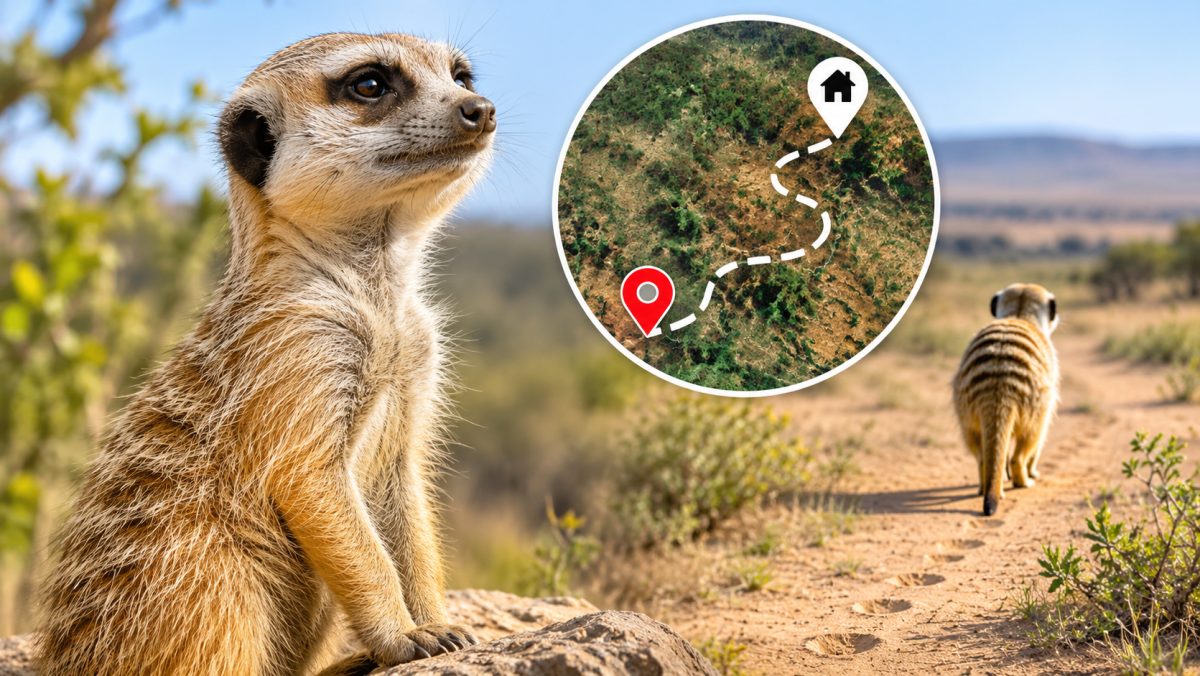

Turns out these small desert animals might be carrying tiny maps around in their heads the whole time.
Scientists studying solo meerkats navigation in the Kalahari Desert found that individual meerkats can find their way back to their pack or capture site completely alone, according to findings published November 19, 2026, in the Journal of Experimental Biology and reported by Science News. The discovery suggests these social animals carry detailed mental maps of their home territory, even when there's no group around to guide them.
Primate Brain Evolution Mystery: How One DNA Switch Built Bigger Brains
How Researchers Tested Solo Meerkats Navigation in the Field
Mathilde Martin, a biologist at the University of Zurich, led the field experiments that put meerkat homing instincts to the test. Her team captured individual meerkats, strapped GPS trackers around their necks, and drove them far from familiar ground before setting them loose. In one case, a meerkat was dropped off 1.5 kilometers from its pack, then released into open desert while researchers tracked every step it took.
The scene itself sounds dramatic. Martin described chasing after a tagged meerkat as it darted between shelters, moving like it knew exactly where it needed to go. That kind of direct, confident movement became the heart of the study. Researchers wanted to know if meerkats were truly navigating on their own, or simply retracing paths they'd recently walked with their group.
2,200-Year-Old Gold Bear Kazakhstan Dig Reveals a Burial Mound Full of Secrets
Why the 90 Percent Success Rate Matters
Twenty meerkats went through the catch-and-release experiments. Eighteen of them made it back in a straight or nearly straight line to their pack, their home turf, or the spot where they'd first been caught. That's a 90 percent success rate. Only two animals failed to complete the journey, and researchers suspect stress from being captured and moved may have kept them from moving normally.
What stood out most was how consistent the results were across the group. Martin didn't single out a few star performers. Instead, she said the meerkats as a whole impressed her. "They all seem to be very, very good," she said. That statement points to something bigger than a handful of gifted individuals. It suggests this kind of solo meerkats navigation skill might be common across the species.
Ruling Out Easy Answers Like Age and Recent Memory
Before drawing conclusions, Martin's team checked whether older or more experienced meerkats performed better than younger ones. They didn't find a clear pattern. Age and prior tracked experience didn't predict which animals found their way home and which ones struggled. That result knocks out a simple explanation and leaves researchers looking at something more fundamental about how these animals process space.
The team also built in a safeguard against a different kind of shortcut. Every meerkat was released in an area it hadn't visited in at least 30 days. Martin explained that skipping this step would have made the test meaningless, since a meerkat could just be following a fresh trail from a recent trip. "A bit too easy for them to find their way back," is how she put it. By forcing a month-long gap, the researchers made sure any successful return relied on long-term spatial memory rather than a quick refresher.
What Might Guide a Meerkat Home
During the return trips, meerkats were seen standing up on their hind legs and scanning the horizon before choosing a direction and moving with purpose. That behavior points to vision as a major tool. Martin's team believes the animals may be reading landmarks across the flat desert terrain to figure out which way leads home.
Smell could play a role too, but the researchers are cautious about leaning on that explanation. Scent marks and territorial odors tend to fade over time and distance, so a meerkat moved more than a kilometer away, weeks after its last visit, likely couldn't rely on smell alone. The combination of eyesight and some memory of the landscape seems the more likely answer, though the study doesn't pin down the exact mix.
What This Means for Understanding Group Animals
Meerkats live in tight cooperative groups, foraging, raising pups, and watching for predators together. That social lifestyle usually masks what any single animal actually knows about its surroundings. By pulling individual meerkats away from their packs, Martin's experiments stripped away the social safety net and exposed a skill that normally stays hidden behind group behavior.
Martin has also floated an idea worth testing further. She suggested that some meerkats within a pack might explore more on their own, building sharper spatial knowledge than their groupmates. Those individuals could end up functionally leading the pack, even if no formal hierarchy exists. Future studies may track each animal's movement history alongside its homing performance to see whether certain meerkats really do serve as the pack's unofficial navigators, and whether similar hidden abilities exist in other cooperative animals that scientists have yet to test alone.