
Scientists rarely get to watch two stars crash together, but this time they saw almost the whole thing happen.
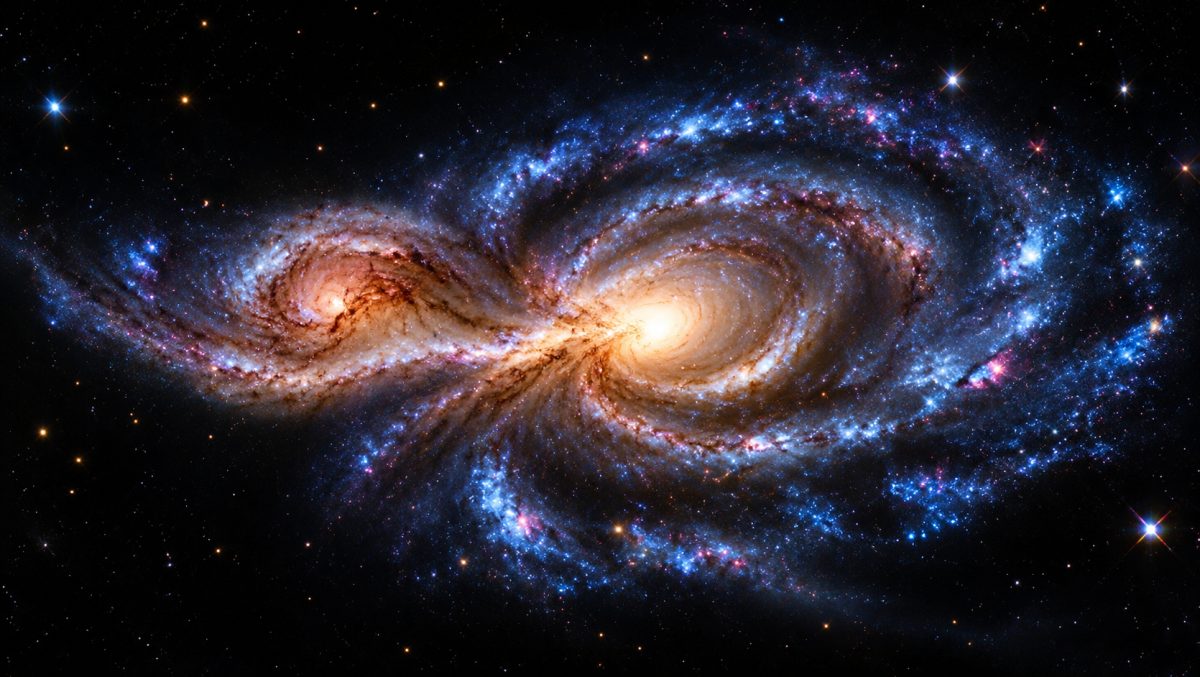
Two Andromeda stars merged in a slow-motion drama that started in 2018 and ended with a violent eruption in October 2025, giving astronomers one of the clearest views ever recorded of a stellar merger in action. The system, nicknamed Big Bao and Little Bao, sits in the Andromeda galaxy, the closest large galaxy to our own.
CERN Zeptoverse Breakthrough Reveals a Decay So Rare It Took 40 Years to Catch
How the Andromeda stars merged over seven years
View this post on Instagram
The story starts quietly. Back in 2018, a giant star astronomers now call Big Bao began getting brighter. That alone was not shocking. But the way it brightened was strange. Over about seven years, Big Bao swelled to more than twice its original size, yet its surface temperature barely budged. Normally, when a star gets dramatically brighter, its temperature shifts too. This one just kept growing.
That mismatch caught researchers' attention. A star puffing up without heating up usually means something is changing its shape from the outside, not just its insides. Astronomers started suspecting a hidden companion star was stirring things up inside Big Bao's outer layers, slowly dragging material around and making the whole system glow brighter year after year.
Then, in October 2025, the quiet buildup turned into a full eruption. The event got an official name, AT 2025abao, and it became the turning point that let scientists finally piece together what had been happening all along.
SpaceX Starship Catch Succeeds, But Why Did the Booster Still Blow Up?
Scientists trace the path of Little Bao into Big Bao's core
Astrophysicist Viraj Karambelkar of Columbia University led the team that connected the dots. They combined the fresh 2025 eruption data with nearly three decades of older telescope observations of the same patch of sky. Their conclusion, published in Nature and reported by Science News on November 18, 2026, is that a smaller companion star, Little Bao, had been orbiting inside Big Bao's puffed-up outer gas.
As Little Bao moved through that gas, friction slowed it down. Think of it like running through water instead of air. That drag made Little Bao lose energy and spiral closer and closer to Big Bao's center. Each loop transferred more energy into the surrounding gas, which is exactly why Big Bao kept brightening between 2018 and 2025 without heating up. The glow was coming from the expanding envelope, not from Big Bao itself burning hotter.
The October 2025 eruption appears to mark the moment Little Bao finally reached Big Bao's core. Researchers say the binary explanation fit the data better than any other option they tested. The drag theory matched both the slow seven-year climb and the sudden explosive finish.
Why this merger looks permanent instead of a near miss
Not every close stellar pairing ends in a merger. Sometimes a smaller star brushes past a giant's outer layers and survives, settling into a new, tighter orbit instead of colliding. So how do scientists know Little Bao and Big Bao actually merged instead of narrowly avoiding it?
Two clues point to a true merger. First, the eruption only blew away about one-tenth of Big Bao's outer gas. If a much bigger chunk of that shared envelope had been blasted away, the two stars might have ended up as a surviving close binary instead. Second, the speed and energy of the gas thrown off in the eruption matches what you would expect if Little Bao actually crashed into Big Bao's core, not just skimmed its outer edge.
Right now, thick dust kicked up by the eruption is blocking a clear view of whatever is left behind. That means astronomers cannot yet say for certain what the merged object looks like today. It could take years, possibly decades, before that dust clears enough to reveal the final result.
What this merger teaches astronomers about stellar survival
This event matters beyond just one unusual star system. Scientists have long wondered why some binary star pairs stay separate for billions of years while others crash together. Catching a merger with seven years of lead-up data, instead of just finding wreckage afterward, gives researchers a rare before-and-after record to study.
The outcome seems to depend on a mix of factors: how massive each star is, how close their orbit is, how the giant star's outer envelope is built, and whether enough gas escapes before the smaller star reaches the core. Big Bao and Little Bao give astronomers real numbers to test against their models instead of just guesswork.
Researchers plan to keep watching AT 2025abao closely. As the dust around the system slowly thins out, telescopes should eventually get a clean look at what remains, whether that is a single newly merged star or some other unexpected shape. For now, the Andromeda stars merger stands as one of the most detailed stellar collision stories ever caught on camera, built from seven patient years of watching and one dramatic night in October 2025.