
A giant spaceship fell from orbit and landed in the arms of a metal tower, and somehow that was only half the story.
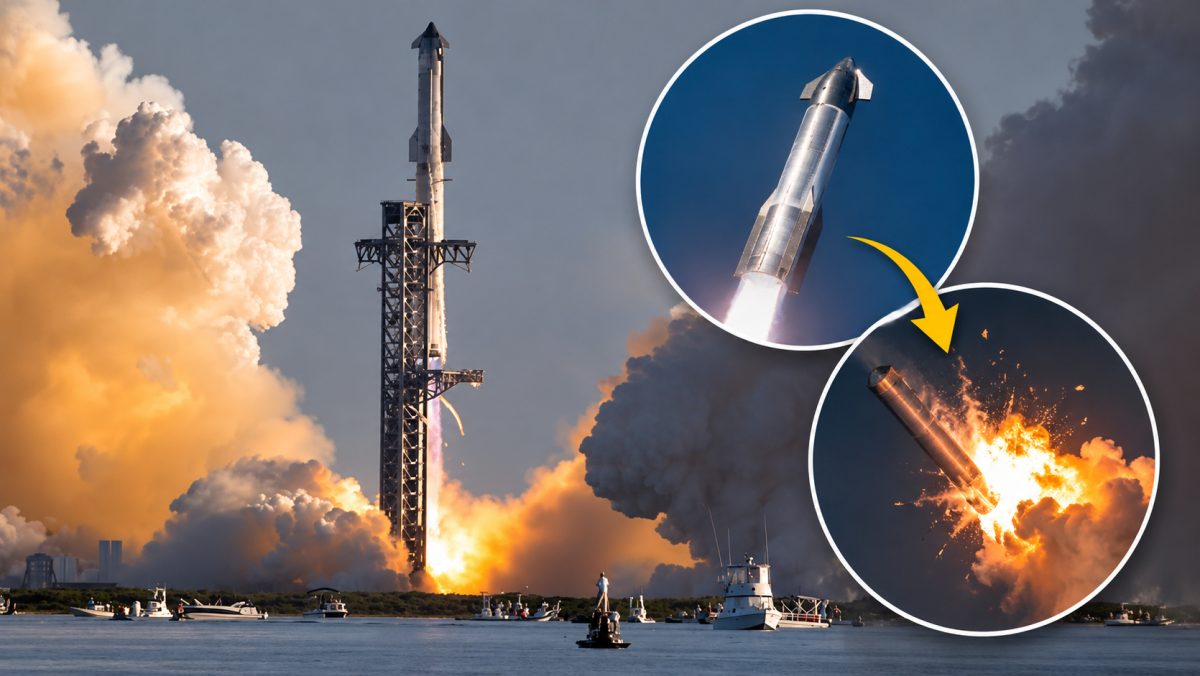
SpaceX pulled off the first-ever catch of its Starship spacecraft on Saturday, November 14, 2026, snagging the uncrewed upper stage between the mechanical arms of its launch tower at Starbase in South Texas, even though the mission's Super Heavy booster exploded over the Gulf of Mexico just minutes after liftoff.
What Ended the Cosmic Dark Age? New Study Upends Old Supernova Theory
How the Starship Spaceship Catch Unfolded
The whole thing started on Friday, November 13, when Starship Flight 15 lifted off from Starbase. The rocket has two parts, the Super Heavy booster on the bottom and the spacecraft on top, which everyone at SpaceX just calls Ship. The plan was simple to say and brutally hard to do: catch both pieces back at the launch tower using huge arms nicknamed chopsticks.
It did not go that way. Right after the two stages split apart, the booster's guidance system sensed something wrong and aborted its own landing attempt. It blew up over the Gulf of Mexico instead of coming home. Ship, though, kept flying and climbed into orbit like nothing happened.
For the next 22 hours or so, Ship circled Earth about 14 times. SpaceX communications manager Kathryn Huot told reporters during the flight, "Overall the ship's still looking healthy, and we are still on track for a catch attempt here at Starbase." That held up. On Saturday, Ship dropped back into the atmosphere, survived the fierce heat of re-entry, and lined up with Launch Pad 2.
FLIP Exoplanet Imaging Tool Finds Hidden Planet JWST Missed Before
Why the Spaceship Catch Matters So Much
This was not a normal rocket landing. There were no legs touching down on a pad. Instead, Ship flipped itself upright, cut back to two engines, then down to just one as it hovered near the tower. The arms slammed shut around two catch points under the ship's forward flaps, and the engine shut off the moment it registered contact. SpaceX had published this exact plan on November 7, describing it as the next big step toward making Starship fully reusable.
The catch happened at around 4:20 p.m. Eastern time, 9:20 p.m. GMT, according to Space.com's live coverage of the flight. That makes this the first time in history that a spacecraft, not just a booster, has been grabbed out of the sky by launch tower arms after coming back from orbit. DW called it a breakthrough in Elon Musk's long-running goal of building a rocket system where nothing gets thrown away after one flight.
A Mixed Result That Still Counts as History
AFP described the catch as a technical feat that shows fully reusable rockets really are possible, something that could eventually make spaceflight a lot cheaper and far more frequent. That reaction makes sense when you consider how Starship is supposed to work. Normal rockets get tossed after each flight. SpaceX wants to fly the same hardware over and over, checking it, fixing small things, and launching again fast.
But it's worth being honest about what actually happened here. SpaceX caught Ship. It did not catch the booster. The company was chasing a full double recovery, and it only got one half of that done. Phys.org reported that the booster's own guidance, navigation and control system is what triggered the abort, sending it into the Gulf instead of into the tower's arms. So this was a milestone with an asterisk attached, a huge win wrapped around a real failure.
What This Means for the Race to Reuse Rockets
SpaceX isn't the only one chasing this kind of technology. DW reported back in July 2026 that China had already managed its own booster-retrieval milestone, a sign that reusable rocket systems are turning into a global competition, not just a SpaceX side project. Every company working on this is after the same prize: launches that cost less and happen more often because the hardware survives and flies again.
For SpaceX, catching Ship proves the concept works, at least once. It does not prove the system is ready for regular use. Engineers still need to pull the recovered spacecraft apart, check its heat shield, its structure, its engines, and figure out whether any of it is actually fit to fly again. That inspection process will tell SpaceX a lot more than the catch itself did.
The Road Ahead for SpaceX's Reusable Rocket Plans
Nobody at SpaceX has said exactly when the next Starship flight will happen. What's clear is that the company now needs to do this again, and again, before anyone can call Ship recovery routine. It also still has to solve whatever went wrong with the Super Heavy booster's guidance system, since catching the booster reliably is just as important as catching the ship.
Saturday's flight leaves SpaceX in an odd spot: closer than ever to a fully reusable rocket, yet still missing one half of the puzzle. The spaceship catch was real, it was historic, and cameras caught the whole thing happening in daylight over Starbase. The booster explosion was just as real, and it's a reminder that building a rocket you can fly again and again is still messy, expensive, and far from finished.