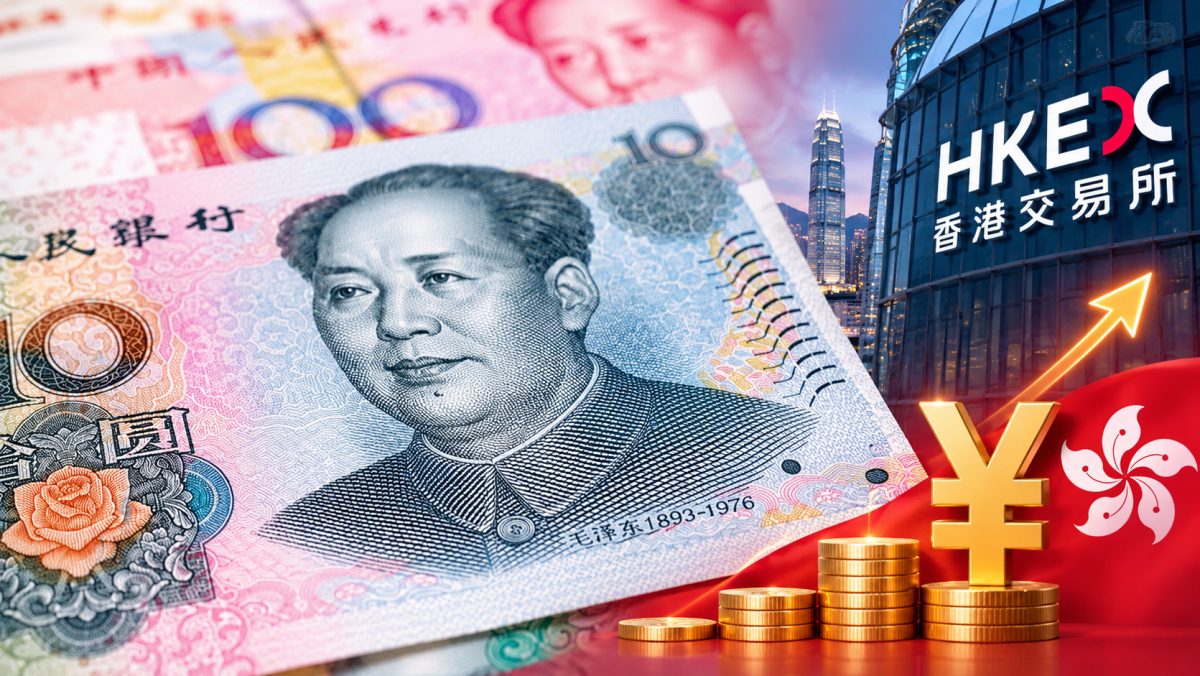

Hong Kong's stock exchange is rolling out a brand new way to track yuan bonds, right as those bonds just beat the US dollar for the first time.
Hong Kong Exchanges and Clearing Limited will launch the HKEX Offshore RMB Bond Index on 16 November 2026, its first-ever bond index, tracking more than 300 offshore renminbi bonds listed in Hong Kong. Financial Secretary Paul Chan Mo-po revealed the plan in a blog post published 15 November 2026, calling it a milestone for the city's growing dim sum bond market.
Mike Johnson Chip Export Restrictions: Why Congress Is Suddenly Uniting on China
HKEX Dim Sum Bond Index Arrives After Record Year for Yuan Debt
The timing of this launch is not an accident. Chan pointed out that offshore yuan bonds made up 38 percent of the value of bonds listed in Hong Kong during the first three quarters of 2026. That number pushed the renminbi past the US dollar as the biggest currency in the city's listed bond market, something that had never happened before.
HKEX chief executive Bonnie Y. Chan has also flagged the strength of this market. Her team reported that year-to-date issuance of HKEX-listed dim sum bonds hit RMB266.9 billion as of 24 September 2026, up 14 percent from the year before. That pace suggests 2026 could end up being a record year for this corner of Hong Kong's bond market.
Trump Addresses Jensen Huang Chinese Spy Plot, Calls Nvidia CEO 'Brilliant'
Why Hong Kong Built Its First Offshore RMB Bond Index
Paul Chan said the new index will act as a benchmark for market trends in the dim sum bond space. He described it as giving international investors a clear reference for allocating yuan assets, while also opening the door for fund companies to build passive products like ETFs and index funds on top of it.
That second part matters a lot. Right now, dim sum bonds trade in a market that is growing fast but still lacks the kind of standard benchmark that big fund managers rely on to build products. An index gives asset managers a common yardstick to measure performance and package bonds into tradeable funds, something Hong Kong has not had for this asset class until now.
Chan also linked the push for more yuan bonds to a wider global trend. He said companies and investors are looking to cut risk and spread out their assets as geopolitical tension and protectionism rise around the world. Offshore renminbi loans outstanding grew 20 percent year on year in the first three quarters of 2026, another sign that yuan usage is climbing well beyond just bond issuance.
Dim Sum Bond Market Pulls In New Types Of Borrowers
The group of companies and governments borrowing through dim sum bonds has changed a lot. Mainland Chinese technology firms have joined overseas governments and foreign financial institutions in tapping this market, according to Chan. That mix matters because it means the market is not leaning on one type of issuer or one government program to keep growing.
This broader issuer base lines up with the direction set out in Hong Kong's 2026 Policy Address. The government said it wants to expand dim sum bond issuance through a better tenor structure, meaning bonds with a wider range of maturities, along with more issuance scale and frequency. Officials also said they would seek support from China's Ministry of Finance and encourage policy financial institutions to sell bonds in Hong Kong.
The Policy Address specifically named the HKEX index as part of that strategy, describing it as both a reference for market trends and an underlying index for exchange-traded funds. That official language matches almost word for word what Chan said in his blog post, showing this index was planned well before its November launch date.
What A New Bond Benchmark Means For Yuan Internationalisation
HKEX has been building out its index business for a while now, and this bond index fits into that bigger picture. Bonnie Chan noted in an October 2026 blog post that trusted benchmarks, like the HKEX Tech 100 Index launched the previous December, give issuers and investors a shared foundation to build products on top of. The offshore RMB bond index extends that same idea into fixed income.
None of this means the yuan has suddenly replaced the dollar everywhere. The 38 percent figure applies specifically to bonds listed in Hong Kong, not to global bond markets or currency reserves worldwide. It is a real and notable shift inside one financial center, not proof of a worldwide changeover.
The real test comes after the launch. Investors and analysts will be watching whether fund managers actually build ETFs and index funds using this new benchmark, and whether trading in dim sum bonds becomes more liquid as a result. If asset managers embrace it, Hong Kong's bet on becoming a bridge between China's currency and global investors could pay off. If they do not, the index risks becoming a symbolic marker for a market that grew faster than the tools built to track it.