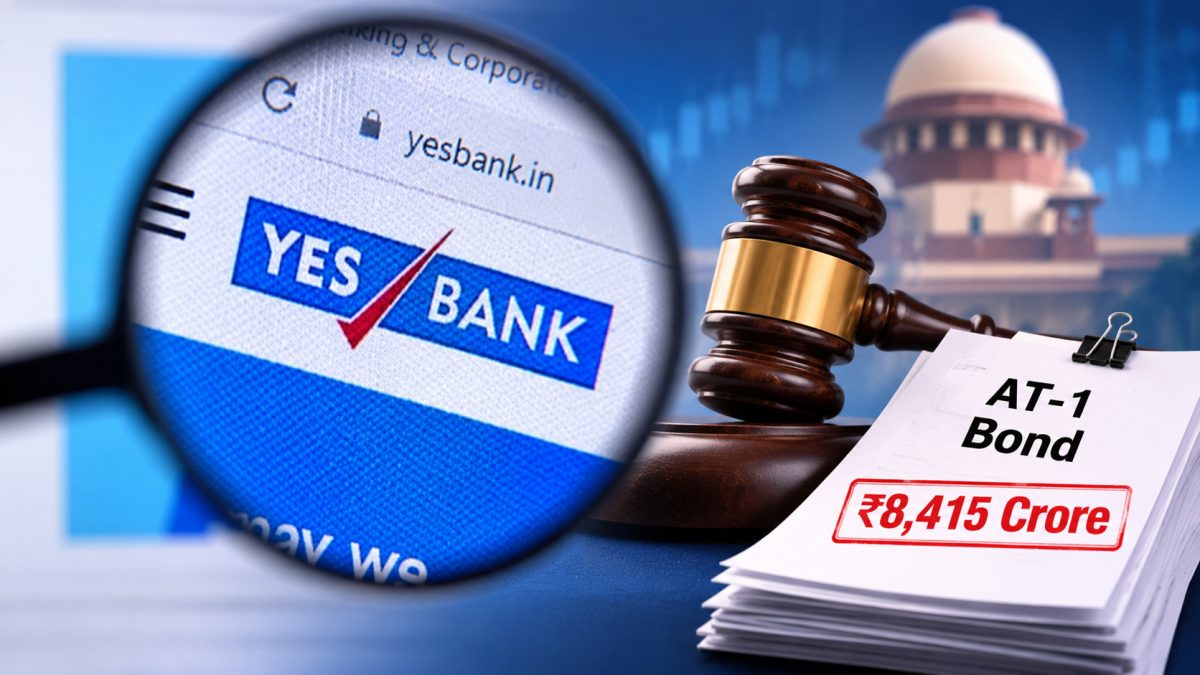

Yes Bank is not giving up on its ₹8,415 crore AT1 bond fight, even after losing at India's top court last month.
Yes Bank filed a review petition before the Supreme Court of India on November 13, 2026, asking judges to reconsider their October 15 judgment that struck down the bank's write-off of Additional Tier-1 bonds worth ₹8,415 crore. The bank made this move under Article 137 of the Constitution, according to its official exchange filing.
Central Bank of India Q2 FY27 Results: Profit Jumps 21% as Loans Surge 30%
Yes Bank AT1 Bond Write-Off Review Petition Takes Shape
The review petition is a direct response to a loss Yes Bank suffered just weeks earlier. On October 15, 2026, a Supreme Court bench made up of Justices Dipankar Datta and Augustine George Masih dismissed appeals filed by Yes Bank, the Reserve Bank of India and the Union government. The judges upheld an earlier Bombay High Court ruling that had already thrown out the bank's 2020 decision to wipe out these bonds.
In its exchange disclosure dated November 13, Yes Bank told stock exchanges it had filed the review petition seeking reconsideration of the judgment and order dated October 15, 2026, related to the AT1 bonds. The bank did not reveal the detailed legal arguments inside the petition, but the filing itself confirms the lender is not accepting the October ruling as final just yet.
Yes Bank AT-1 Bond Contempt Petition Puts ₹8,415 Crore Order to the Test
How the ₹8,415 Crore AT1 Bonds Became a Legal Battle
This whole dispute traces back to two bond issuances. Yes Bank raised ₹3,000 crore through AT1 bonds carrying a 9.5% coupon in December 2016. Less than a year later, in October 2017, it raised another ₹5,415 crore at a 9% coupon. Together, these added up to the ₹8,415 crore now at the center of the Supreme Court case.
Everything changed on March 14, 2020, when Yes Bank was in deep financial trouble. As part of a reconstruction scheme meant to save the bank, its administrator wrote down both sets of AT1 bonds to zero. Bondholders who had invested their money expecting returns were left with nothing. They pushed back in court, arguing the administrator never had the legal power to erase their bonds after the reconstruction scheme had already been finalized.
The Bombay High Court agreed with the bondholders. On January 20, 2023, it quashed the write-down, ruling that the administrator had overstepped his authority. That decision set off a chain of appeals from Yes Bank, the RBI and the central government, all trying to protect the original write-off. Those appeals finally reached their end on October 15, 2026, when the Supreme Court sided firmly with the bondholders.
What the Supreme Court Actually Said
The Supreme Court did not hold back in its criticism of how the write-down was carried out. The bench said the bank's administrator acted under an "erroneous impression" that he still had the power to cancel the bonds even after the reconstruction scheme had already taken effect. Judges went further and called the entire write-off "impermissible."
That language matters because it strikes at the heart of how Yes Bank and its regulators defended the 2020 decision. Reuters reported the ruling as a direct blow to the lender and to regulators who had spent years defending what it called the 2020 "wipeout" of bondholders. In dollar terms, the ₹8,415 crore figure works out to roughly $883.7 million, based on the exchange rate used in that report.
Why This Case Matters Beyond Yes Bank
AT1 bonds exist to help banks absorb losses during a crisis, but this case raises a bigger question about who actually has the power to trigger that loss-absorption. If an administrator overseeing a bank rescue cannot write down AT1 bonds without clear authority under the approved scheme, that changes how future bank rescues in India might work. Investors who buy AT1 instruments will be watching closely, since the ruling could affect how these bonds are priced and trusted going forward.
For Yes Bank itself, the financial stakes are real. A report from ETBFSI noted the bank had already disclosed details about the potential capital impact of the ruling, along with its position on coupon payments and discussions with the bond trustee. None of that gets resolved overnight. The bank still has to work out what it owes bondholders and how that affects its books, regardless of how the review petition turns out.
What Comes Next for Bondholders and the Bank
Right now, the Supreme Court has not said when it will take up Yes Bank's review petition. There is no confirmed hearing date, and the available filings do not mention a timeline for a decision. Review petitions under Article 137 are narrow by design, so the bank will need to show the court made a clear error, not just that it disagrees with the outcome.
Until the Supreme Court decides otherwise, the October 15 judgment stands. That means the ₹8,415 crore write-down remains cancelled, and the Bombay High Court's original ruling in favor of bondholders stays in force. Investors who held these AT1 bonds are, for now, on the winning side of one of the most closely watched banking disputes in India in recent years, even as Yes Bank tries one more time to change that outcome.