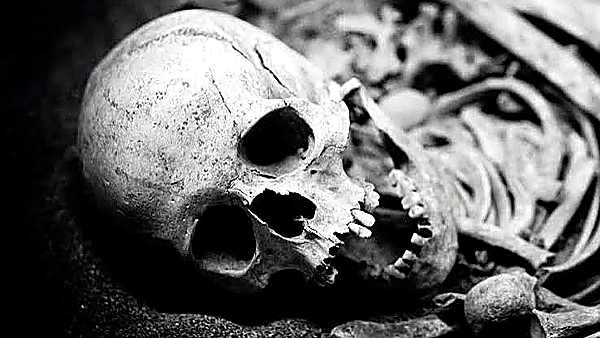

Some medieval skeletons buried in Danish monasteries seemed to die before the buildings around them were even constructed.
Researchers studying 27 skeletons from medieval Danish monasteries discovered that six produced radiocarbon dates that made no sense, placing the individuals' deaths decades or even centuries before the monastery walls went up. The culprit, scientists say, was fish. A diet heavy in freshwater fish can quietly distort radiocarbon dating, a problem now known as the freshwater reservoir effect.
Expedition: Saving Our Seas Documentary Finds Krill Near a Hidden Vent
Skeletons That Didn't Match Their Graves
The project started as a routine reanalysis of human remains pulled from medieval monastery grounds in Denmark. Scientists expected the radiocarbon dates to line up neatly with what historians already knew about when these religious buildings were constructed. Instead, six of the 27 skeletons came back with ages that clashed with the archaeological record, sometimes suggesting people had died long before the monastery existed at all.
That kind of mismatch is not just an odd footnote. It pushes researchers to question whether the testing method failed, or whether something about these specific people's lives threw off the science. The team zeroed in on diet, and specifically on fish pulled from rivers and lakes near where these people once lived.
Two New Howler Monkey Species Amazon Discovery Reveals Hidden Primates
Why Freshwater Fish Confuse Radiocarbon Dating
Radiocarbon dating works by measuring how much carbon-14 remains in old organic material like bone collagen. Living things constantly take in carbon from their environment, and scientists rely on the assumption that this carbon generally matches what is floating around in the atmosphere. Rivers and lakes break that assumption. Ancient carbon from sediment, rock, and other geological sources can seep into freshwater systems, and that carbon carries very little carbon-14 to begin with.
Fish living in those waters absorb that depleted carbon their entire lives. When a person eats a lot of that fish, year after year, some of that same carbon signature ends up locked into their bones. Centuries later, when scientists test those bones, the collagen looks like it belongs to someone who died much earlier than they actually did, simply because the starting carbon levels were already skewed.
Professor Emeritus Kaare Lund Rasmussen, who works with the University of Southern Denmark's Cultural Heritage and Archaeometric Research Team, explained the stakes plainly. "If someone ate a lot of freshwater fish during their lifetime, their bones can appear older than they really are," he said. He added that "the difference can amount to several hundred years and can vary considerably," depending on the person and the water source they relied on.
How Scientists Confirmed the Fish Connection
To check their suspicion, researchers measured nitrogen-15 levels in the bones. Nitrogen-15 is a well-known marker scientists use to spot how much of a person's diet came from aquatic sources rather than land-based crops and livestock. Sure enough, the six skeletons with the strange radiocarbon dates also showed elevated nitrogen-15 readings, pointing straight back to a fish-heavy diet as the likely explanation.
The findings appeared in a comment article published in the journal npj Heritage Science, and the University of Southern Denmark publicized the research in May 2026. Science outlets picked up the story again in November 2026, framing it as a fresh warning for archaeologists working with human remains from regions where river and lake fishing was common. The researchers did not dispute that the freshwater reservoir effect is real or significant. Instead, their focus was on how unpredictable the size of the error can be.
No Simple Fix for the Timeline Errors
One striking example cited alongside the Danish research involved fish from the Rhine River, which under extreme conditions could appear up to 1,300 radiocarbon years older than a land animal that lived at the exact same time. That number sounds dramatic, but Rasmussen was careful to warn against treating it as a universal formula. "But that does not mean you can simply subtract 1,300 years from the date of a person who ate freshwater fish," he said.
The actual offset depends on too many moving parts to standardize. Local geology, the specific river or lake, the particular fish species, how much of a person's diet came from fish, and how long they ate that way all shape the final number. That means every skeleton with high nitrogen-15 readings needs its own careful look, not a blanket correction applied across the board.
What This Means for Archaeology Going Forward
The researchers are now urging archaeologists to treat radiocarbon dates from human bones with more caution whenever freshwater fishing was a realistic part of the local diet, especially for medieval remains. Their recommendation is straightforward: pair radiocarbon testing with nitrogen-15 measurements, cross-check results against known construction dates and historical records, and apply regional reservoir models where they exist.
None of this means radiocarbon dating is broken or unreliable as a whole. It remains a trusted tool for dating organic material across archaeology and science more broadly. What the Danish monastery cases show is that human diet can quietly sabotage the assumptions baked into the method, and that researchers need extra verification steps before locking in a date tied to someone's final resting place. The bigger open question now is how many older archaeological interpretations, built on similar fish-eating populations, might need a second look.