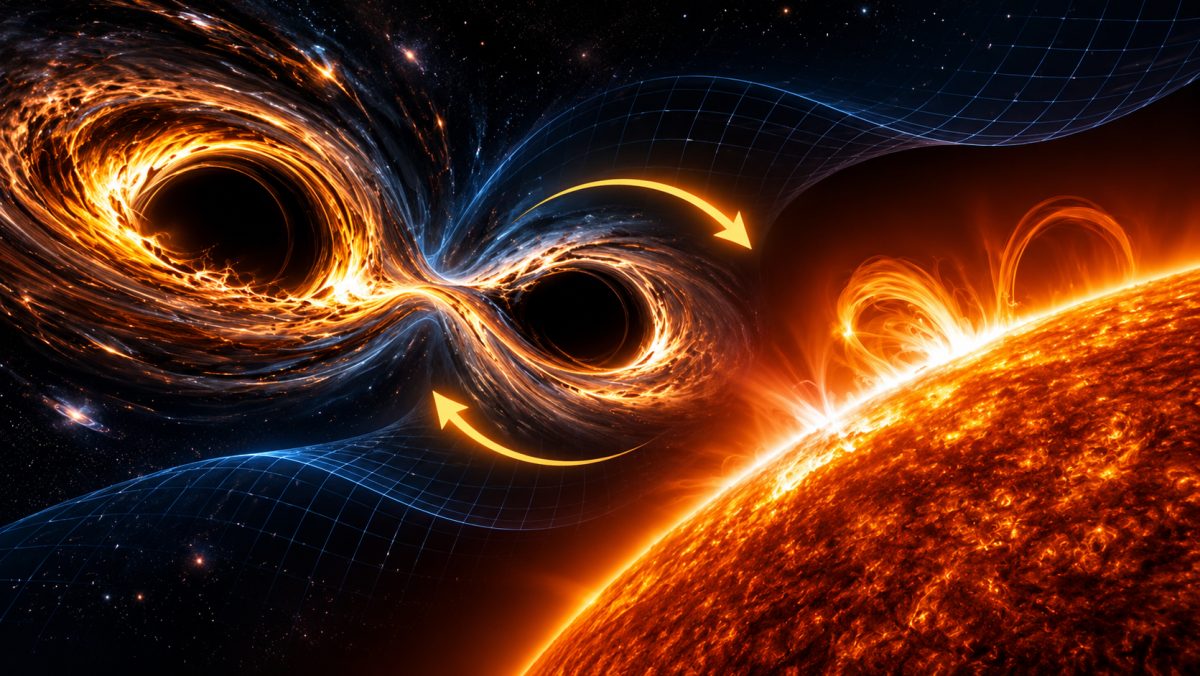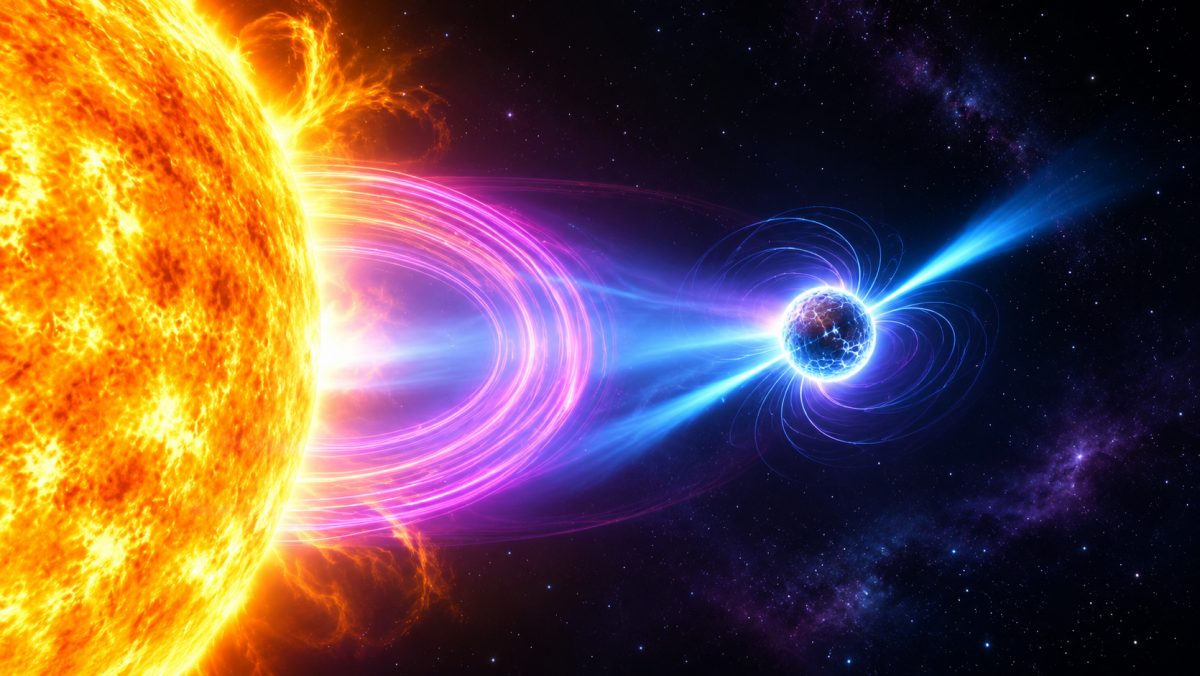

A dead star next to a Sun-like twin is blinking radio waves into space every eight minutes, and scientists finally know why.
Astronomers have identified GPM J071507−114153, a binary star system where a white dwarf circles a Sun-like star, as the source of radio pulses repeating roughly every 7.9 minutes. The discovery was announced on November 12, 2026, by researchers at Curtin University and the International Centre for Radio Astronomy Research in Western Australia, marking the first known detection of this kind of pairing.
Stone Age Children Fingerprints Clay Art Reveal Secret Lessons From Parents
How the GPM J071507−114153 Signal Was Found
The story starts in late 2024, when the Murchison Widefield Array, a radio telescope spread across the Australian outback, picked up something odd. A faint radio pulse kept showing up every few minutes, then vanished, then came back. Scientists watched it for months, from December 2024 through September 2025, and recorded 214 separate pulses coming from the same patch of sky.
That pattern put GPM J071507−114153 into a strange and still-new category called long-period transients. Unlike typical radio pulsars that blink in seconds, these objects repeat on a scale of minutes to hours. They also flash with highly polarized light and show signs of a tightly focused, coherent beam, not just random noise from hot gas.
To figure out what kind of star was doing this, the team turned to the W. M. Keck Observatory for optical follow-up. That is where the surprise came in. The companion star turned out to be a G-type star, the same general class of star as our Sun. Pairing a rapidly spinning white dwarf with a Sun-like companion had never been confirmed before in a long-period transient.
2,200-Year-Old Gold Bear Kazakhstan Dig Reveals a Burial Mound Full of Secrets
Scientists Describe What Makes This Star System Unusual
Curtin University explained the system plainly in its announcement, describing it as pairing "a white dwarf — a dense core left behind when a star dies — and a G-type star similar to our own Sun." That simple description hides a complicated physical puzzle, because white dwarfs are not supposed to produce this kind of sharp, repeating radio beam on their own.
Lead researcher Sam McSweeney said the new data gave scientists their clearest picture yet. "This is the first time the pulses are clear enough to see the white dwarf moving in its orbit around its companion," he said. He added that the signal appears to come "from a region close to the white dwarf, or possibly even from the white dwarf itself."
Timing analysis published in Nature Astronomy pinned down two separate rhythms in the data. One is the fast 7.9-minute cycle, likely tied to how quickly the white dwarf spins or how its radio beam sweeps around like a lighthouse. The other is a slower, roughly 1.3-day cycle, which lines up with the orbital dance between the white dwarf and its Sun-like partner.
Why This Discovery Matters Beyond One Star System
This is not the first long-period transient astronomers have found, but it is the first one tied so clearly to a star like our Sun. Researchers had previously tracked GPM J1839−10, a 21-minute pulsing object paired with a white dwarf and a red dwarf, and GLEAM-X J0704−37, a slower source pulsing roughly every three hours, also linked to a white dwarf paired with a smaller, cooler star.
Finding a Sun-like companion changes the picture. It suggests white-dwarf binaries capable of producing these radio flashes are not limited to pairings with small, dim red dwarfs. That widens the hunt considerably, since Sun-like stars are common across the galaxy. Natasha Hurley-Walker, part of the research team, noted that the pulses even helped scientists spot stellar flares bursting off the companion star itself, turning the radio signal into a tool for studying both stars at once.
The leading explanation involves the white dwarf's magnetic field reaching out and grabbing material or wind thrown off by its companion. As the white dwarf spins, that magnetic interaction can accelerate charged particles and fire them out in a beam, similar in spirit to how a pulsar works, just on a much slower clock. Scientists are not yet certain this is the full answer, but it fits the polarization, timing, and brightness patterns seen in the data.
What Comes Next for This Radio-Pulsing Star
Researchers plan to keep watching GPM J071507−114153 with radio telescopes and optical instruments to nail down exact numbers. They want to know whether 7.9 minutes is precisely the white dwarf's spin rate, confirm the 1.3-day orbit with more precision, and measure just how strong its magnetic field really is.
There is also a bigger question hanging over the whole field. Is this specific pairing rare, or are there many more white dwarfs quietly pulsing away near Sun-like stars that nobody has noticed yet? Comparing this system against GPM J1839−10 and GLEAM-X J0704−37 may help scientists figure out whether fast spin, strong magnetism, or a close orbit is the key ingredient.
For now, there is no confirmed distance to the system in the published findings, and no sign that the signal is anything other than a natural process. What is confirmed is simple enough for anyone to grasp: a dead star next to a star like our Sun is ticking out radio pulses every eight minutes, and after two years of watching, astronomers finally caught it in the act.