
Two physicists say Einstein's own equations hide a surprising link between gravity and the sun's explosive magnetic storms.
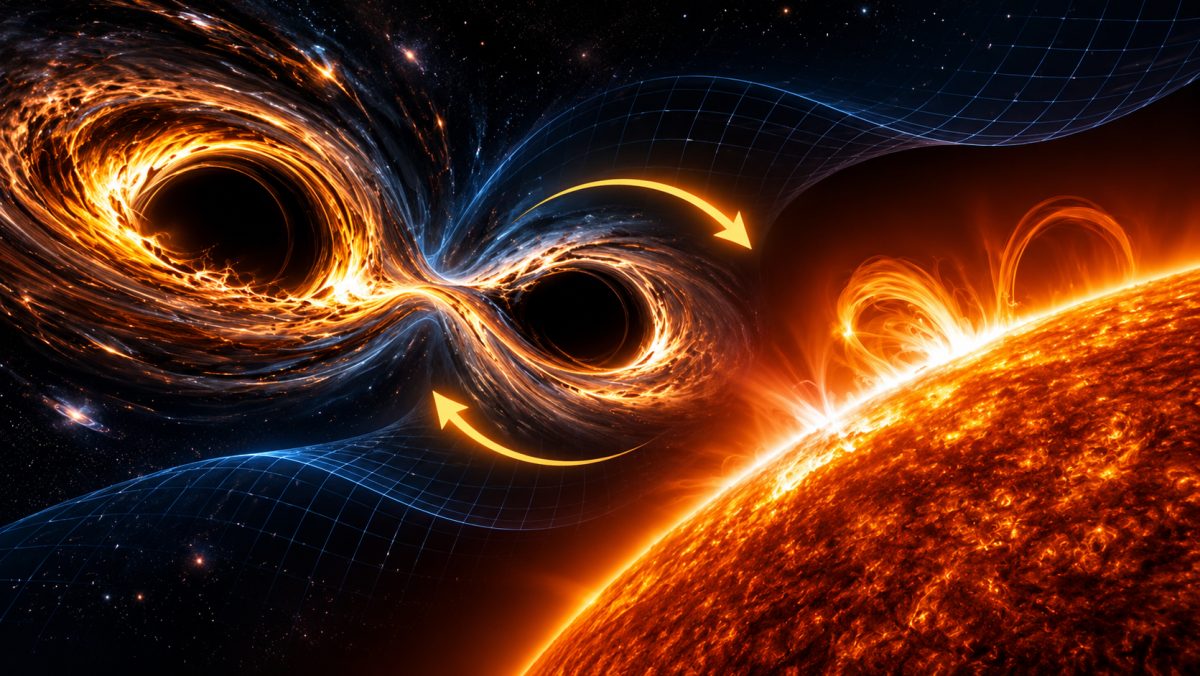
A new theoretical study published Oct. 28, 2026, in Physical Review D proposes that gravity can undergo a process called gravitational reconnection, in which hidden mathematical structures in a gravitational field break apart and rejoin in new patterns, echoing how magnetic fields behave on the sun. The paper, written by Luca Comisso of Columbia University and Felipe A. Asenjo of Universidad Adolfo Ibáñez in Chile, is a mathematical proposal, not an observed event.
What Ended the Cosmic Dark Age? New Study Upends Old Supernova Theory
What the gravitational reconnection theory actually claims
Comisso and Asenjo did not say spacetime rips open or that gravity snaps like a broken rope. Instead, they rewrote Einstein's equations using what is called a tetrad formulation, a different mathematical toolkit that describes the same physics but in a way that looks a lot like the equations used in plasma physics. Once written this way, gravity starts to resemble something scientists already understand well: magnetic fields.
In the sun's atmosphere, magnetic field lines stretch, twist and sometimes snap, then reconnect in a new shape. That sudden rearrangement releases huge bursts of energy, which is part of what powers solar flares. Comisso and Asenjo found that gravity, when described using their new mathematical approach, shows a similar pattern. Instead of field lines, gravity forms what the researchers call sheets, stretching through four-dimensional spacetime rather than ordinary three-dimensional space.
Comisso explained the discovery plainly, saying gravitational field sheets can break and reconnect in a different arrangement, much like magnetic field lines do in plasmas. He also clarified the strange geometry involved, noting that instead of lines extending through three-dimensional space, the gravitational field forms sheets extending through four-dimensional spacetime. These sheets are not physical objects you could touch or see. They are mathematical tools used to track how the gravitational field behaves.
NASA Swift Telescope Reentry Set for Days After Rescue Mission Fails in Space
Why gravitational reconnection echoes solar magnetic storms
The comparison to the sun is not just a catchy analogy. Magnetic reconnection is one of the most studied processes in plasma physics because it explains how stored magnetic energy suddenly converts into heat and particle motion, fueling solar flares and other eruptions. Researchers have spent decades mapping exactly when and how magnetic field lines lose their connections and snap into new configurations.
Comisso and Asenjo built on earlier research, including work by Comisso, Asenjo and Maricarmen A. Winkler published in Physical Review Letters, which looked at mathematical limits on how spacetime geometry can change over time. That earlier paper laid some of the groundwork for thinking about gravity in terms borrowed from plasma science. The new study pushes that idea further by describing the specific condition, called an ideal Ohm-type condition, that normally keeps gravitational field connectivity locked in place. When that condition breaks down, reconnection can happen, and energy can move between the gravitational field and matter.
Columbia University frames the discovery as a new lens on Einstein
Columbia University, where Comisso works as an associate research scientist in the Departments of Astronomy and Physics and the Columbia Astrophysics Laboratory, described the finding as a new way of looking at Einstein's equations that reveals a striking analogy with plasma behavior. The university's explanation stressed that gravitational reconnection represents a change in how field structures connect, not a literal tearing of spacetime itself.
Outside reporting has picked up on the same point. Science writers covering the paper repeatedly noted that this is a theoretical prediction pulled out of existing equations, not a new theory of gravity and not a confirmed astronomical event. No telescope has detected gravitational reconnection happening anywhere in the universe. The achievement, for now, is mathematical: showing that Einstein's general relativity, when rewritten in the right variables, contains plasma-like behavior that nobody had fully mapped out before.
What scientists still need to figure out
The next steps are computational rather than observational. Physicists will need to test whether the conditions required for gravitational reconnection actually show up in realistic solutions to Einstein's equations, the kind used to model real astrophysical systems. That means running simulations and checking whether the proposed energy exchange between gravity and matter produces any signal that instruments could ever catch.
Extreme gravitational environments are the most likely places to look. Systems involving very dense, compact objects, where spacetime geometry changes rapidly, are the kind of settings where this process might plausibly occur. But the current research does not claim that black hole mergers, neutron stars, or any specific observed cosmic event involved gravitational reconnection. That link remains an open question for future study.
A theoretical spark that could reshape how physicists read Einstein
For now, gravitational reconnection stands as an idea grounded firmly in mathematics rather than observation. It offers a fresh way to read century-old equations and hints that gravity might share more in common with the turbulent, energetic behavior of plasma than most physicists assumed.
Whether this reshapes how scientists study black holes, gravitational waves, or extreme cosmic events depends on work that hasn't happened yet. No experiment, mission, or observation has been scheduled to test it directly. What the study does offer is a new mathematical bridge between two fields, gravity and plasma physics, that had rarely been connected this closely before.