
A 22-year-old space telescope is about to make its final trip home, and nobody could stop it in time.
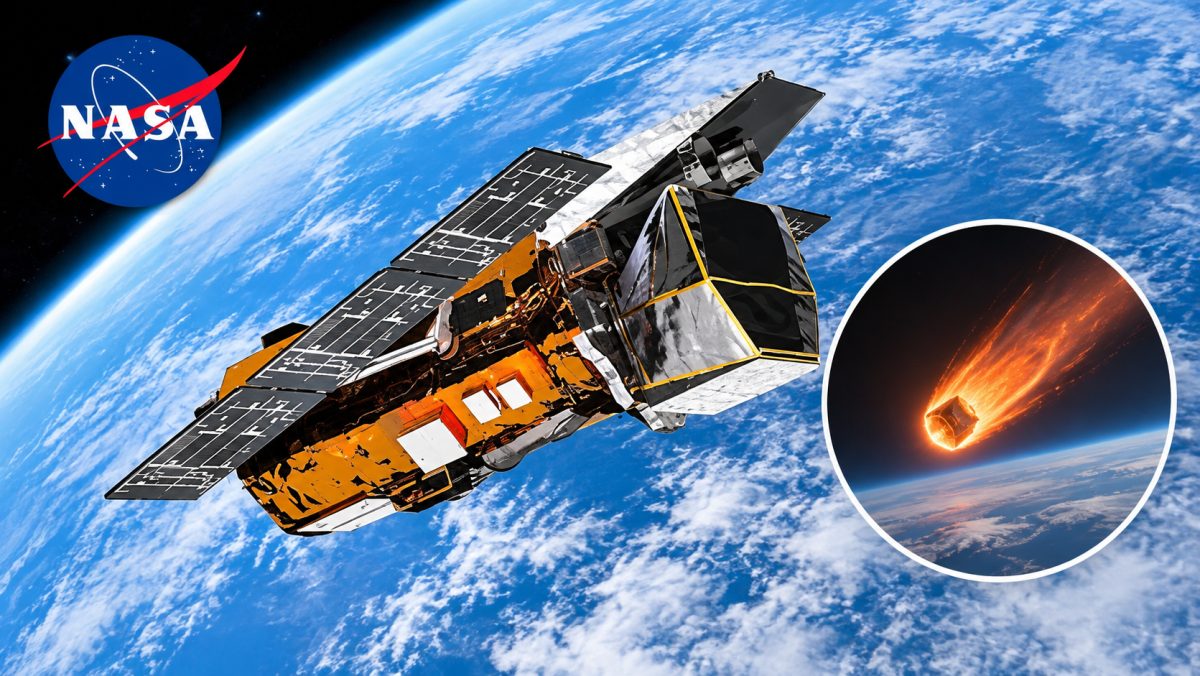
NASA's Neil Gehrels Swift Observatory is expected to reenter Earth's atmosphere around early November 2026, after a last-ditch commercial rescue mission failed to push the aging telescope into a higher, safer orbit. The roughly 1.5-ton spacecraft will mostly burn up, though NASA says some dense parts could survive and splash into the ocean.
4.1 Billion-Year-Old Martian Meteorite Found in Sahara Stuns Scientists
How the Swift telescope ended up falling back to Earth
View this post on Instagram
Swift has spent more than two decades hunting gamma-ray bursts, the most powerful explosions known since the Big Bang. But by Oct. 20, 2026, its orbit had dropped below 171 miles above Earth. At that height, drag from the thin upper atmosphere was too strong for the spacecraft to fight anymore.
The telescope's team at Pennsylvania State University put Swift into safe mode and sent commands that ended its science work for good. NASA confirmed Swift made its very last observation that same day, Oct. 20, closing the book on one of its longest-running missions.
Solar activity made things worse. When the sun gets more active, it heats up and puffs out Earth's upper atmosphere, which creates more drag on spacecraft flying in low orbit. That extra drag sped up Swift's fall far faster than normal.
Seabird Jet Lag Is Real ,How It Throws These Birds Off Course
The failed rescue mission that could not save Swift
NASA did not just let Swift fall without a fight. The agency hired Arizona-based Katalyst Space Technologies to try something bold: send a robotic spacecraft called LINK to grab Swift and boost it higher. LINK, built with three robotic arms, launched in July 2026 with that exact job.
About three weeks after launch, things went wrong. LINK's propulsion system and reaction wheels started acting up, sending the spacecraft into an unexpected spin. Without stable control, LINK could not safely move in to grab Swift and lift it to safety.
By Aug. 19, 2026, NASA and Katalyst admitted the capture and boost plan was off. LINK still tried to get close for practice, eventually flying within about 7.5 to 9.3 miles of Swift and snapping photos of it. But it never touched the telescope. NASA formally ended its part in the LINK mission on Sept. 3, and LINK itself reentered the atmosphere on Sept. 25.
What NASA and mission scientists are saying
NASA has been upfront that Swift's science mission is over, but the agency is not calling the whole effort a failure. In an Oct. 23 statement, NASA said Swift left behind a "scientific bonanza," pointing to decades of gamma-ray burst data that researchers will study for years to come.
Brad Cenko, the mission's chief scientist, said some debris that survives reentry could include tungsten parts, which he described as denser than lead, along with pieces of Swift's mirrors. That detail matters because tungsten is tough enough to resist burning up completely during the fiery trip through the atmosphere.
NASA also said that even without Katalyst's rescue attempt, Swift was always going to come down by the end of 2026. The agency framed the failed LINK mission as a learning experience, saying it gathered valuable data for future commercial satellite rescue and servicing attempts, even though this particular rescue did not work out.
Why this matters for future space missions and public safety
The Swift situation is a real-world test of a growing idea in the space industry: using private companies to extend the life of aging government satellites instead of scrapping them. Katalyst's LINK spacecraft proved it could rendezvous with another object in orbit and get remarkably close, but the mission also showed how hard the final steps of capture and repositioning really are.
For people on the ground, there is little reason to worry. NASA expects most of Swift's structure to disintegrate from the heat of reentry, and any surviving pieces are most likely to land in open ocean rather than populated areas. The U.S. Space Force has been tracking the telescope closely and predicted its reentry would happen around a Friday in early November 2026, though the exact timing and location can shift as drag changes day to day.
What comes next for Swift's legacy
There will be no second rescue attempt. NASA and Katalyst have both said they are done trying to save Swift and are instead focused on applying what they learned to future missions involving commercial spacecraft servicing and orbital debris management.
Swift's story now shifts from an active telescope to a massive archive of discoveries. Renamed in 2018 to honor its first lead scientist, Neil Gehrels, the observatory helped researchers understand black holes, collapsing stars, and neutron star mergers. Even after the failed rescue, Swift kept working and detected more high-energy cosmic events before its final shutdown, a fitting finish for a telescope that outlasted its expected lifespan by years.