
A planet hunter now runs one of the world's top science schools, right as its biggest partner faces an uncertain future.
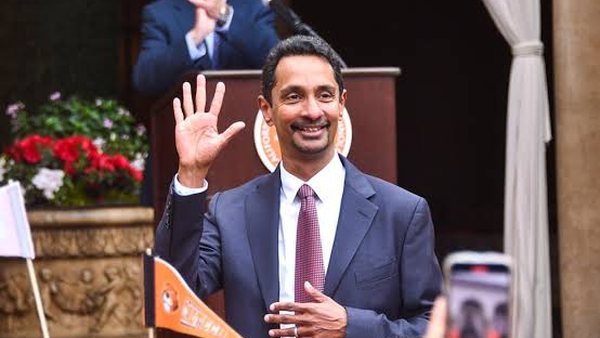
Caltech formally installed Ray Jayawardhana as its 10th president during a ceremony on Beckman Mall in Pasadena on Thursday, Oct. 29, 2026, as the institute confronts NASA's decision to open Jet Propulsion Laboratory management to outside bidders for the first time ever, alongside shifting federal policy and the rise of artificial intelligence in research.
Ray Jayawardhana Caltech President Takes Office Amid Beckman Mall Ceremony
Hundreds of people gathered at the Beckman Mall on Caltech's Pasadena campus for the 10 a.m. ceremony. Trustees, faculty members, Jet Propulsion Laboratory representatives, undergraduate and graduate students, postdoctoral scholars, and alumni all took turns speaking before Jayawardhana delivered his inaugural address. The event wrapped up with a campus-wide celebration that organizers called First Light, a nod to the moment a new telescope captures its very first image of the sky.
Jayawardhana is the first astronomer and the first South Asian American to lead Caltech, according to the Los Angeles Times. He actually started the job back on July 1, 2026, taking over from Thomas F. Rosenbaum, who had led the institute for 12 years. The October ceremony marked his formal installation rather than his first day on the job, a common setup for university presidencies where the title changes hands months before the public celebration.
JPL Management Contract Opens to Outside Competition for First Time
The most pressing challenge facing Jayawardhana has little to do with telescopes and everything to do with federal contracts. NASA has decided to open JPL's management contract to outside organizations, something that has never happened in the lab's history. Caltech has run JPL for NASA for decades, and that relationship has shaped the university's identity, its budget, and its reputation in space science. Now Caltech has to compete to keep that role instead of assuming it will simply continue.
Speaking with the Los Angeles Times, Jayawardhana said Caltech needs to "find clarity at a time of change and uncertainty" caused by artificial intelligence, shifting federal policy, and global events. The Times described the Trump administration as a source of ongoing threats and uncertainty for the university, tying federal funding questions and policy shifts directly to JPL's fate. No final decision, named competitor, or firm timetable for the contract outcome has been reported yet.
$27.5 Million Gift and New JPL Leader Announced Alongside Inauguration
One day before the inauguration, on Oct. 28, Caltech and JPL announced $27.5 million in combined gifts from philanthropists Foster and Coco Stanback. A $20 million portion, channeled through the Foundation for the Carolinas, will fund a new Space Makerspace at JPL along with education and workforce-training programs. A separate $7.5 million gift will expand Caltech's hypersonic research facilities, including a new shock tube built to study extreme flight conditions.
Jayawardhana praised the donation in Caltech's official announcement, saying, "Caltech and JPL have played defining roles in modern aerospace research and innovation since the field's earliest days, and Foster and Coco's remarkable generosity will help build upon that pioneering legacy." Caltech also revealed that Artemis II commander Reid Wiseman will join the institute as associate vice president and JPL deputy director starting Nov. 30, bringing real astronaut and spaceflight experience into JPL's leadership right as the lab approaches its 90th anniversary.
Campus Reaction Shows JPL's Future Matters to Entire Caltech Community
The range of people who spoke at the inauguration, from trustees to postdoctoral scholars, suggests JPL's situation is not just a concern for administrators. It touches students doing hands-on research, scientists building instruments, and alumni who built careers through the lab. The Space Makerspace project is designed to bring Caltech researchers and JPL engineers together on actual flight hardware, while also opening doors for students and even community-college participants to get real training.
Wiseman's appointment adds weight to JPL's leadership bench at a moment when questions about who runs the lab remain unanswered. Still, nothing in current reporting confirms a winner in NASA's contract review, nor does it name a specific outside bidder challenging Caltech. Treating any outcome as settled would be premature based on what's been publicly confirmed so far.
What Comes Next for Caltech Under Its New President
The clearest near-term milestone is Wiseman's Nov. 30 start date at JPL. Beyond that, the timeline for NASA's management-contract decision remains unclear, and that uncertainty will likely shape much of Jayawardhana's first year in office. His background as a working astrophysicist, someone who has spent his career studying exoplanets and searching for signs of life beyond Earth, gives him scientific credibility. But his presidency will be judged on very different ground: whether Caltech keeps JPL, how it navigates federal funding changes tied to the Trump administration, and whether it builds a real strategy for handling AI's growing role in research and education.
The Stanback gifts give Caltech fresh money and momentum heading into this stretch, but they don't settle the bigger question hanging over the campus. Who manages JPL for the next chapter of its history is still an open question, and Jayawardhana now owns the answer to it.