
Nature hides a strange trick where one creature quietly takes the wheel inside another creature's body.
Real-life zombie parasites and fungi are not science fiction. The Washington Post published a feature on October 29, 2026, describing how fungi, worms, wasps and even viruses can infect animals and change how they act, all to help the invader survive and spread.
How Real-Life Zombie Parasites And Fungi Take Control
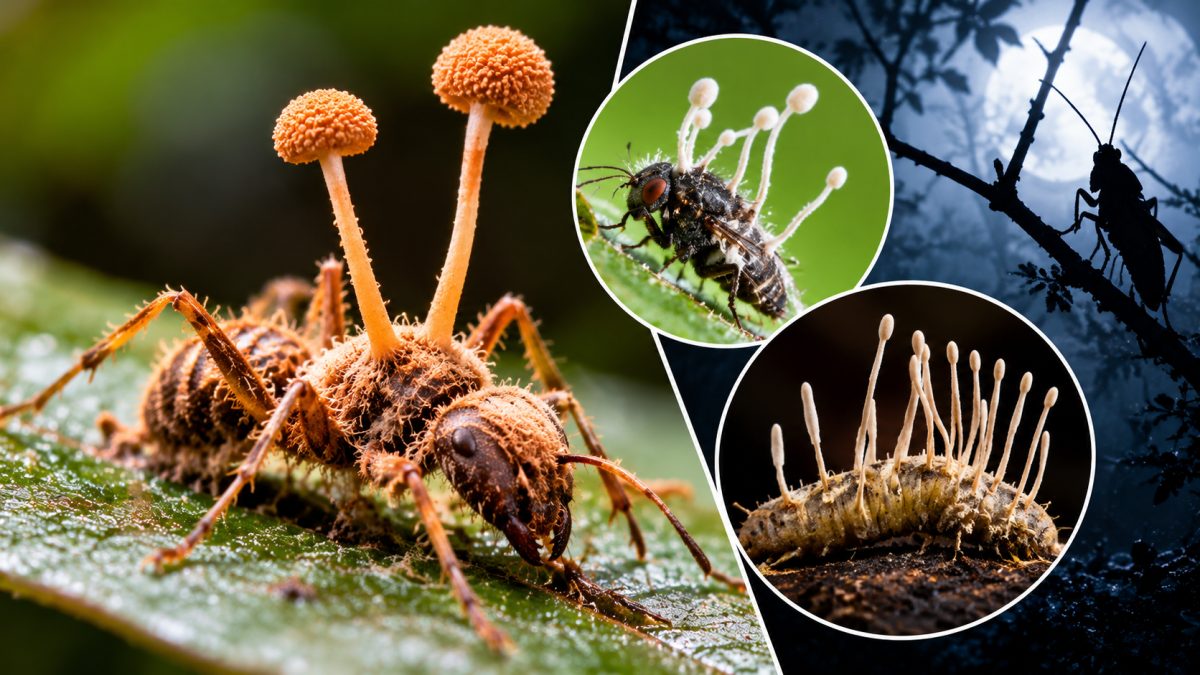
The article centers on a parasitic fungus called Ophiocordyceus curculionum, which infects beetles. Once inside, the fungus grows until it eventually pushes a stalk straight out of the beetle's body. That stalk is not random. It is the fungus setting itself up to release spores and start the cycle again.
This is not mind control in the way movies show it. The host animal stays biologically alive the whole time. What changes is its behavior. A parasite can mess with muscles, hormones, nerve signals or movement patterns, and that is enough to steer the host somewhere useful for the parasite, even if the host's brain is not technically being read or rewritten.
Zombie Ants Show The Pattern Clearest
The most famous case involves Ophiocordyceps fungi that infect ants. Once infected, an ant leaves its colony, something it would never normally do. It climbs a plant stem and clamps down in a very specific spot, almost like it was told exactly where to go. Then the fungus grows a stalk out of the ant and drops spores onto the ground below, right where other foraging ants are likely to walk by and pick up the infection.
Science writer Matt Simon, quoted by National Geographic, summed up how widespread this behavior really is, saying scientists have found that fungi, bacteria, wasps and worms all do versions of this. That range matters. It shows zombification is not one weird fungus doing one weird thing. It is a strategy that keeps popping up across completely different branches of life.
Spiders, Hairworms And Snails Reveal The Same Trick
Fungi are not the only culprits. A parasitic wasp called Hymenoepimecis argyraphaga paralyzes a spider just long enough to lay an egg on it. The spider recovers and goes back to normal life, except it is not really normal anymore. Chemicals from the wasp egg push the spider to build a completely different kind of web, one built to protect the wasp larva instead of catching food.
Hairworms pull off something even stranger. They grow inside crickets and grasshoppers on land, but the adult worms need water to reproduce. So the parasite nudges its host toward the nearest pond or stream, and the insect basically walks itself to its own watery exit so the worm can swim free. Snails get a similar treatment from a flatworm called Leucochloridium paradoxum, which swells the snail's eye stalks into bright, pulsing, caterpillar-like blobs. Birds spot the strange pulsing stalks, eat the snail, and the parasite gets its next ride.
Why This Keeps Happening Across So Many Species
None of this is random cruelty from nature. It is natural selection doing what it always does. If a parasite's genes happen to make an infected host act in a way that helps the parasite spread, those genes stick around and get passed on. Over long stretches of time, that small advantage turns into a full behavioral takeover. Scientists call it convergent evolution when totally unrelated organisms, like fungi and wasps and worms, land on strikingly similar solutions because they are all solving the same basic problem, getting from one host to the next.
Other cases back this up. Baculoviruses push infected caterpillars to climb high on plants before killing them, so the liquefied body drips virus onto leaves below for other caterpillars to eat. A fungus called Massospora cicadina infects periodical cicadas and replaces part of the abdomen with fungal material, yet the cicadas keep flying and mating, spreading spores the whole time. Each case is its own specialized hack, built for one host and one transmission method.
What The Zombie Label Really Means
Calling these animals zombies is a journalistic shortcut, not a scientific diagnosis. Nothing comes back from the dead, and nothing is fully possessed in every sense. Manipulation is usually narrow and timed, affecting one behavior like climbing, moving toward water or building a web, at one specific stage of infection. The rest of the animal's biology keeps functioning normally until the parasite is ready to finish its cycle.
There is no evidence of any human equivalent to these infections, and nothing in the research points to a public health threat tied to this story. Researchers mainly study these cases to understand how parasites and hosts evolve together over time, and how fragile the line really is between an animal controlling itself and quietly being steered by something living inside it.