
A new computer model lets scientists watch the universe's earliest galaxies switch on and burn away the cosmic fog.
Researchers from MIT, Harvard University and the Center for Astrophysics unveiled the Lumina early-universe simulation on October 26, 2026, a massive cosmological model that tracks the first 2 billion years after the Big Bang, showing exactly how the first galaxies formed and ended the universe's dark age.
How the Lumina early-universe simulation was built
View this post on Instagram
Lumina begins its clock about 45 million years after the Big Bang, right in the middle of what scientists call the cosmic dark age. At that point, the universe was mostly neutral hydrogen gas, dark and quiet, with no stars or galaxies lighting things up. The simulation then tracks how dark matter, gas, radiation, stars and galaxies all tangled together and changed over time.
The simulated patch of space stretches about 1.6 billion light-years across. That is a huge volume for this kind of work. Most simulations have to pick one or the other: either a big chunk of space with low detail, or a tiny patch with sharp detail. Lumina tries to do both at once, which is why the Smithsonian called it one of the largest and most detailed simulations ever created of the early universe, and separately described it as the largest cosmological radiation-hydrodynamics simulation ever built.
That combination matters because early galaxies were rare and scattered. A small simulated volume might miss the biggest, brightest ones entirely. By going big while still tracking fine details like gas clumping and star formation, the research team gave themselves a shot at catching those rare bright galaxies alongside the ordinary ones.
What the simulation shows about reionization
For hundreds of millions of years, neutral hydrogen gas blocked and scattered light, keeping the universe dark to our eyes. Lumina shows how that changed. As the first stars and galaxies switched on, their ultraviolet light began stripping electrons from hydrogen atoms nearby, carving out bubbles of ionized gas around each galaxy.
Those bubbles grew and eventually merged into one another, a process scientists call hydrogen reionization. The simulation also follows a second, later transformation called helium reionization, when more energetic radiation stripped electrons from helium atoms too. Watching both processes unfold in one connected model is part of what makes Lumina useful, since earlier work often treated these stages separately.
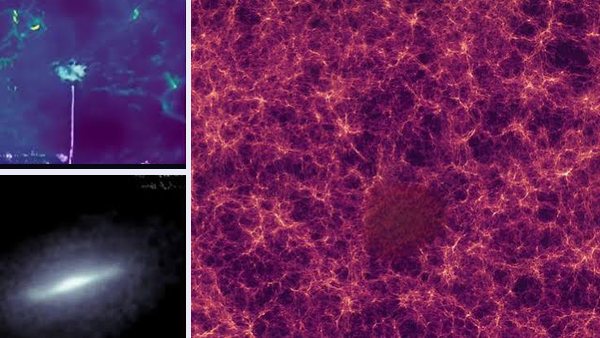
MIT described the simulation as giving researchers a detailed view of how the first galaxies, stars and other structures could have unfolded after the dark age ended. The visualizations show gas piling up inside dark matter halos, young galaxies igniting inside that gas, and radiation spreading outward like ripples, slowly clearing the fog that once filled the cosmos.
Why scientists needed a model this big
The timing lines up with a bigger puzzle in astronomy. The James Webb Space Telescope has spotted galaxies from the early universe that look surprisingly bright and surprisingly grown-up for their age. That has left researchers scrambling to explain how galaxies could mature so fast after the Big Bang.
Lumina gives scientists a way to test ideas without rewriting the rules of cosmology. By running the physics forward and comparing the simulated galaxies to what Webb and other telescopes actually see, researchers can check whether standard theories of star formation and galaxy growth can produce objects that match reality. If the simulated galaxies look very different from the real ones, that is a clue that something in the model, or something in our understanding of early galaxy formation, needs adjusting.
This approach treats galaxy formation as a two-way street. Early galaxies were not just shaped by the gas around them. They also reshaped that gas through their own radiation and feedback, changing the environment for every galaxy that formed afterward. Lumina was built specifically to capture that back-and-forth instead of treating galaxies as isolated objects floating in empty space.
What researchers plan to do with the results
The most immediate use of Lumina is comparison work. Scientists can take the simulated galaxies and radiation fields and line them up against real observations of distant, ancient galaxies. Where the two match, it strengthens confidence in current theories. Where they clash, it points researchers toward gaps in the science.
No specific follow-up study or new observing campaign tied to Lumina has been announced yet. But the project is built to keep running and improving, with researchers likely to refine its physics, generate test predictions, and measure those predictions against future telescope data. Given that the simulation only covers the first 2 billion years of a 13.8-billion-year-old universe, it captures a narrow but critical slice of cosmic history, the exact window when the universe went from dark and empty to filled with galaxies.
For now, Lumina stands as a working laboratory for one of astronomy's oldest questions: how did the universe go from a dark, silent gas cloud to the galaxy-filled sky we see today. The answer, piece by piece, is being tested inside this simulation.