
A giant volcano, a morning cloud, and an ice trick that scientists say they've never seen happen on any planet before.
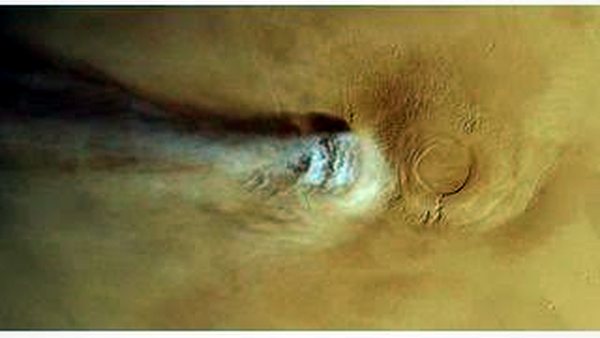
The Arsia Mons elongated cloud is a huge ribbon of water-ice that stretches up to 1,800 kilometers across the Martian sky every spring and summer morning. A study published October 7, 2026, in Nature Geoscience says it may form without any dust or other starting material at all, through a rare process called homogeneous ice nucleation.
How the Arsia Mons elongated cloud forms each morning
The cloud appears downwind of Arsia Mons, a Martian volcano that stands about 20 kilometers tall. Winds blowing across the mountain hit that massive wall of rock and get thrown upward fast. Researchers led by J. Hernández-Bernal found that this collision creates a strong atmospheric wave that lifts moist air several kilometers in just minutes.
That sudden rise causes the air to expand and cool at a wild pace. The model showed temperatures dropping by about 30 degrees in just 10 minutes. That kind of rapid cooling leaves the air holding far more water vapor than it should be able to carry, roughly 100,000 times more than normal. Under that kind of stress, something strange happens. Water molecules start clumping together and freezing on their own, with no dust speck needed to get things started.
Why the Arsia Mons elongated cloud puzzled scientists for years
Most clouds, on Mars and on Earth, need help to form. Water vapor usually needs a tiny particle like dust, salt, or soot to grab onto before it can turn into ice or liquid. Scientists call this heterogeneous nucleation, and it's been the standard explanation for Martian clouds for a long time.
But the Arsia Mons elongated cloud never quite fit that story. Earlier modeling work, going back to 2021 and 2022, found a cold, supersaturated pocket of air near the volcano at just the right height, time, and season to match the cloud. The problem was that models using normal dust-based cloud physics could never reproduce the cloud's long, stretched-out tail. Something was missing.
Scientists call the discovery wholly unexpected
The European Space Agency, whose Mars Express mission has tracked the cloud for years, called the new explanation wholly unexpected. ESA scientist Jorge explained it simply: for this cloud, formation happens without needing any of that dust or seed material at all. Water vapor turns directly into icy cloud particles without any middle step, he said, comparing it to condensation droplets appearing in the middle of a room instead of forming on a cold window.
The research team built homogeneous nucleation directly into a mesoscale weather model of Mars. When they ran it, the model finally produced the cloud's real shape, its timing, and that long stretched tail that had stumped scientists before. The simulation showed hundreds of ice particles forming in every cubic centimeter of air under the most extreme conditions, with a peak nucleation rate of about four particles per cubic centimeter every second.
What the finding means beyond one Martian volcano
This isn't just a quirky detail about one cloud. If homogeneous nucleation really is happening on Mars, it could change how scientists think about clouds across the whole planet. The study's authors say the same process might explain other Martian clouds that form under similarly extreme supersaturation, something separate surveys have measured at levels even higher than what triggered the Arsia Mons cloud.
It's worth being clear about what scientists have and haven't actually seen. Nobody watched individual ice crystals freeze out of thin air under a microscope. This is a model-based explanation, built to match real observations, and it worked where older models failed. The researchers describe the process as strongly suggested, not directly confirmed. That distinction matters for how carefully the claim should be treated, even as it reshapes thinking about Martian weather.
Next steps for studying Martian clouds
Scientists now want to check whether this same ice-forming trick shows up in other Martian clouds, not just the one near Arsia Mons. That means comparing more Mars Express data against models that include homogeneous nucleation, looking for the same telltale signs of extreme supersaturation and rapid cooling.
The implications might stretch even further than Mars. Understanding how ice can form without any seed material could matter for atmospheric science on Earth and for predicting cloud behavior on other planets entirely. For now, the Arsia Mons elongated cloud remains a rare natural laboratory, a towering volcano and a stubborn morning cloud that forced scientists to rethink how ice itself comes into being.