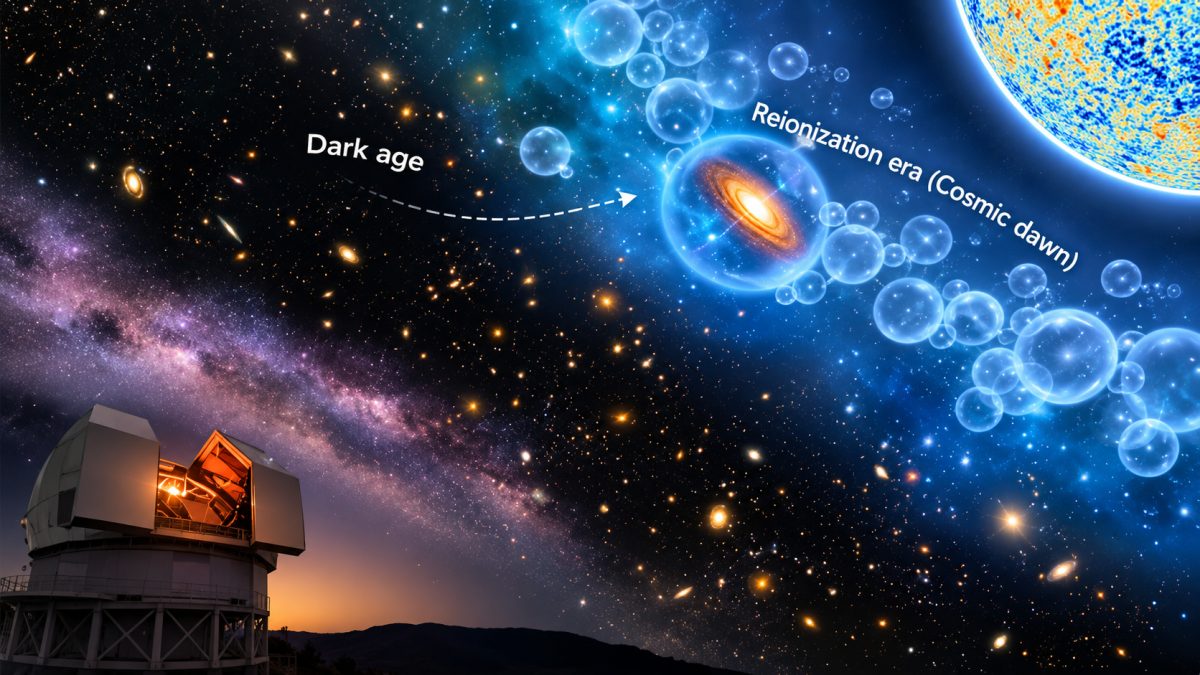

Scientists thought they knew how the universe lit up for the first time, but new evidence says think again.
A new study published October 15, 2026, in Nature Astronomy argues that supernova-driven winds, long credited with helping end the Cosmic Dark Age, may have actually trapped the radiation needed to light up the early universe. The research, led by Cody Carr of the University of Michigan, questions one of the most popular explanations for how the cosmos became transparent billions of years ago.
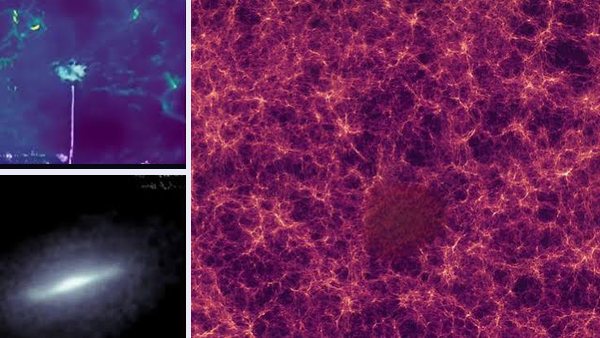
Lumina Early-Universe Simulation Reveals How First Galaxies Lit Up the Cosmos
What ended the Cosmic Dark Age, according to the new research
For years, many astronomers believed supernova explosions played a helpful role in ending the Cosmic Dark Age. The thinking went like this: massive stars explode, their shockwaves punch holes through thick gas clouds, and those holes let ultraviolet light escape into space. That escaping light, known as Lyman-continuum radiation, would then ionize hydrogen gas spread across the universe, clearing the fog that once blocked light from traveling freely.
Carr's team looked closely at galaxies that shoot out the strongest doses of this ionizing radiation. What they found surprised them. These bright galaxies did not show the fast winds that the supernova theory predicted. Instead of blasting gas out of the way, something else seemed to be letting the radiation slip out. That finding flips a key assumption people have relied on for explaining what ended the Cosmic Dark Age.
Carr explained the discovery plainly. "The most interesting thing about our paper is the observation that the strongest LyC emitters do not have fast galactic winds," he told Live Science. He added, "This challenges the notion that galaxies require fast supernova-driven winds to enable LyC escape."
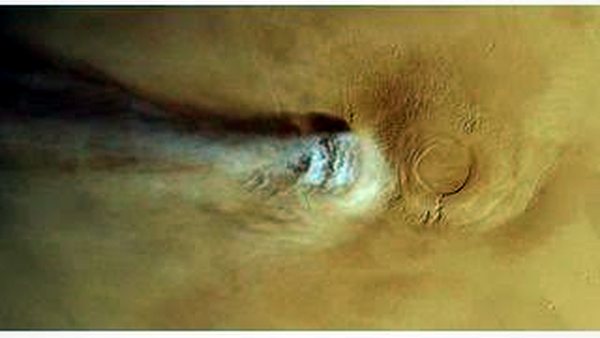
Arsia Mons Elongated Cloud on Mars May Form Without Any Dust at All
Why scientists once trusted supernova winds to explain cosmic reionization
To understand why this matters, it helps to look back at what the universe looked like right after the Big Bang. Once things cooled down enough, protons and electrons joined together into neutral hydrogen gas. That gas soaked up light like a thick curtain, leaving the universe dark and opaque for a long stretch of time. Scientists call this stretch the Cosmic Dark Age.
Roughly 100 million years after the Big Bang, tiny differences in density began pulling matter together under gravity. Slowly, the first stars and galaxies formed along what scientists call the cosmic web. Massive stars lit up quickly and burned out fast, lasting only a few million years before dying in supernova explosions. Those explosions released huge amounts of energy, which is exactly why astronomers suspected they played a starring role in freeing ionizing radiation.
The missing piece was always the so-called escape fraction, or how much of that ionizing light actually made it out of its home galaxy instead of getting soaked up by gas and dust inside it. Supernova winds seemed like a logical answer because violent explosions can blow holes through dense material. Carr's findings suggest that story does not hold up as well as previously thought, at least not for the brightest sources of escaping radiation.
Reactions from researchers and the role of James Webb Space Telescope data
Carr was careful not to overstate the conclusion. "We don't know exactly what objects caused reionization or how it evolved," he said. That statement matters because the study does not claim to solve the entire mystery of cosmic reionization. It simply knocks down one widely accepted mechanism and points attention back toward the raw ultraviolet power of newly formed, massive stars.
This debate is playing out at a perfect moment for astronomy. The James Webb Space Telescope has been peering deeper into space than any previous instrument, capturing galaxies that existed just after the Cosmic Dark Age ended. Those ancient galaxies give researchers real targets to test ideas like Carr's, instead of relying purely on theory.
A separate modeling effort from the University of Texas, called Cosmic Dawn III, recreated this early era in unusual detail. That project described a universe where young galaxies flooded space with enough ultraviolet starlight to ionize atoms and lift the cosmic fog. While that project does not directly confirm Carr's findings about supernova winds, it reinforces the idea that starlight itself, not explosive aftershocks, may deserve most of the credit.
What comes next in the search for what caused cosmic reionization
The story is far from finished. Researchers now need more observations and better simulations that track how ionizing light escapes galaxies, how fast gas moves inside them, and how dust blocks or allows that light through. Scientists will also want to know whether Carr's pattern holds true across many different types of early galaxies, or whether it only applies to the brightest and most unusual ones.
There is no scheduled hearing, launch, or deadline tied to this research. Instead, progress will come steadily, through continued study of galaxies spotted by the James Webb Space Telescope and refined computer models of the Epoch of Reionization. The next real test will be simple to state but hard to answer: do the brightest sources of ionizing radiation keep showing up without the fast winds that the old supernova model predicted? If that pattern holds, astronomers may need to rewrite a key chapter in the story of how our universe first filled with light.