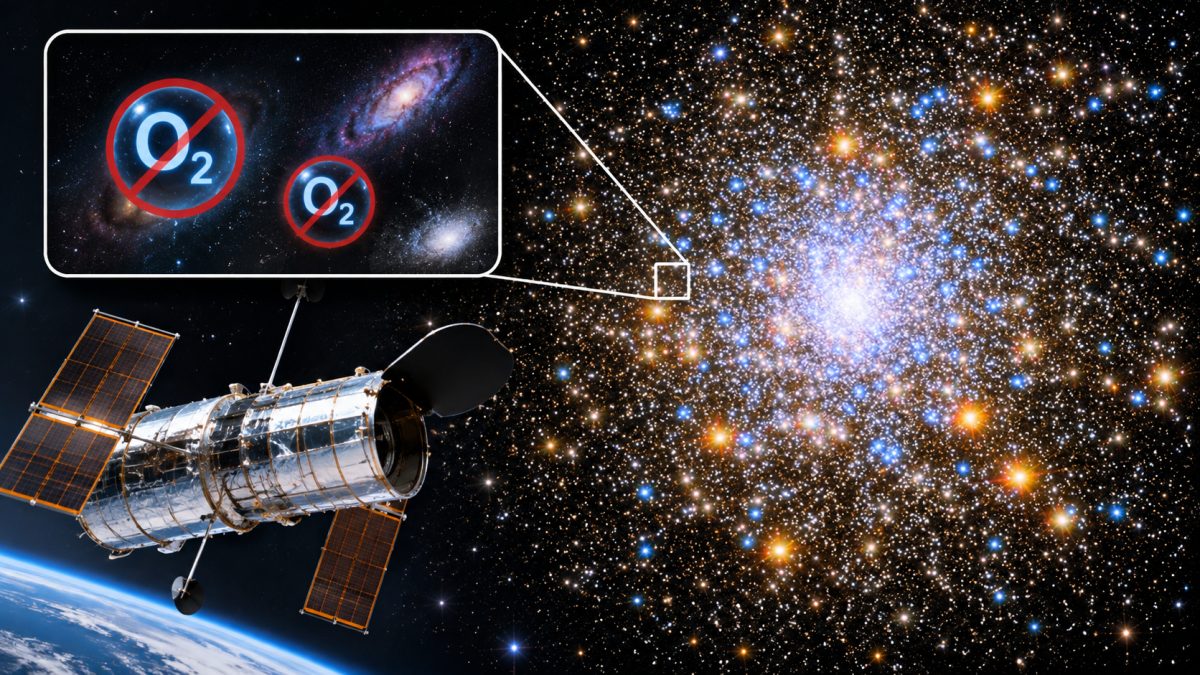

Scientists pointed Hubble at 37 small galaxies and found most of the oxygen their stars made has simply disappeared.
A new study using NASA's Hubble Space Telescope found that 37 nearby dwarf galaxies kept only about 11% of the oxygen their stars produced, according to research published in The Astrophysical Journal in early November 2026. The rest, scientists believe, got blown away into deep space by powerful stellar winds and supernova blasts.
NASA Swift Telescope Reentry Set for Days After Rescue Mission Fails in Space
Hubble Study Finds Dwarf Galaxies Losing Most of Their Oxygen
The research came from a project called Galaxies Losing Oxygen via Winds, or GLOW. Researchers wanted to track oxygen through three stages: oxygen trapped inside stars, oxygen floating in the gas between stars, and oxygen that had escaped into intergalactic space entirely. The 37 galaxies studied ranged wildly in size, from tiny systems with just a few thousand stars to bigger dwarfs holding hundreds of millions of stars.
What the team found surprised them. Based on how many stars these galaxies had formed over time, scientists expected a certain amount of oxygen to be sitting inside them. Instead, the galaxies held onto far less. The strongest oxygen keepers retained about 25% of what their stars made. The leakiest galaxies held onto just 4%. Across the whole sample, the average came out to roughly 11%.
Mars Radiation Health Risks: Rat Study Hints at Years of Hidden Heart Damage
Why Dwarf Galaxies Can't Hold Onto Their Oxygen
NASA's own report on the discovery put it plainly: "much of the oxygen they expected to see is missing." The agency added that "galactic winds unleashed by supernovae are apparently more effective at removing oxygen from low-mass galaxies than current models predict." That's the key piece of this puzzle. Dwarf galaxies are small, and small means weak gravity. When massive stars explode as supernovae, they release huge amounts of energy into the surrounding gas. In a galaxy the size of the Milky Way, that gas mostly stays put. In a dwarf galaxy, that same burst of energy can push gas clear out of the galaxy's grip.
One researcher explained the mechanism involves energy from "massive stars and supernova explosions to drive material out of the host galaxies and into the space between galaxies." NASA also summed up the bigger picture this way: "The findings show that dwarf galaxies can hold onto only a small fraction of the oxygen made by stars." The GLOW team describes its own motivation simply, noting that tracing oxygen production "helps us understand galaxy evolution."
NGC 4449 Puts a Face on the Oxygen Mystery
Among the 37 galaxies studied, one in particular became the public face of this discovery. NGC 4449, a dwarf irregular galaxy, was featured in a striking Hubble image released alongside the research. It's not the only galaxy in the GLOW sample, but it offered scientists and the public a clear visual example of the kind of small, star-forming galaxy where this oxygen loss is happening.
Interestingly, the study also looked at whether being close to a bigger, more massive galaxy changed the outcome. It didn't seem to matter much. Galaxies sitting more than 3.3 million light-years away from any massive neighbor still retained less than 15% of their oxygen on average. That finding pushes back against the idea that gravitational interactions with bigger galaxies are stripping away the oxygen. Instead, it points back to internal forces, stars and supernovae doing the damage from the inside.
A Challenge for Galaxy Evolution Models
This discovery isn't just a fun space fact. It pokes a hole in how scientists model galaxy evolution. Cosmological simulations have generally done a good job matching the known relationship between how massive a galaxy is and how many heavy elements it contains. But those same simulations seem to predict that dwarf galaxies should retain more oxygen than Hubble actually observed. That gap between prediction and reality is exactly what makes this finding important to astronomers building the next generation of galaxy models.
Dwarf galaxies matter for a bigger reason too. If they keep losing oxygen, hydrogen, and other elements through these outflows, they may struggle to recycle enough raw material to keep forming new stars over long stretches of cosmic time. Their chemical makeup ends up being shaped as much by what they lose as by what their stars actually create.
What Comes Next for the Missing Oxygen
Right now, nobody knows exactly where all that missing oxygen ended up. NASA has been careful to frame this as an open question rather than a solved case. The gas presumably drifted into intergalactic space, but its exact location, how far it traveled, and how it's spread out remain unknown. Future observations will likely try to track down that oxygen directly, rather than just inferring it's missing from what's left behind in these galaxies.
Researchers also want to see whether the outflow patterns change depending on how actively a galaxy is forming stars, how massive it is, or how far it sits from larger neighbors. Funding from NASA and the National Science Foundation is backing continued work on the GLOW project, and scientists expect this dataset to serve as a benchmark for future dwarf galaxy research. Solving the mystery could reshape how astronomers understand star formation, gas recycling, and the chemical history of galaxies going back billions of years.