
Scientists found that the gunk in your ears might be a tiny, built-in bodyguard against bugs.
A new study shows that earwax deters insects through a strange combination of slipperiness and stickiness, according to research led by David Hu and his team at the Georgia Institute of Technology. The findings were published October 28, 2026, in the journal Soft Matter and reported by Science News on November 4, 2026.
Cat's Head Nebula Hubble Webb Images Reveal a Sinister Glowing Red Eye
How Earwax Deters Insects in the Lab
The research team collected 36 earwax samples from six different animals, including pigs, sheep, dogs, cows, rabbits and humans. They wanted to know what happens when insects actually touch the stuff. So they brought in fire ants, a species scientists often use to study how bugs walk, climb and grip.
What they found was odd. Rough earwax actually let ants move along fairly well because their tiny claws could grab onto the bumps. But smooth earwax was a different story entirely. Ants that tried to climb it lost their footing almost right away. David Hu described the material simply: "It's both sticky and slippery." That mix is exactly what seems to trip ants up.
Dinosaur Blood Fossil Found in Brazil Bone Stuns Scientists Worldwide
The Science Behind the Stickiness
Earwax is not really wax at all. According to the study, about 60 percent of it is made of dead skin cells, with oils and moisture filling out the rest. Those skin flakes are held together by a natural binder, which creates a sponge-like, porous texture. That structure turns out to matter a lot for how insects experience it.
The pores inside earwax are shaped like tiny ink bottles, and this geometry helps the material soak up liquid. Researchers reported that earwax can absorb about twice its own weight in water. That absorbency seems to be the secret behind the slipperiness. When an ant's foot touches smooth earwax, the material pulls moisture right off its foot, weakening the thin layer of liquid that ants rely on to stick to surfaces.
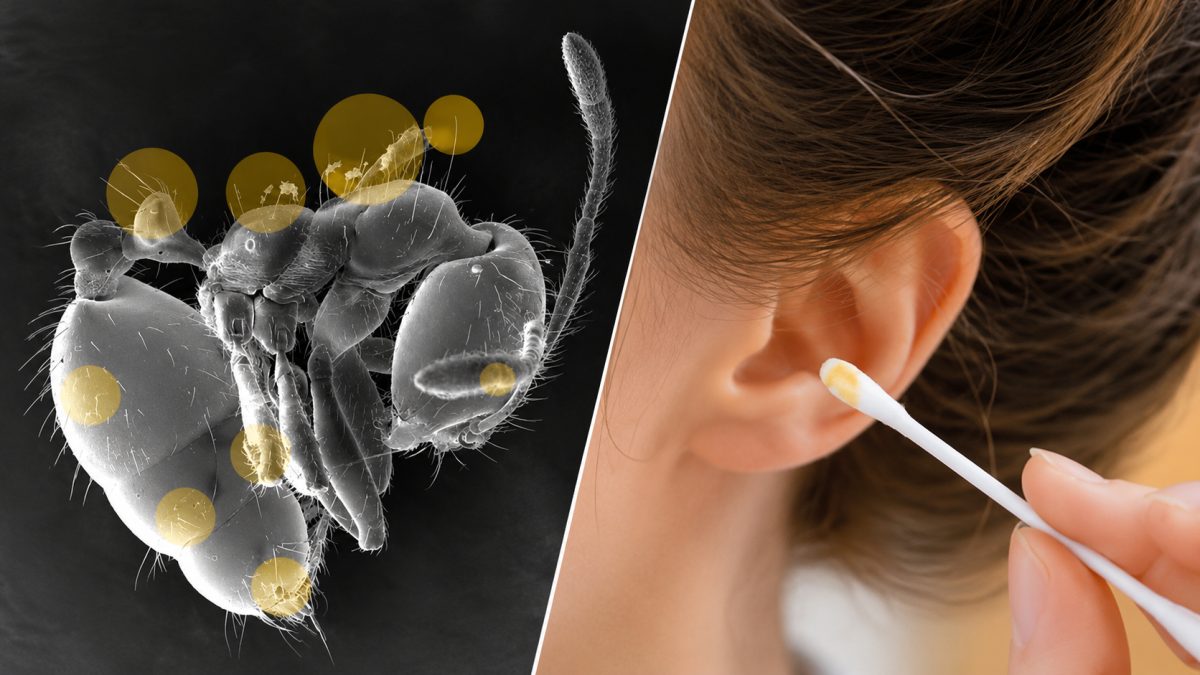
At the same time, earwax clings to the ants themselves. In one test, researchers built a tunnel shaped like an ear canal and coated it with earwax. Ants that crawled through picked up earwax on their legs and bodies, then stopped to groom themselves over and over. Some of the material stayed stuck in hard-to-reach spots even after several minutes of cleaning.
Why the Texture Changes Everything
Hu explained that earwax works best when it's thin. "Too much, and the ants can use their tiny claws to grab hold and climb in," he said. That detail matters because it flips the assumption that more earwax would mean more protection. A thick, lumpy buildup can actually give ants something to grip, almost like stepping stones.
The material also behaves in a way scientists call shear-thinning. That means it gets less resistant to flow when something pushes or rubs against it, similar to ketchup, paint or shampoo. This property likely explains why earwax can feel firm sitting still but turns slick the moment an ant's foot presses into it. The lipids in earwax add to the slipperiness, while the skin-cell framework gives it enough grip to stick to anything that touches it.
What This Means Beyond the Ear Canal
Earwax already plays a role in keeping ears clean. Under normal conditions, it dries out and turns crumbly after about 10 weeks. Cells lining the ear canal then push the old material outward, working almost like a slow conveyor belt. This new research adds another layer to that story by suggesting the same material may also block insects from crawling in.
The study does not claim earwax evolved specifically to fight off bugs. It only shows that its physical structure can repel insects under lab conditions, which leaves the evolutionary question open. The idea that earwax might guard against insects isn't entirely new either. A 2008 paper in Medical Hypotheses floated the possibility that cerumen could someday become a biodegradable insect repellent, though that paper never tested the mechanism or built a real product.
No Product Yet, But Ideas for the Future
Despite the exciting results, Hu was clear that nobody should expect an earwax-based bug spray anytime soon. He acknowledged there is currently no practical way to turn earwax into a commercial insect repellent. There is no approved household use, no regulatory review, and no company working on turning this biology into a store-bought product.
Instead, scientists see this as a lesson in biomimicry. If a natural material can be both sticky and slippery at once, engineers might be able to design synthetic surfaces that copy the same trick without using harsh chemicals. Fire ants gave researchers a useful way to study grip, movement and grooming behavior, but the team notes the results don't prove every insect would react the same way. For now, the takeaway is simple and a little funny: the goo you clean out of your ears might be doing more work than anyone realized, quietly standing guard against tiny invaders long before anyone thought to study it.