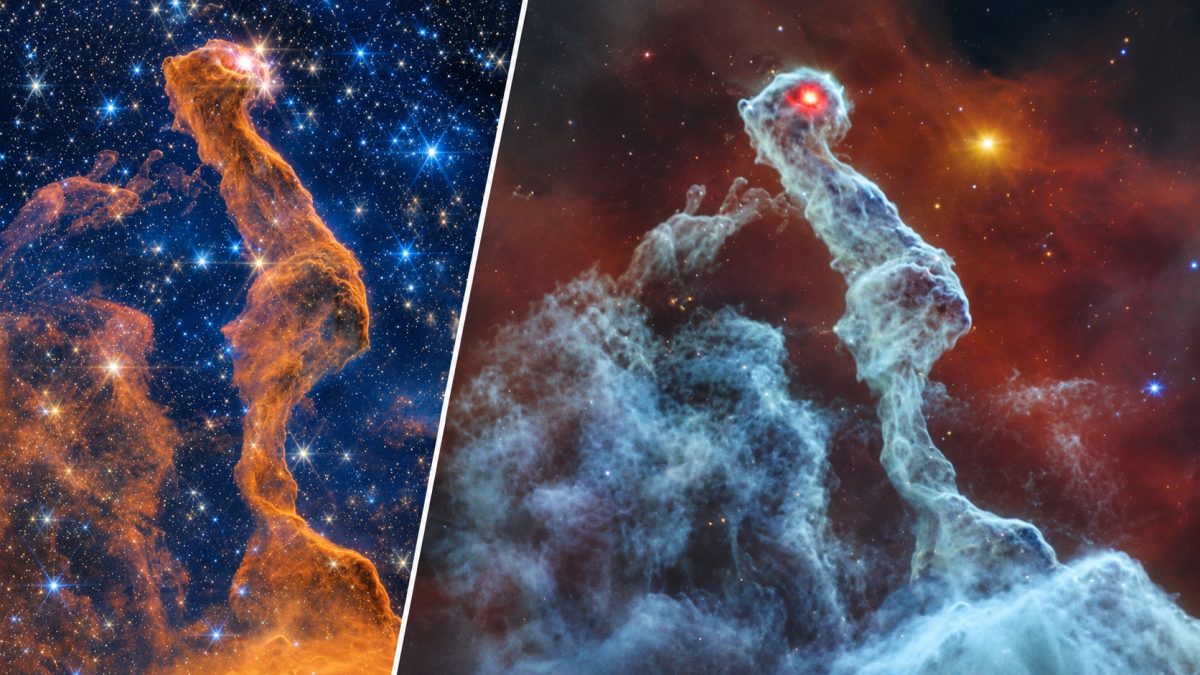

Two of the world's most powerful telescopes just stared at the same cosmic cat and saw two completely different creatures.
NASA and ESA released new Cat's Head Nebula Hubble Webb images in late October 2026, showing a small, dusty star-forming pillar inside the Carina Nebula, about 7,500 light-years from Earth, with a glowing red eye that has puzzled viewers since the pictures went public, according to reporting published by Live Science on November 1, 2026.
Lumina Early-Universe Simulation Reveals How First Galaxies Lit Up the Cosmos
Two Telescopes, One Strange Cosmic Face
The Cat's Head Nebula gets its nickname from its shape. It looks like a cat sitting with its back to us, tail stretching down, head turned so one glowing eye stares back at the camera. It is not a separate object floating in space. It is a narrow column of dust and gas tucked inside the much bigger Carina Nebula, a sprawling cloud where new stars are constantly being born.
Hubble's Wide Field Camera 3 captured the scene in visible light, the same kind of light our eyes can see. In that picture, the cat shape looks like a dark brown, almost solid wall of dust, with a bright red eye glowing on one side. Along one edge, you can see a bright strip where radiation from nearby stars is slowly eating away at the dust, called an ionization front.
What Ended the Cosmic Dark Age? New Study Upends Old Supernova Theory
Webb's Infrared Eyes See Right Through the Dust
James Webb Space Telescope's NIRCam instrument looked at the same patch of sky using near-infrared light, which can cut through dust that blocks visible light. Where Hubble showed a solid dark shape, Webb showed something busy and detailed, packed with stars, faint background galaxies, and layers of dust structure that were basically invisible before. The red eye is still there in Webb's picture too, but it looks different because infrared light picks up heat and radiation that visible light cannot.
Then Webb's other instrument, MIRI, which detects mid-infrared light, changed the picture again. Almost all the regular starlight vanishes in this view. Instead, warm dust glows brightly, and a strange orange speck appears off to the side of the cat's head. ESA has openly called this orange feature a genuine mystery, saying its connection to the rest of the nebula is not yet known.
What the Red Eye Might Actually Be
So what is causing that glowing red eye? NASA and ESA say it may be a young star still wrapped in a blanket of dust, the kind of object astronomers call an embedded protostar. Its reddish or yellowish glow fits with what scientists expect from a baby star that has not yet burned away the material around it.
But here is the honest part: nobody has officially confirmed this. NASA's own description says the eye "may indicate a young star that is still partially embedded in dust," which is careful science language for "this is our best guess, not a proven fact." The same caution applies to that orange MIRI speck. It is bright, it is strange, and right now, it is unexplained.
Why Hubble and Webb Keep Disagreeing on Purpose
This is not really a disagreement between Hubble and Webb. It is the whole point of using both telescopes together. Hubble is built mainly for visible light, so it is excellent at capturing dark silhouettes and glowing surfaces of dust clouds. Webb was designed for infrared astronomy, which lets it peek behind dusty curtains that would otherwise hide stars and structures completely.
Neither image is the "real" or "fake" version of the Cat's Head Nebula. They are two honest recordings of the same patch of space, just tuned to different wavelengths of light. Put together, as ESA did in its three-panel release combining Hubble's visible image with Webb's NIRCam and MIRI views, they give scientists a much fuller picture of how dust, gas, heat, and baby stars interact inside a stellar nursery like this one.
Not to Be Confused With a Different Cosmic Cat
It is worth clearing up one mix-up here. This nebula is sometimes confused with the separate Cat's Eye Nebula, officially named NGC 6543, which NASA and ESA also imaged using Hubble and the Euclid telescope earlier in 2026. That object is a planetary nebula, the leftover shell from a dying star. The Cat's Head Nebula covered here is the opposite story entirely, a place where stars are just starting their lives, not ending them.
For now, the glowing red eye stays an open case, most likely a young star hidden in dust, and the orange speck in Webb's mid-infrared image remains a true unsolved puzzle. Scientists will likely need more detailed studies, including breaking down the light into its individual wavelengths through spectroscopy, before anyone can say for certain exactly what is staring back at us from inside that cosmic cat.