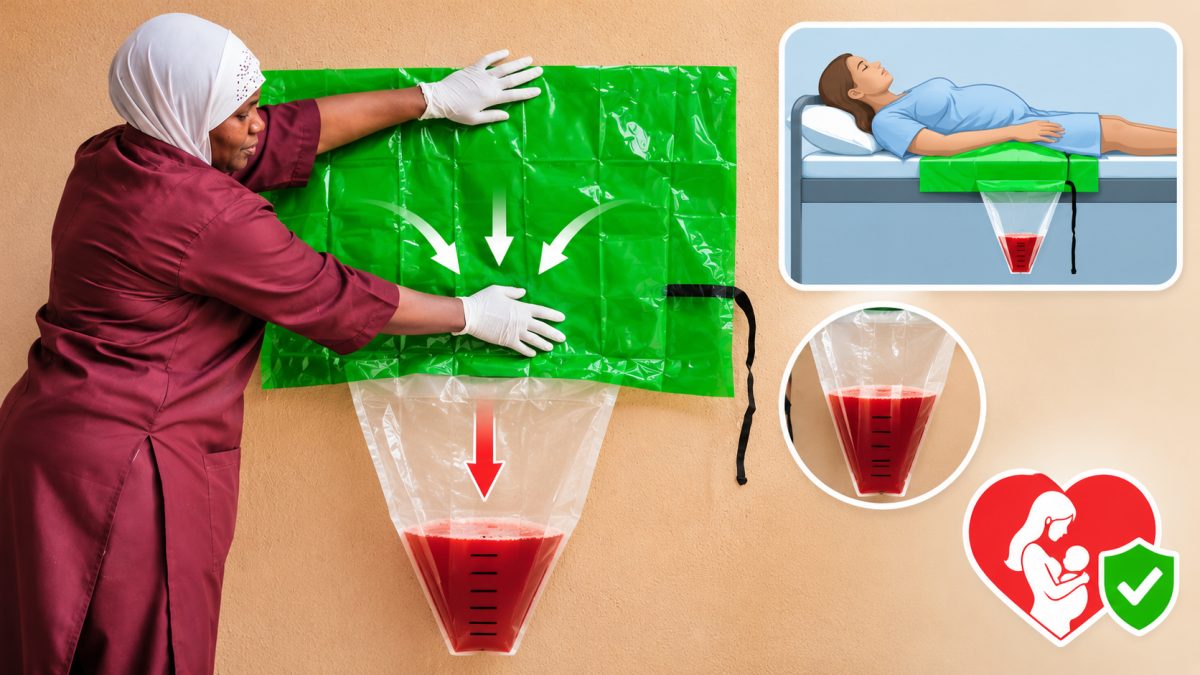

A thin green plastic sheet costing less than a dollar is quietly changing what happens in delivery rooms across Nigeria.
Husaina Balarabe, a 26-year-old optometrist, gave birth to her son Aabid at a hospital in Kano, northern Nigeria, when she suddenly began bleeding dangerously after delivery. She survived because a midwife had placed a maternal drape for postpartum hemorrhage beneath her before the baby arrived, according to a New York Times report published Nov. 3, 2026.
Flint's Rx Kids Cash Payments Cut Newborn Deaths Nearly in Half, Study Finds
How the maternal drape caught the danger in time
View this post on Instagram
The drape itself is simple. It is roughly the size of a cookie sheet, made of thin green plastic, with a pouch hanging off one end. That pouch collects blood as it leaves the body instead of letting it soak into sheets or the floor, where it becomes almost impossible to measure accurately. Printed markings on the pouch show exactly how much blood has collected, turning a guessing game into a clear number.
In Balarabe's case, the midwife watching her saw blood pass the 300-milliliter line on the pouch, roughly 10 ounces. That single visual cue was enough to set off an emergency response while Balarabe was still in the delivery ward, not after she had already become critically unstable. The Times reporting credits that early warning with giving the medical team time to act before things turned fatal.
Flint's Rx Kids Cash Payments Cut Newborn Deaths Nearly in Half, Study Finds
Why postpartum hemorrhage kills so many women
Postpartum hemorrhage is described in the report as the leading cause of maternal death around the world. The danger is not just the bleeding itself but how fast it can escalate and how hard it is to notice in time. Hospital staff have traditionally relied on eyeballing blood loss, a method that studies and experience have shown often badly underestimates the real amount, especially when blood mixes with other fluids or soaks into cloth and bedding.
That gap between what staff see and what is actually happening is exactly the problem the maternal drape for postpartum hemorrhage was built to close. It does not treat the bleeding. It does not replace medicine, IV fluids, or a blood transfusion. What it does is make the danger visible fast, so that trained staff can start treatment before a woman crashes. In hospitals with limited blood supplies, limited surgical backup, and limited monitoring equipment, that extra time can be the difference between life and death.
Toronto CEO Home Invasion: Masked Men Shoot Father and Daughters
A low-tech fix in one of the world's toughest health settings
Kano, where Balarabe delivered her son, is a major city in northern Nigeria, a region where access to emergency obstetric care can vary enormously between a well-staffed urban hospital and a rural clinic with few resources. The Times report notes that this same method, using a calibrated drape to flag dangerous blood loss, is already being used in maternity units across other poor parts of Africa, not just in Kano.
Part of what makes the story notable is how little the solution costs and how little it demands. There is no electricity needed, no machine to calibrate, no special training beyond knowing what the markings mean. The device is disposable, the sheet is plastic, and the whole thing reportedly costs around 80 cents. In global health, interventions that work without heavy infrastructure tend to spread faster, simply because they fit into wards that already have too little of everything else.
What this means for mothers and what comes next
For Balarabe, the outcome was straightforward: she survived, and photos accompanying the original report show her cradling Aabid in her hospital bed, unaware at the time of just how close the situation had come to turning dangerous. Her story is being used as a human face for a much larger statistic, the staggering number of women worldwide who still die from bleeding that could have been caught sooner.
The available reporting does not point to a specific national rollout date, a government procurement plan, or a formal endorsement from a global health body. What it does show is health workers already using the pouch on the ground, incorporating it into routine delivery care in places where every other resource is stretched thin. The likely path forward, based on what has been reported, is broader adoption in hospitals and clinics where visual guessing has long been the only tool available, with the drape acting as an early warning system rather than a cure.
The story, reported by Stephanie Nolen and Taiwo Aina for the New York Times, has drawn wide reader interest since its publication, appearing among the paper's most emailed and trending articles. That attention reflects how striking the core idea is: a problem responsible for so many maternal deaths worldwide is being pushed back, in part, by a piece of plastic that costs less than a dollar.