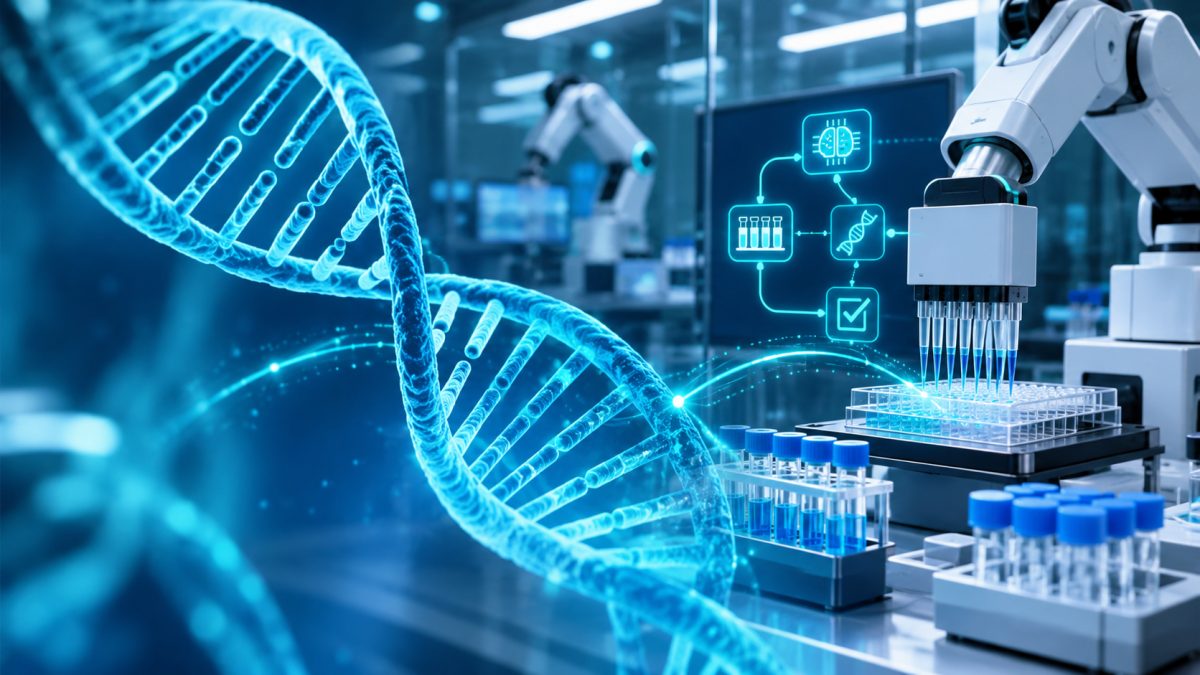

A new lab system lets AI plan and run entire DNA experiments from start to finish, barely needing a human hand.
Researchers published details of AutoDNA, an autonomous laboratory that plans, coordinates and executes multi-step DNA experiments, in the journal Nature on November 4, 2026. The system managed more than 20 instrument types across over 11,000 operational steps, with humans mainly handling reagent refills and equipment upkeep.
NASA Swift Telescope Reentry Set for Days After Rescue Mission Fails in Space
How The AutoDNA Autonomous Laboratory Works
The research team, led by Mingyu Wu along with co-authors Zhaoguo Wang, Jiabin Wang, Zhiyuan Dong, Jingkai Yang, Qingting Li, Tianyu Huang, Chi Zhang, Ping Song, Lei Zhao, Mingqiang Li and Xiaolei Zuo, built something different from typical lab robots. Most automated labs attach AI to a single task, like tweaking one reaction. AutoDNA instead acts as the brain for an entire workflow, deciding what to do, when to do it, and which machine should do it.
The paper calls AutoDNA an AI-native autonomous biomolecular engineering laboratory built for multi-objective experiments across diverse instruments. That means it doesn't just run one script over and over. It handles DNA synthesis, transcription, amplification and sequencing, switching between tasks and machines the way a skilled lab manager would direct a busy team.
4.1 Billion-Year-Old Martian Meteorite Found in Sahara Stuns Scientists
Four Tests That Proved The System Works
To show what AutoDNA could actually do, the team ran four real demonstrations. In one, the system matched the yields that expert scientists get when they hand-optimize enzymatic DNA synthesis. In another, it sped up multiple protocols running at the same time by 3.2 times compared to normal methods.
The lab also completed a full DNA data-storage cycle, writing digital information into DNA and then reading it back out perfectly, with no errors in the recovered data. Perhaps the most striking test involved genetics tied to real disease. AutoDNA identified and experimentally confirmed the KRAS G13D mutation, a genetic change that doctors already detect in cancer patients. That result links the autonomous laboratory autonomous system directly to work that matters in medicine, not just in a research setting.
Closing The Gap Between Ideas And Actual Lab Work
A companion piece in Nature's news section framed this moment simply: AI agents are entering the wet lab. For years, AI could design a promising molecule or protein in minutes, but actually testing that idea in a real lab still took weeks or months of manual work. That gap between a smart idea and a finished experiment has been one of science's most stubborn bottlenecks.
Autonomous experimentation already exists in chemistry and materials science, but those systems usually chase one goal through a fixed sequence of steps. Biology is messier. DNA work involves liquids, living materials, contamination risks, precise timing, and judgment calls at every stage. A machine that's good at optimizing one chemical reaction doesn't automatically know how to manage an entire DNA workflow from start to finish. The AutoDNA authors argue that older systems treated AI like an add-on bolted onto existing lab equipment. Their approach instead builds the AI, the experiments, and the physical instruments together, so all three evolve as one connected system.
What This Means For Labs And Researchers Going Forward
This doesn't mean scientists are becoming unnecessary. Human researchers still decide what questions to ask, still interpret the results, and still handle safety checks and basic maintenance like restocking reagents and consumables. What changes is where people spend their time. Instead of pipetting samples for hours, researchers can focus on designing smarter experiments and reviewing what the AI finds.
The multi-user design detailed in the paper suggests AutoDNA was built with shared research facilities in mind, not just a single private project. That could matter for university labs, diagnostic centers, or companies working on DNA data storage, where several teams might need access to the same automated infrastructure at once.
Open Questions That Still Need Answers
The Nature paper doesn't announce a product launch or a specific rollout plan. There's no mention of regulatory approval, commercial partners, or a timeline for wider use. What's confirmed is a working demonstration, not a finished commercial platform ready for every lab tomorrow.
Bigger questions remain about cost, reliability over long stretches of time, and how AutoDNA would handle unfamiliar experiments outside the four demonstrated cases. Biosafety oversight and quality control at scale will likely draw close attention from other scientists trying to replicate or build on this work. Still, the core achievement stands on its own. An AI system coordinated a sprawling, multi-instrument DNA laboratory and delivered results that matched or beat manual methods, marking a real step past AI simply suggesting what to try next.