
A team of astronomers built a digital copy of a space telescope to peel away starlight and spot planets that were hiding in plain sight.
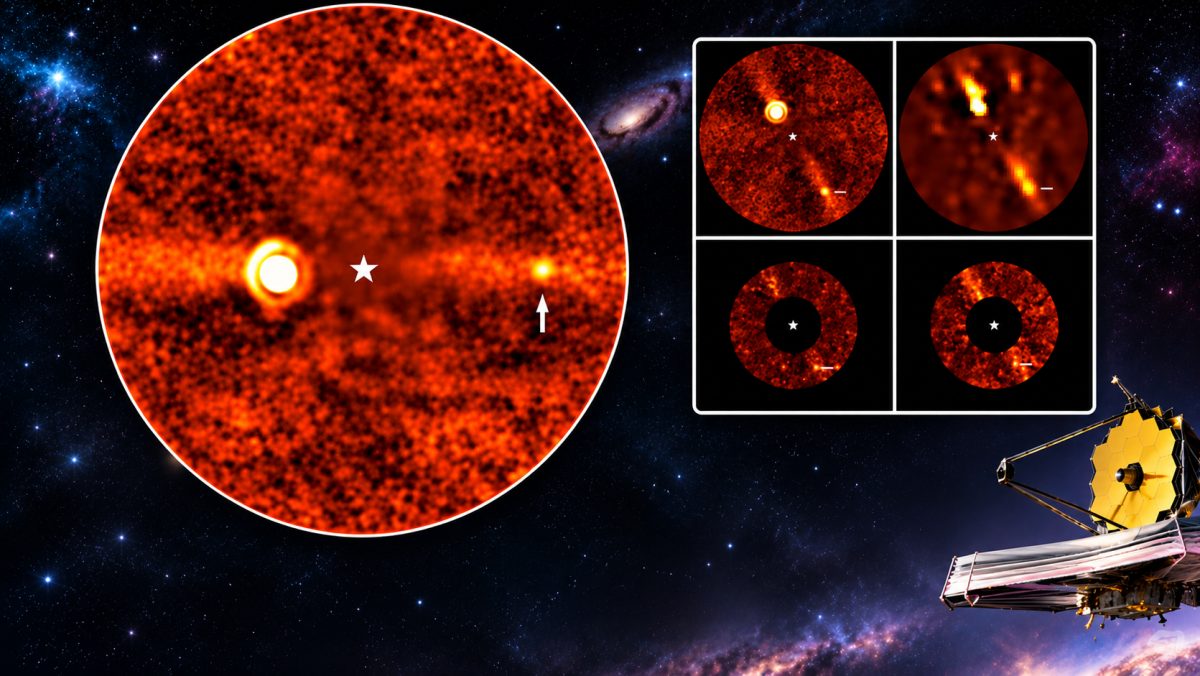
A research team led by Rodrigo Ferrer-Chavez has created a new computer method called FLIP exoplanet imaging that strips away far more starlight from James Webb Space Telescope pictures than older tools could manage. The study, published online in Nature on November 4, 2026, describes how the technique produced the first clear image of the giant planet 51 Eridani b at 4.3 micrometers, a wavelength where it had never been seen before.
NASA Swift Telescope Reentry Set for Days After Rescue Mission Fails in Space
How the FLIP exoplanet imaging method actually works
View this post on Instagram
Telescopes like JWST use coronagraphs to block most of a star's blinding light so faint planets nearby can show up. But coronagraphs are not perfect. Tiny shifts in the telescope's pointing, small changes in its mirrors, and quirks in its detectors all cause leftover glare that hides planets. Scientists call this the telescope stability limit, and it has been a wall that direct imaging kept running into.
FLIP, which stands for Physics-based Learning for Imaging Planets, gets around that wall in a clever way. Instead of just comparing a science image to a reference star image and subtracting the difference, FLIP builds a full working model of JWST's Near Infrared Camera. Researchers call it a digital twin because it mimics exactly how starlight bounces through the telescope's optics before it lands on the detector.
Arsia Mons Elongated Cloud on Mars May Form Without Any Dust at All
Putting the digital twin to the test on real JWST data
Once the model existed, the team trained it against real observations, letting it adjust for tiny optical aberrations and pointing changes until it could recreate the star's glare with high precision. Then they subtracted that simulated glare from the actual image, leaving behind whatever faint planetary light remained. Caltech explained the approach this way: "By combining a physical model of the instrument with optimization techniques from machine learning, we have been able to remove starlight much more precisely, making it easier to detect faint exoplanets and even reveal one that was previously hidden in the JWST data."
The results were striking. Across tests, FLIP delivered sensitivity two to 15 times better than standard glare-removal techniques. Ferrer-Chavez said the method "allows us to remove the glare much more precisely," and added that the tool has value beyond new observations. "We now have a tool that lets us discover and study planets that we were not able to 'see' before, even if that planet was already in an image in the JWST archive," he said.
Why the 51 Eridani b detection matters so much
The standout achievement from the study was spotting 51 Eridani b, a giant exoplanet, at 4.3 micrometers. Standard processing techniques applied to the same JWST data did not detect the planet at that wavelength at all. The authors wrote that FLIP achieved "sensitivity 2 to 15 times superior to standard techniques, including the first detection of 51 Eridani b at 4.3 μm."
This is not a new planet discovery in the sense of finding something nobody knew existed. 51 Eridani b was already known. What makes this different is that FLIP pulled out a signal that older software simply could not separate from the star's glare. That distinction matters because it shows the method can recover real information already sitting inside existing data, not just squeeze out marginally better pictures of things already visible.
What this means for the hunt for distant worlds
Nature's coverage framed FLIP as a way of overcoming the stability barrier that has limited direct exoplanet imaging for years, and suggested it could eventually help in the search for Earth-like planets around other stars. Nature Asia highlighted the same 15-fold sensitivity boost and the successful recovery of 51 Eridani b as the clearest proof the method works outside a lab setting.
It is worth being clear about what has and has not been shown. FLIP has not found an Earth-sized or habitable-zone planet. Its demonstrated success involves a giant planet that was already known to exist. Researchers describe the Earth-like planet goal as a future possibility tied to better telescopes and further refinement, not something this study has delivered yet.
Applying the tool to years of archived telescope images
Because FLIP is software rather than new hardware, scientists can apply it to observations JWST has already collected, not just future ones. That means the tool could be pointed at years of archived NIRCam images to search for planets that were missed the first time around, essentially letting researchers mine old data for new discoveries without needing any new telescope time.
The next real test will be validation. Any time a processing method boosts sensitivity this much, scientists need to rule out that what looks like a planet is actually a modeling error, a detector glitch, or some other artifact. Follow-up observations and independent checks will be needed before any new candidate found through FLIP gets confirmed as a genuine planet, but the method has already demonstrated it can recover real, previously hidden planetary light from JWST's own archive.