
Scientists finally caught octopuses on camera revealing the secret playbook behind their famous disappearing act.
Researchers have discovered exactly how octopuses squeeze through tiny openings, publishing their findings on November 5, 2026, in the Journal of Experimental Biology. The study, reported by Science News, found that common octopuses do not wiggle through holes randomly. Instead, they follow a consistent, step-by-step plan that shifts depending on how narrow the opening is.
What Ended the Cosmic Dark Age? New Study Upends Old Supernova Theory
Lab Experiments Reveal A Hidden Pattern
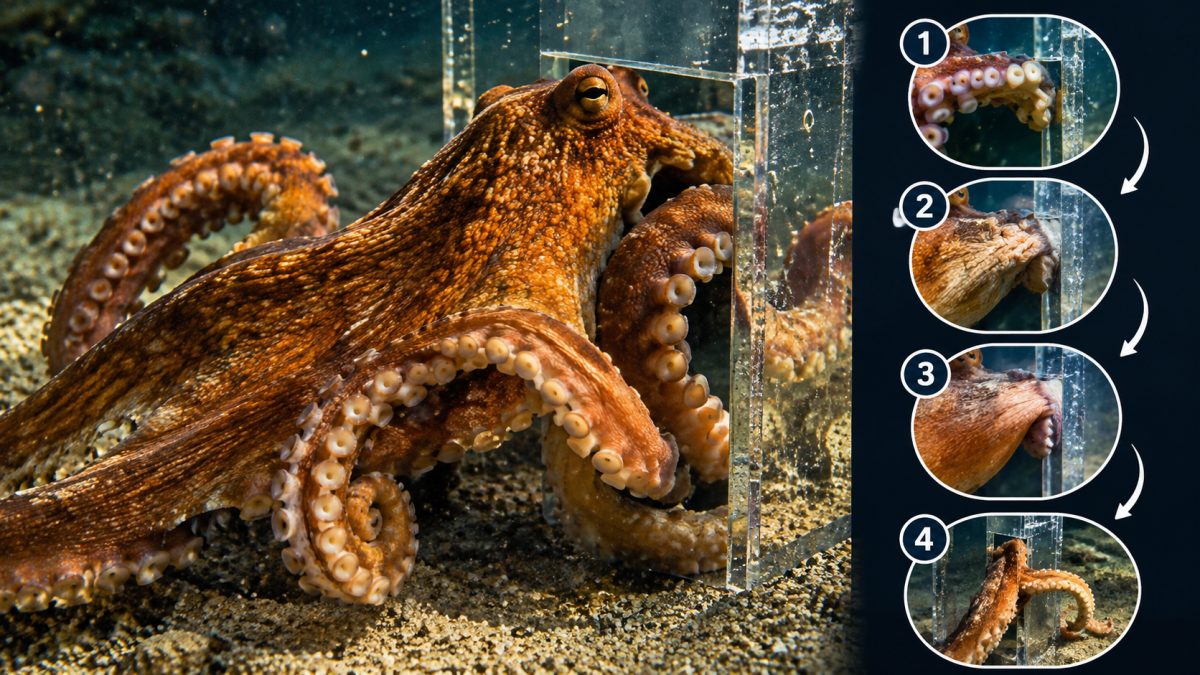
The research team placed common octopuses inside clear acrylic boxes with holes cut into them. Each hole was a different size, and cameras recorded every move as the animals tried to escape. What the scientists saw was not chaos. It was a routine, repeated again and again, almost like the octopuses had memorized the steps.
For holes wider than the distance between an octopus's eyes, the escape unfolded in three quick stages. First, the octopus pushed one or two arms through the gap. Then more arms followed through the same opening. Finally, the arms already outside pressed against the acrylic and pulled the head, mantle and remaining arms through in one motion. The whole process took just a few seconds, according to the study.
4.1 Billion-Year-Old Martian Meteorite Found in Sahara Stuns Scientists
Why Narrower Holes Need An Extra Step
When the hole was smaller than the distance between the eyes, the octopuses needed a fourth step. They pushed all eight arms through the opening first, before attempting anything else. Only after every arm had cleared the hole did they begin squeezing the head and the bulbous mantle, the soft part of the body holding most of the internal organs, through the narrow space.
This extra stage makes sense once you think about leverage. With a wider hole, the octopus can start pulling itself through before every arm is clear, because there is already enough room to maneuver. With a tighter squeeze, it needs every arm outside first, using them like anchors to drag the rest of the body through bit by bit.
The study suggests the octopus is not just reacting instinctively. It appears to size up the opening and choose a strategy that fits, almost like picking the right tool for the right job. Their lack of rigid bones makes this possible, since the arms and mantle can reshape themselves in ways a bony animal never could.
What The Researchers Are Saying
Wenci Xin, a robotics researcher at the National University of Singapore who worked on the study, said the discovery could shape future machines built for tight spaces. "This incredible capability could enable robots to overcome environmental limitations and enter spaces that are difficult to reach," Xin said, according to Science News.
Another researcher on the team, Crook, pointed out that holes are just one type of obstacle. Science News reported that Crook believes future work should test whether octopuses use different tricks for slits or tube-shaped openings, which are common in ocean crevices and man-made structures alike.
Octopuses have long had a reputation for slipping out of tanks, climbing out of boats, and vanishing through gaps that look far too small for their bodies. What had been missing until now was a clear picture of the actual mechanics behind those famous escapes. This study fills that gap by breaking the behavior down into a repeatable formula rather than a mysterious party trick.
Soft Robots Could Learn From The Octopus Playbook
The idea of robots squeezing through gaps is not new, but most current designs copy snakes, relying on one long, bendable body to slither through narrow paths. Octopus movement offers a different blueprint entirely. Instead of one flexible tube, you get eight independent arms that can each push, pull, anchor or probe at the same time.
That kind of multi-limb coordination could be useful in search and rescue work, pipe inspection, or exploring collapsed buildings where space is tight and unpredictable. Engineers would need to build machines that can change their overall shape, not just bend along a single line, which is a much harder design problem than it sounds.
No prototype robot has been announced yet, and the Science News report makes clear this research is still at the foundational stage. The next steps involve testing other hole shapes and figuring out how octopuses control individual arms during the escape. For now, the main achievement is scientific: researchers finally have a clear, repeatable map of how a boneless animal solves one of nature's trickiest physical puzzles.