
Scientists say the answer to one of geology's oldest puzzles was hiding deep below our feet the whole time.
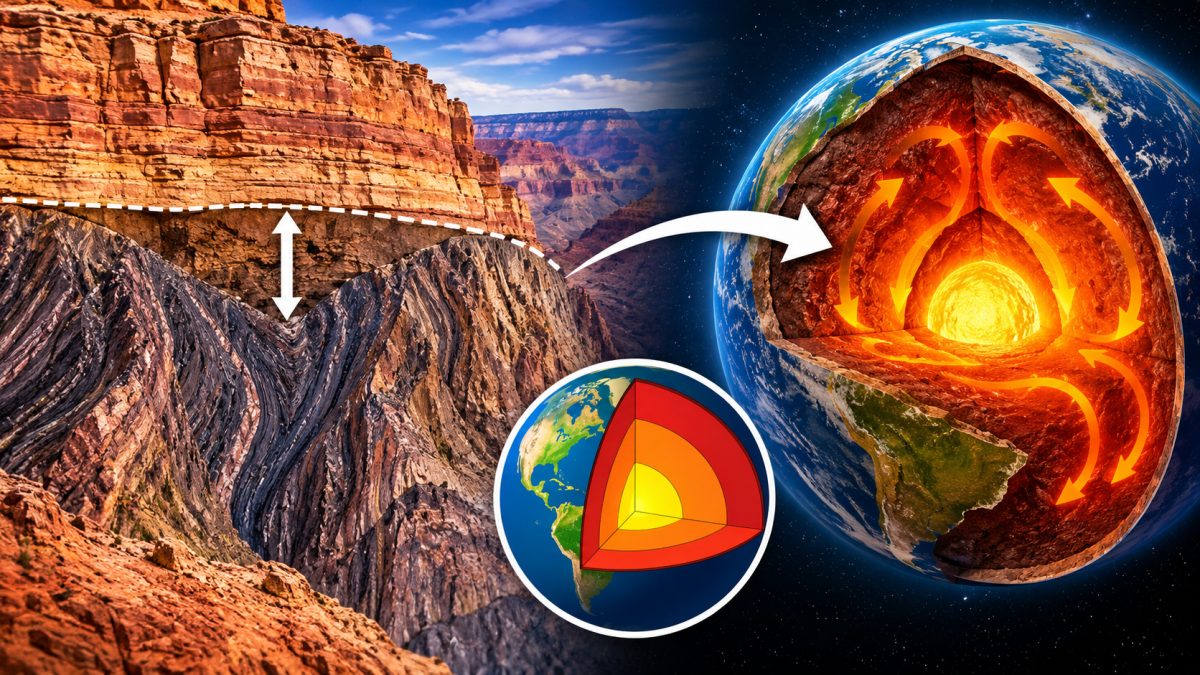
A study published in Nature on November 4, 2026, says slow-moving rock deep inside Earth helped create the Great Unconformity, a missing chunk of geologic history that can span more than a billion years. The research comes from Santosh Dhungana and Nicolas Flament, a geoscientist at the University of Wollongong in Australia, and points to mantle convection as the hidden force behind this famous gap.
How Octopuses Squeeze Through Tiny Openings Using a Clever Step-by-Step Trick
How Mantle Convection Explains The Great Unconformity
The Great Unconformity isn't one single place you can visit. It's a pattern found around the world where old, hardened basement rock sits directly beneath much younger sediment, with nothing in between to mark hundreds of millions of years. In North America, the sediment sitting right above this gap dates back to somewhere between 635 and 482 million years ago, according to Ars Technica's report on the study.
Nicolas Flament put it simply in comments to Ars Technica. "It's called the Great Unconformity, and it's a gap in the geologic record," he said. He added that the missing time "can be anywhere between 200 million years, which is not that impressive, to more than a billion years." That's the mystery the new paper tries to solve, and it does so by looking at something most people never think about: the mantle.
The mantle is a layer of hot, solid rock roughly 2,900 kilometers thick that sits between Earth's crust and its core. It doesn't sit still. It moves in slow currents over tens of millions of years, and those currents can nudge the surface of our planet up or down by hundreds of meters. Geologists call this effect dynamic topography, and the new study argues it's the missing piece behind the Great Unconformity.
2,800-Year-Old Siberian Tomb Cannabis Find May Reveal a Dark Ritual Secret
Rising Continents Then Sinking Seas
According to the Nature paper, the mechanism worked in two acts. First, during the Neoproterozoic Era, roughly 1 billion to 540 million years ago, mantle convection pushed entire continental regions upward over areas spanning about 5,000 kilometers. This happened gradually, over roughly 20 million years at a time, but it was enough to expose ancient basement rock to the elements.
That timing lines up with Snowball Earth, a period when massive ice sheets crept across the planet for tens of millions of years. With continents raised up and exposed, these glaciers could grind down and strip away enormous amounts of rock. The study's authors found their modeled uplift overlapped with this icy stretch of Earth's history, giving a clear reason why so much rock vanished from the record.
Then came the second act. Starting around 540 million years ago, at the dawn of the Phanerozoic Eon, those same continental blocks began sinking back down. As they dropped relative to sea level, shallow seas crept in and buried the scoured, eroded surface under fresh layers of sediment. That burial is exactly why the Great Unconformity still exists today, locked beneath younger rock layers across Laurentia, Baltica, and North China.
A Puzzle That Started In 1869
Geologists have argued about the Great Unconformity since the term was first coined in 1869. Earlier theories leaned on more familiar forces: mountains rising and falling, continents colliding, rifts tearing land apart, and changing sea levels. Those ideas aren't thrown out by the new research. Instead, the mantle convection model adds a much larger, slower-acting piece to the puzzle, one that works across entire continents rather than single mountain ranges.
The formal conclusion in the Nature paper states that "continental-scale uplift and subsidence associated with long-wavelength dynamic topography due to mantle convection drove the formation and preservation of the Great Unconformity." That's a fairly bold claim, since it reframes a problem that geologists have treated mostly as a surface-level mystery into something driven from deep inside the planet.
Earlier research, including a well-known 2012 study based on data from 830 locations across North America, had already linked the Great Unconformity's erosion to changes in ocean chemistry. That weathering may have altered the makeup of ancient seas in ways that helped trigger biomineralization, a key step before the Cambrian explosion, when complex animal life rapidly diversified.
Why This Rock Gap Still Matters Today
The significance here stretches well beyond rock layers. If mantle convection really did raise and lower whole continents, it means Earth's deep interior has been quietly shaping surface geology, climate conditions, and even the chemistry of ancient oceans for over a billion years. That's a much bigger connection than scientists previously drew between the planet's hidden depths and the history of life on its surface.
The available reporting doesn't point to any government panels, industry statements, or public hearings tied to this finding. It's purely a scientific model for now, though a significant one, since it offers a testable explanation for a gap that has puzzled researchers for more than 150 years.
What Comes Next For This Research
The next step for scientists will be testing this model against other Great Unconformity sites around the world. Researchers will likely compare the predicted pattern of uplift followed by subsidence against the actual ages, locations, and rock types found at unconformity surfaces outside Laurentia, Baltica, and North China.
There's no scheduled follow-up study or event tied to this announcement yet. But the open-access Nature paper gives other geologists a clear framework to test, meaning future research could either strengthen this mantle convection theory or reveal it needs more refinement as new continental data comes in.