
Two packed passenger trains collided south of Cairo, and investigators are still trying to figure out why one of them never stopped in time.
The Egypt train crash in November 2026 killed seven people and injured at least 125 on Sunday, November 8, when a train heading to Fayoum smashed into the back of another train bound for Aswan near Al-Ayyat, a town in Giza governorate just south of Cairo. The conductor was among the dead, officials confirmed.
Spain Train Crash Near Toledo Kills 68 , What Went Wrong on the Rails?
How the Egypt train crash in November 2026 unfolded near Cairo
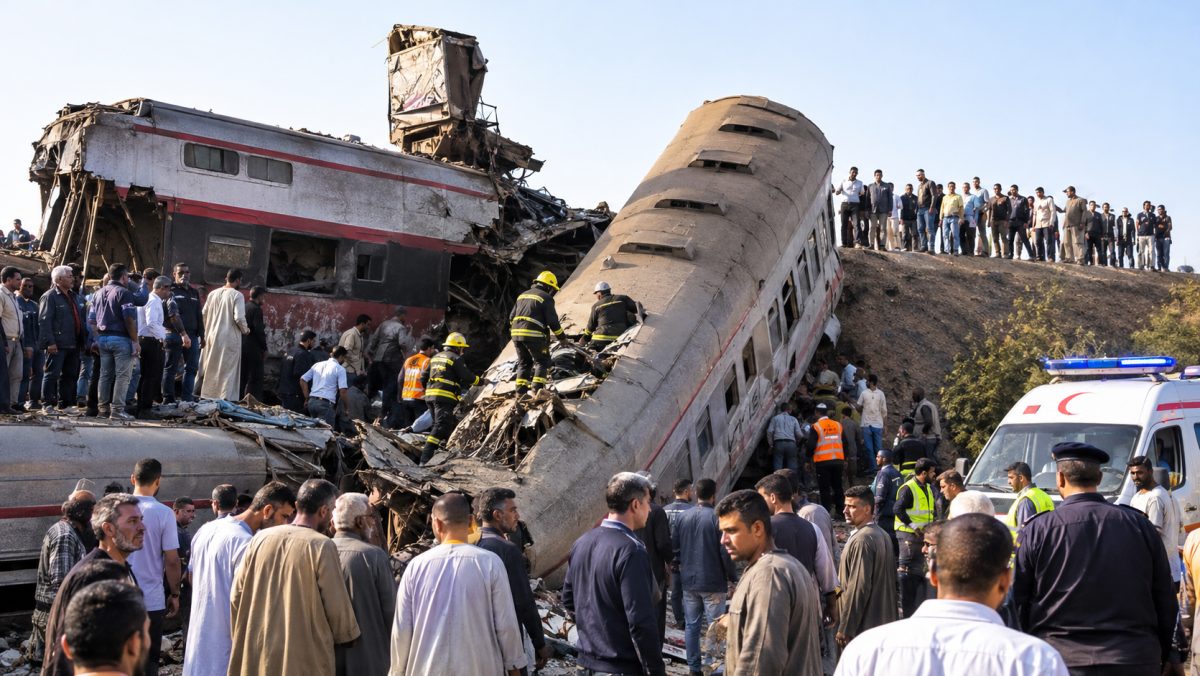
The crash happened between the Kafr Ammar and El Reqqa stations in Al-Ayyat district, roughly 52 kilometers, or about 32 miles, south of the Egyptian capital. Egypt's National Railways said train number 134, a Tahya Misr service traveling from Giza toward Fayoum, struck the rear of train number 2010, which was making its way from Cairo to Aswan. The impact was strong enough to knock several carriages off the tracks.
Photos from the scene showed rescue workers and ordinary people searching through mangled train cars for survivors. Emergency crews rushed to pull passengers from the wreckage while ambulances lined up nearby to carry the injured to hospitals in the area. The chaos stretched well into the day as officials worked to confirm exactly how many people had been hurt.
Egypt's Health Ministry said the death toll stood at seven, with at least 125 people injured. That number shifted slightly as rescue teams finished their work, since early reports from the morning of the crash had cited lower figures before hospitals and officials finalized their counts later in the day.
Air Traffic Controllers 2.8% Pay Raise Comes With a Catch After LaGuardia Crash
Official statements confirm scale of the Egypt train crash in November 2026
Egypt's railway authority said plainly that one train struck the rear of another, which is the clearest description officials have given so far about how the crash actually happened. The Transportation Ministry backed this up, confirming the two routes involved and stating that the Fayoum-bound train hit the back end of the Aswan-bound train.
The Chief Prosecutor's Office also weighed in, confirming the seven deaths and 125 injuries and noting that the train conductor was among those who died. The Health Ministry added a small piece of good news, saying more than 70 of the injured passengers had already been treated and released from area hospitals by the time of the early updates.
None of these statements, though, explain why the lead train was stopped or moving slowly in the first place, or why the second train failed to brake in time. No official has yet announced a confirmed technical or human cause, and investigators have not named any single factor like signal failure, braking problems, or crew error as the reason behind the crash.
A railway system under repeated strain
This is not the first time Egypt's rail network has made headlines for the wrong reasons. The country has suffered a string of deadly train accidents over the years, even as the government has poured billions of dollars into modernizing tracks, signals, and rolling stock. The Cairo to Aswan corridor, which runs through Upper Egypt, carries huge numbers of passengers every day, making any failure along that route especially dangerous.
Trains remain one of the main ways Egyptians travel between Cairo and southern cities like Fayoum and Aswan, since the network is cheaper and often more practical than flying or driving long distances. That heavy reliance means even a single rear-end collision can injure well over a hundred people at once, simply because the trains are so full.
Survivors described terrifying scenes in the moments after the crash, with metal twisted and crumpled where the two trains met. One passenger described the wreckage as completely mangled, according to local accounts gathered after the collision. Families of passengers rushed to hospitals and the crash site, searching for loved ones amid the confusion.
What investigators still need to determine
Egyptian authorities now face the task of explaining exactly why this crash happened. Investigators will need to look closely at signaling systems, braking equipment, train dispatch procedures, and crew communication to figure out where the breakdown occurred. So far, officials have only confirmed the mechanics of the crash, not the root cause behind it.
The prosecutor's office has indicated the incident is under official review, though no timetable for finishing that investigation has been announced. It remains unclear whether any individual will be named responsible or whether the findings will point instead to equipment or system failures across the aging rail network.
For now, the confirmed facts are limited but serious: seven people dead, including a train conductor, and at least 125 injured after one train rammed into the back of another on a busy stretch of track south of Cairo. Egyptian officials have promised updates as hospitals continue treating the injured and as the formal investigation moves forward in the weeks ahead.