
Tiny finger marks pressed into clay thousands of years ago are rewriting what we know about prehistoric family life.
A new study reported by Science News on November 11, 2026, finds that Stone Age children left fingerprints on clay art projects more than 11,000 years ago in what is now Israel. Researchers studying Natufian hunter-gatherer sites say the clay sculptures prove kids were not just watching adults work. They were helping shape the art with their own hands.
Human Sacrifice Violence Peru Study Reveals a Strange Ancient Peace
How Researchers Found Stone Age Children Fingerprints Clay Art
The discovery started as something else entirely. A researcher named Davin and a team of colleagues wanted to know if Natufian hunter-gatherers made clay art before farming spread through the region. They were not hunting for children's handiwork. They were just trying to understand early sculpture.
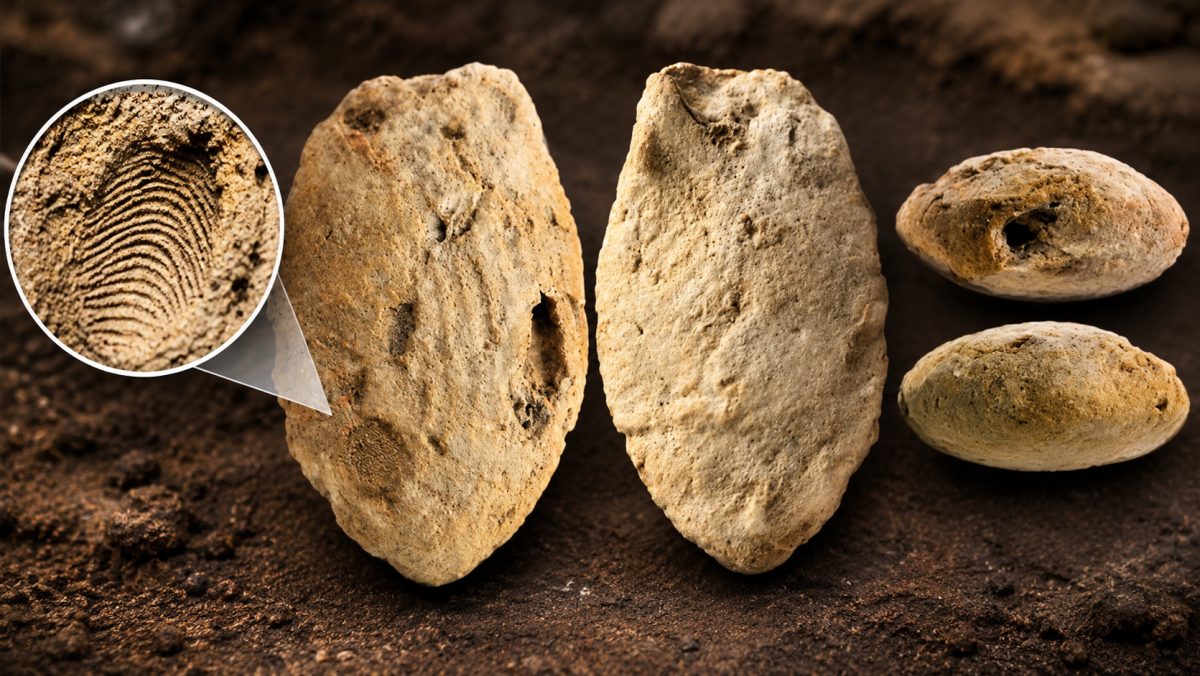
While sorting through 40 kilograms of clay dug up from three Natufian sites, the team found tens of thousands of clay lumps. Hidden among them were about 150 sculpture fragments. Fifteen pieces were clear enough to identify. Some looked like birds. Others looked like gazelles. A few looked like human figures. That is when things got interesting.
Disappearing Planet TOI-2535 b Vanished From Sight
Fingerprints Tell A Story Adults Never Wrote Down
About 60 of the clay fragments still held fingerprints from the moment someone pressed, pinched, or poked the wet clay thousands of years ago. Fingerprint ridges change based on a person's age and sex, so the team measured the spacing and width of each ridge pattern. That let them guess who made each piece.
Most of the prints belonged to women and children. Some of those children were younger than 10 years old. Only a handful of prints came from men. One fragment stood out from the rest. It showed a small human torso with fingerprints from both an adult and a child pressed into the same piece of clay.
Davin believes that single fragment tells a quiet story. "The adult actively taught a child how to work the clay," Davin said, describing the likely scene. It suggests a grown-up guiding a child's hands, showing them how to press and shape the material, much like a parent teaching a kid to draw today.
Why These Clay Sculptures Still Puzzle Scientists
Nobody knows exactly what these figures were for. Most of them are smaller than 2 centimeters, barely bigger than a fingernail. They show no signs of heavy use or long-term handling, which rules out the idea that they were everyday tools or trade goods.
Davin compared the figures to something more familiar. Kids today often draw characters from stories they know well. Maybe Natufian children did something similar with clay, shaping animals or people tied to tales told around the fire. That is a theory, not a proven fact. The study does not claim these were toys, religious objects, or teaching tools. It only shows that children had a hand in making them.
This mystery fits into a bigger pattern Natufian communities left behind. These hunter-gatherers lived across the Levant roughly 14,000 years ago and built some of the earliest lasting settlements in the region, long before farming took hold. Finding children's fingerprints in their clay art pushes back the timeline for when kids were already taking part in creative work passed down from their parents.
Earlier Clues Already Hinted Kids Were Involved In Ancient Art
This is not the first time scientists have found signs that children experimented with ancient crafts. At France's Rouffignac Cave, researchers compared old finger marks dragged through soft clay walls with fresh impressions made by 124 schoolchildren and 11 teachers. They concluded that children as young as 2 to 5 years old may have made many of the marks found deep inside the cave.
Another case comes from Israel's Tel Nagila site, where archaeologists found 48 miniature clay vessels dating back roughly 3,650 to 4,000 years. Ten of those tiny pots held fingerprints the size of a child's hand, pressed in before the clay hardened. Researchers think kids were copying adult pottery work, practicing skills they would need later in life.
What Comes Next For This Ancient Discovery
Scientists plan to keep studying the clay fragments using closer fingerprint comparisons and marks left by tools. That work could reveal whether single figures were made by one person or passed between several hands during a teaching session.
The real purpose behind these tiny clay figures may stay a mystery for a while longer. Future digs at other Natufian sites could show whether this kind of family crafting was common across the region or limited to just a few communities. For now, the fingerprints offer rare, quiet proof that children were present, active, and learning alongside adults thousands of years before anyone wrote a single word down.