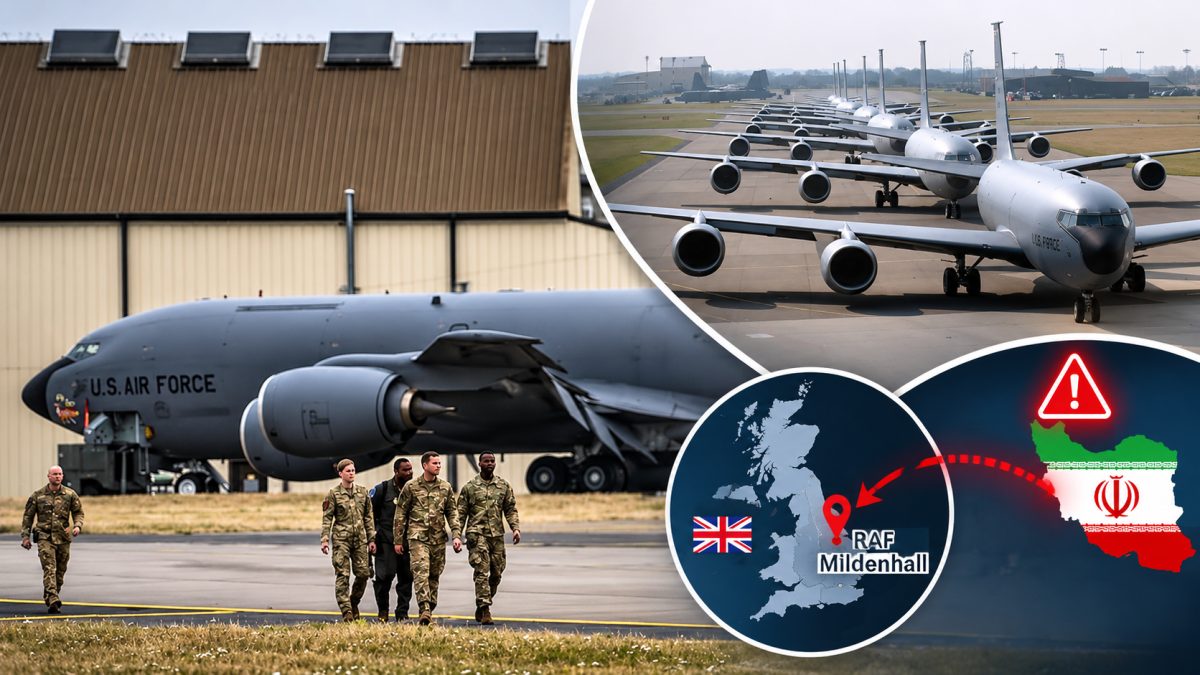

Dozens of refueling planes vanished from a quiet English airbase overnight, and nobody is fully explaining why yet.
U.S. aircraft evacuated RAF Mildenhall in eastern England on Monday, Nov. 9, 2026, after American officials flagged a threat linked to Iran, according to The Wall Street Journal and confirmed by Reuters, the Associated Press and The Washington Post. At least 10 KC-135R Stratotanker jets and three CV-22B Osprey aircraft left the base and scattered to locations in Germany, Spain and Scotland.
Iran U.S. Ceasefire Talks Continue as Washington Demands New Terms
Why US Aircraft Evacuated RAF Mildenhall So Suddenly
View this post on Instagram
RAF Mildenhall sits in Suffolk and works as one of the busiest hubs for the U.S. Air Force in Europe. On Monday, flight-tracking data reviewed by Reuters showed at least 10 KC-135R tankers taking off and heading in different directions. One went to Germany. Another landed in Scotland. Two more touched down in Spain. The remaining six destinations were never made public.
The Washington Post counted the same 10 tankers plus three Osprey aircraft, bringing the total to 13 planes tracked through open-source flight data. The Ospreys, which belong to U.S. Special Operations Forces, did not travel far. They landed at RAF Lakenheath, a base just four miles from Mildenhall. The Associated Press separately confirmed the 13-aircraft count through its own reporting.
Iran Attacks Sink Two Ships Near Strait of Hormuz in Just 24 Hours
Second Evacuation Linked to Iran Threat in Three Months
This is not the first time this year that American aircraft have quietly left a British base. In early October 2026, U.S. bombers abruptly departed RAF Fairford in Gloucestershire and flew back to bases in the United States. At the time, reports said Iran had played a role in a suspected plot involving explosives or drones aimed at American aircraft or pilots.
The Mildenhall move follows a similar pattern. Planes left before British officials confirmed any specific plot to the public. The big difference this time is the type of aircraft involved. Fairford's withdrawal centered on bombers. Mildenhall's evacuation focused on tankers and Ospreys, aircraft that refuel and transport forces rather than strike targets directly.
What US Officials and British Authorities Are Saying
An unnamed U.S. official told the Associated Press that the relocation came in response to a threat but called it a precaution. The official said some planes based at Mildenhall are permanent fixtures while others were only there on rotation, and that aircraft could return once the situation clears.
The Wall Street Journal reported the evacuation happened "in the wake of a threat from Iran," but added that officials still had not settled whether the warning pointed to something imminent or a broader, more general risk. British officials told Reuters that UK military bases remained safe. Separately, British sources told The Washington Post that security services are tracking a steady stream of threats connected to Iran, though no single new plot had surfaced that clearly explained why Mildenhall emptied out so fast.
According to the Military Air Tracking Alliance, a group of roughly 30 open-source flight analysts cited by the Associated Press, Mildenhall's force-protection status was raised to Force Protection Condition Charlie, the second-highest alert level used by the U.S. military. Reports did not clarify exactly when that status took effect or how long it stayed in place.
Why This Matters for US Operations in Europe
Mildenhall's tankers matter because they let American fighter jets and bombers fly farther and stay airborne longer. Refueling aircraft are not glamorous, but they are essential. Keeping a large group of them parked at one well-known base makes them an easy target if someone wants to strike U.S. military assets without touching American soil directly.
Spreading the tankers across Germany, Spain and Scotland, instead of flying them all to one safe harbor, suggests the U.S. wanted to avoid creating a new single target somewhere else. Keeping the Ospreys close by at Lakenheath, rather than sending them out of the country entirely, hints that officials may not have viewed the threat as requiring a full withdrawal from the UK, unlike the bomber pullout from Fairford weeks earlier.
What Happens Next for Mildenhall and US-UK Security Ties
Nobody has said when the tankers and Ospreys will fly back to Mildenhall. The U.S. official who spoke to the Associated Press left that door open, noting several aircraft were only rotational and could simply resume their normal schedule once officials feel confident the threat has passed.
Bigger questions remain unanswered. Did intelligence agencies find a specific, detailed plot, or was this a broader precaution based on general chatter? How long will Force Protection Condition Charlie stay active at Mildenhall? And after two apparent evacuations in three months, will the U.S. military rethink how it protects aircraft stationed in Britain long term? For now, British officials insist their bases are safe, even as American planes sit scattered across three different countries, waiting for the all-clear.