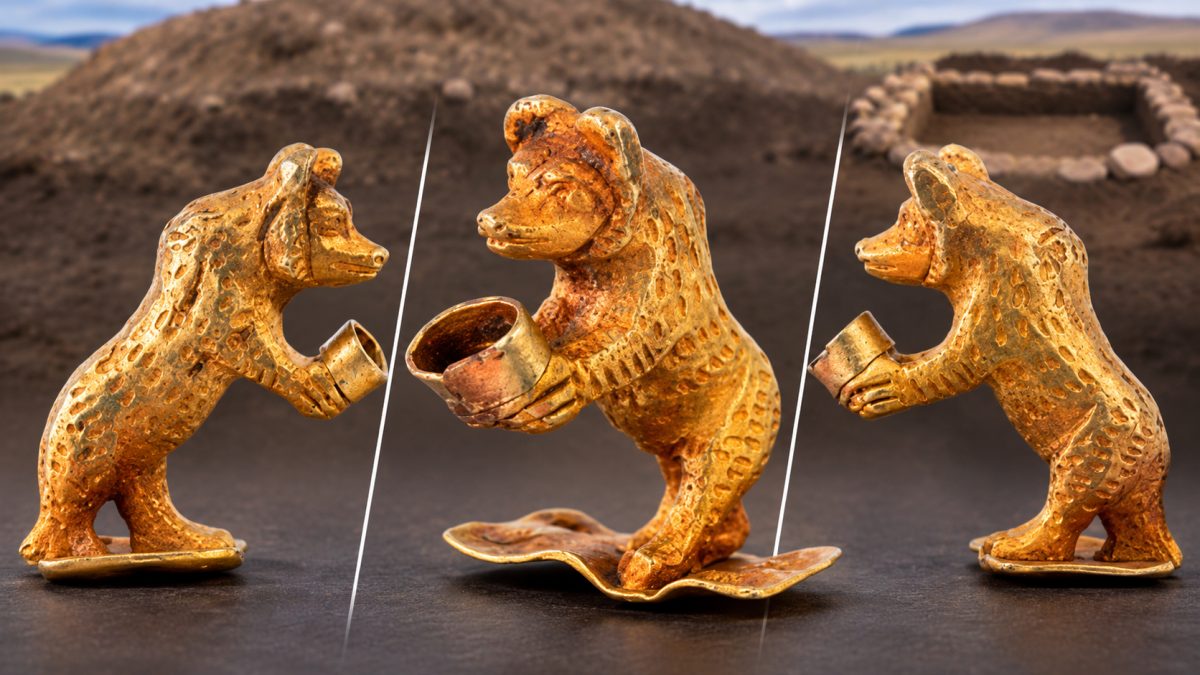

A tiny gold bear survived ancient looters and thousands of years underground, and now it's raising big questions about who was buried with it.
Archaeologists excavating the Karagaily burial ground near Almaty, Kazakhstan, have uncovered a 2,200-year-old gold bear figurine inside a massive Early Iron Age burial mound, alongside bones that may belong to as many as seven people, according to reports from Almaty authorities released November 5 and 6, 2026, and picked up internationally by Live Science on November 11.
2,800-Year-Old Siberian Tomb Cannabis Find May Reveal a Dark Ritual Secret
Gold Bear Found Despite Ancient Looting
The mound sits in Almaty's Nauryzbay District and belongs to the Saka cultural horizon, a group of nomadic peoples who roamed Central Asia during the first millennium B.C. Preliminary dating places the burial in the fourth to third centuries B.C., which lines up with the 2,200-year age attached to the gold bear figurine.
This wasn't a small grave. Reports put the mound at roughly 25 to 26 meters across and about 2.4 to 2.5 meters tall, which works out to around 85 feet wide and 8 feet high. That's a serious piece of construction for a burial site, and it hints at the importance of whoever was laid to rest there. The mound had already been looted long ago, scrambling the original layout of bones and grave goods. Yet somehow, the gold bear stayed hidden the whole time.
Great Unconformity Mantle Convection Theory Finally Explains Earth's Missing Rock
Why the Bear May Have Been Part of a Headdress
Small holes punched into the gold bear suggest it wasn't meant to stand alone. Researchers think it was likely sewn onto fabric, possibly as part of a ceremonial headdress or some other piece of elite clothing worn by a person of high status. That would fit with what's known about Saka culture, where gold ornaments and animal-style art often marked out important figures within the community.
Local coverage has called the gold bear a rare, possibly unique find for Kazakhstan, though the exact meaning behind it is still being studied. Nobody has confirmed yet exactly whose headdress this was, or what role that person played within their group. For now, the bear is a strong clue rather than a finished answer.
A Mound That May Hold Seven People
The human remains found at the site are just as striking as the gold bear itself. Preliminary assessments suggest the mound may have held four adults and three children, adding up to seven people total. That's an unusually large number for a single burial mound, and it's part of why the discovery has drawn so much attention from archaeologists and the public alike.
That seven-person figure isn't locked in yet. Anthropologists still need to study the fragmented and scattered bones to figure out exactly how many individuals are represented. Because looters disturbed the mound in antiquity, bones and objects got moved around from where they originally sat. That makes it harder to know whether everyone was buried at the same time, whether the mound was reused later on, or whether this reflects some more complicated burial process that played out over time.
What the Looting Tells Us About the Site
The fact that thieves broke into this mound long ago and still missed the gold bear says something interesting on its own. The figurine may have survived because it got buried under collapsed material, or because it simply sat outside the area the looters searched most carefully. Either way, the mound now offers two different stories at once: one about the Saka people who built it, and another about the people who robbed it centuries or even millennia later.
The excavation was carried out as an emergency archaeological project, backed by Almaty's city administration with involvement from the Almaty Museums Association. No single lead archaeologist has been named in current reporting, and a final excavation report hasn't been published yet. That means many details are still preliminary, including the headdress theory and the seven-person estimate.
What Comes Next for the Karagaily Discovery
The next real step is deeper anthropological work on the bones themselves. Specialists plan to figure out the minimum number of people buried in the mound, along with details like age and sex where the remains allow it. That kind of analysis takes time, and no public deadline has been set for when it will wrap up.
Researchers also want to learn more about how the gold bear was made, how it was attached to clothing, and how it fits into the broader picture of Saka art and burial customs. There's no announced date yet for a final report, a museum display, or lab results confirming the exact number of people buried at Karagaily. Until then, the gold bear remains one of the more intriguing archaeological finds to come out of Kazakhstan in recent memory, with plenty of its story still buried in the details.