
A nearly 49-year-old spacecraft is about to cross a distance so vast that even its own radio signals need a full day just to get there.
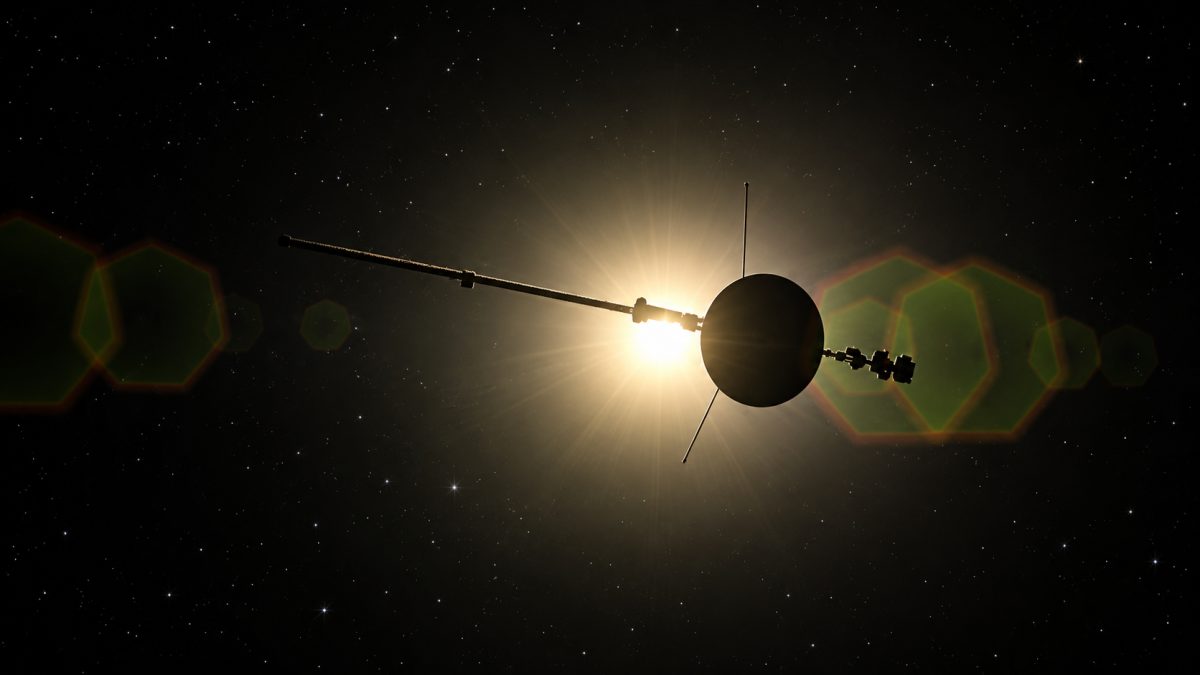
NASA's Voyager 1 spacecraft will become the first human-made object to reach one light-day from Earth on Nov. 18, 2026, at 5:16:07 a.m. Eastern Time, or 2:16:07 a.m. Pacific Time, when it sits roughly 16.094 billion miles (25.902 billion kilometers) away from home.
Gravitational Reconnection: How Gravity May Snap and Reconnect Like the Sun
Voyager 1 One Light-Day Milestone Explained
A light-day is simply how far light travels in 24 hours. For Voyager 1, that works out to about 16.1 billion miles, or 25.9 billion kilometers. Once the spacecraft crosses that line, a radio command sent from Earth will take a full day to reach it, and any reply will take another full day to come back. That means scientists on the ground have to wait two full days just to confirm a single instruction worked.
NASA has been careful to point out what this milestone is not. It is not a new edge of the solar system, and it does not mean Voyager 1 has somehow traveled at the speed of light. The spacecraft moves at about 38,000 mph, which is fast by human standards but nowhere close to light speed. It has simply been flying outward for so long, nearly 49 years, two months, and 11 days by the time it reaches this point, that the accumulated distance now matches what light covers in a single day.
Stone Age Children Fingerprints Clay Art Reveal Secret Lessons From Parents
Decades of Flight Led to This Point
Voyager 1 launched on Sept. 5, 1977, from Launch Complex 41 at Cape Canaveral Air Force Station in Florida, riding a Titan IIIE-Centaur rocket into space. Just two weeks later, from about 7.25 million miles away, it turned its camera back toward home and captured the first-ever single image showing both Earth and the moon together.
The spacecraft's early mission focused on the outer planets. It crossed the asteroid belt between December 1977 and September 1978, then made its closest approach to Jupiter on March 5, 1979, passing within about 216,837 miles of the planet's center. It later swung by Saturn in November 1980, studying the moon Titan along the way. Those flybys helped scientists spot active volcanoes and new moons, reshaping what researchers understood about the outer solar system.
From Planetary Explorer to Interstellar Traveler
Once its planetary work wrapped up, NASA opened a new chapter for the mission. The Voyager Interstellar Mission officially began on Jan. 1, 1990. Voyager 1 later passed Pioneer 10 to become the most distant human-made object on Feb. 17, 1998, a title it has held ever since.
The biggest leap came on Aug. 25, 2012, when Voyager 1 crossed the heliopause, the outer edge of the sun's protective bubble of charged particles, and entered true interstellar space. NASA confirmed this using plasma-density readings from the spacecraft, officially announcing the achievement the following year. That made Voyager 1 the first human-made object to ever leave the heliosphere and travel among the stars, a distinction separate from, but closely tied to, the light-day milestone now approaching.
Engineers Fight to Keep an Aging Spacecraft Alive
Kelly Perry, a Voyager program data-systems engineer at NASA's Jet Propulsion Laboratory, told Live Science that the team's goal is simple: keep the spacecraft going as long as possible. That task gets harder every year. Voyager 1 originally carried 11 scientific instruments, and NASA has confirmed that only four were still returning usable data after more than four decades of flight. The craft's power source keeps fading, forcing engineers to shut down systems one by one just to stretch its working life further.
There's no fixed date for when Voyager 1 will finally go silent. Instead, mission engineers are making constant trade-offs, balancing power for communications, temperature control, onboard computers, and whatever instruments still function. NASA has not set an endpoint; the plan is simply to keep listening for as long as the spacecraft can keep talking back.
A Worldwide Wave to Mark the Moment
To celebrate the achievement, NASA is inviting people around the world to take part in something it calls a symbolic wave of golden light. On the evening of Nov. 17, the night before Voyager 1 crosses the one-light-day mark, people are encouraged to light up phones, flashlights, and buildings after sunset, creating a global ripple of light to honor the spacecraft's journey.
It's a fitting tribute for a mission that has quietly outlived its original purpose by more than three decades. Voyager 1 was built to study planets, not to become humanity's farthest-reaching ambassador into interstellar space. Yet here it is, still transmitting, still drifting outward, and about to mark a distance no human-made object has ever reached before. What happens after Nov. 18 is simple: Voyager 1 keeps going, sending back whatever data its aging systems allow, for however long NASA's engineers can keep the lights on.