
A strange gap in Earth's rock layers has puzzled geologists for over a century, and now scientists think they finally know what caused it.
The Great Unconformity explained at last: new research published in the journal Nature in November 2026 argues that deep currents inside Earth's mantle slowly lifted huge chunks of ancient continents, exposing old rock to erosion for hundreds of millions of years before the land sank back down and got buried again. The study was led by University of Wollongong PhD candidate Santosh Dhungana.
Gravitational Reconnection: How Gravity May Snap and Reconnect Like the Sun
Great Unconformity Explained Through New Mantle Models
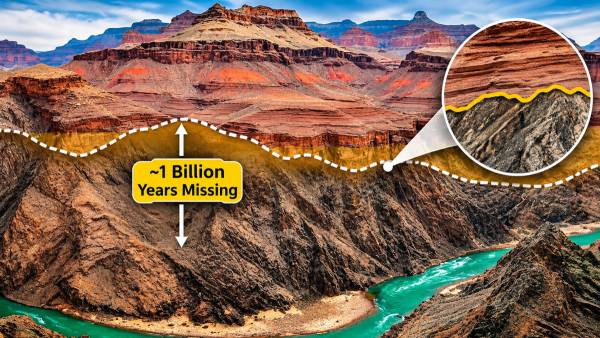
For decades, geologists have stared at a strange line in the rocks found around the world. Below the line sits ancient crystalline rock, sometimes more than a billion years old. Above it, much younger sedimentary rock begins, often around 540 million years old. Nothing in between survived. This gap is called the Great Unconformity, and it shows up at famous spots like the Grand Canyon, where you can literally see one era of rock sitting directly on top of a much older one with nothing connecting them.
Dhungana and his co-author, Associate Professor Nicolas Flament, built computer simulations that tracked how ancient continents moved up and down over deep time. They found that three major regions, Laurentia, which includes much of modern North America, Baltica, tied to northern Europe, and North China, all rose upward during the Neoproterozoic Era, a stretch of time running from roughly one billion to 540 million years ago. That uplift, they say, left enormous areas of land sitting high and exposed, ready to be worn away.
Rapidly Rising Antarctic Bedrock Stuns Scientists, Who Finally Found the Reason Why
How Rising and Sinking Continents Created the Missing Billion Years
According to the University of Wollongong's own published material, the cause was “the gentle rise and fall of whole continents over hundreds of millions of years,” driven by hot currents churning below Earth's crust. Once those blocks of land were pushed upward, rivers, wind, and possibly massive ice sheets ground away at the surface for an incredibly long stretch of time, stripping off rock that had taken ages to form.
Then, during the following roughly 540 million years, known as the Phanerozoic Eon, those same regions slowly sank again. As they dropped, rising seas spilled across the worn-down surfaces and buried them under fresh layers of sediment. That process sealed the sharp, strange boundary we see today, old basement rock directly beneath much younger stone, with nothing in between to tell the story of what happened during all those missing years.
Snowball Earth and Ice Sheets May Have Sped Up the Erosion
The mantle convection idea doesn't stand alone. It connects closely with another major theory involving Snowball Earth, a period when much of the planet may have frozen over, with major glaciations happening roughly 635 to 720 million years ago. Smithsonian Magazine described a scenario where mantle movement first pushed the land up, and then giant ice sheets ground down the exposed rock like a slow, patient bulldozer.
Moving glaciers can scrape away far more material than ordinary rivers and wind, especially across land that's already sitting high above sea level. So instead of competing explanations, the new mantle research may actually explain why the ice had so much elevated land to work on in the first place. This timing also overlaps with the breakup of Rodinia, an ancient supercontinent that split apart during roughly the same stretch of Earth's history, adding another layer to an already complicated puzzle.
Why the Grand Canyon Still Tells the Clearest Story
The Grand Canyon remains the easiest place to picture all this. Its walls show Cambrian rock, around 540 million years old, resting right on top of basement rock that's more than a billion years older. Reports covering the new study stress that the missing time doesn't mean those years never happened on Earth. It just means the rock record from that period was eroded away, carried off by water, wind, or ice, and never preserved in that location.
ScienceDaily summarized the new model by noting that powerful currents deep inside the planet slowly raised and then lowered entire continents, giving erosion enough time to erase huge volumes of rock before later seas buried what remained. That distinction matters for anyone trying to understand the discovery. Earth didn't lose a billion years of history. It lost the physical evidence of that history in specific places, while the rest of the planet kept moving right along.
What Comes Next for Geologists Studying This Ancient Puzzle
Researchers now face the task of testing this mantle-driven model against real evidence found in the field, including mineral ages, sediment samples, and traces left behind by ancient glaciers. The study's authors have framed their work as a proposed explanation rather than a final answer, and coverage of the research consistently describes it as a testable idea rather than settled fact.
The most likely path forward blends several forces together. Mantle convection may have lifted the continents, the breakup of Rodinia may have reshaped their borders, and Neoproterozoic glaciers may have scraped away rock that was already sitting exposed. Scientists will keep comparing this model against new regions and new data, hoping to figure out whether this combination finally explains one of geology's oldest and strangest mysteries.