
Worms, compost and a little patience may be the secret to feeding astronauts on the Moon someday.
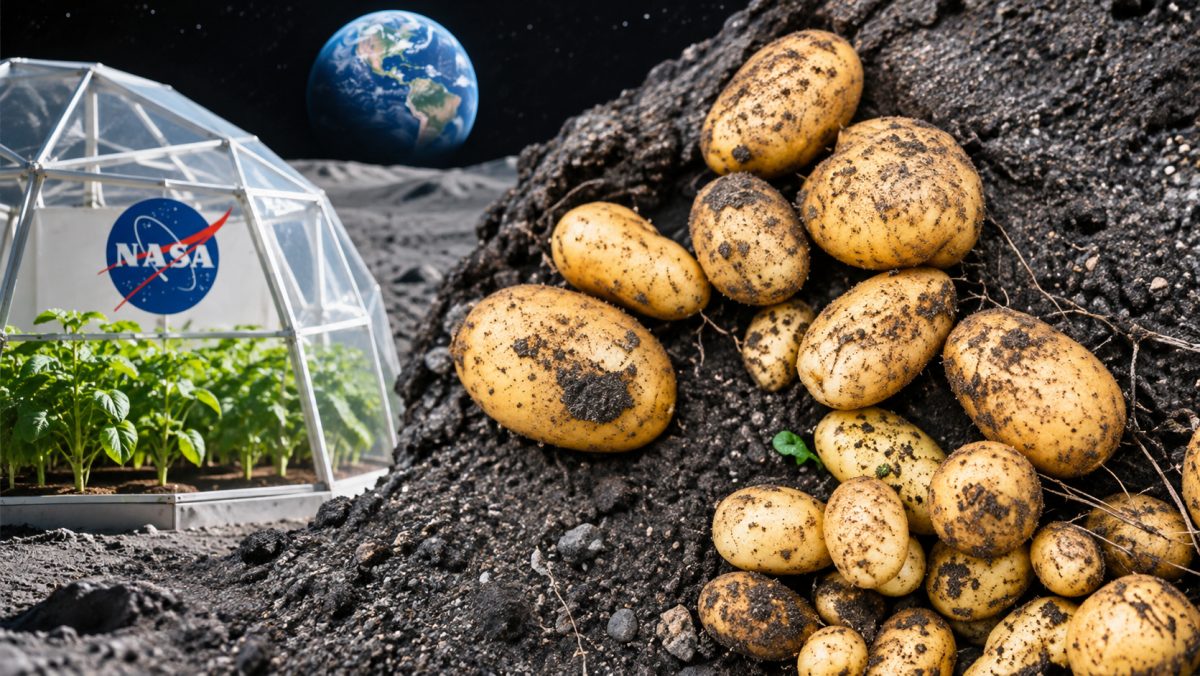
Scientists at Oregon State University reported on 19 November 2026 that potatoes grown in simulated lunar soil can match the growth and yields of potatoes grown in Earth soil, as long as the soil is mixed with enough organic matter. The NASA-supported study appeared in the journal npj Microgravity and marks one of the clearest signs yet that future Moon bases could someday grow their own food.
Asteroid Apophis Stargate Villain Myth Finally Cleared Up By NASA Scientist
How the potato experiment actually worked
View this post on Instagram
The research team did not use real Moon dirt. Instead, they worked with lab-made simulants built to copy different parts of the lunar surface, including areas that look like the dark lunar mare and the brighter highland regions. They tested five different versions of this fake lunar soil inside a greenhouse here on Earth.
Plain simulant, with nothing added, was a disaster for potatoes. Plants grown in it produced almost no roots and almost no tubers. Once researchers added vermicompost, a rich organic material made by earthworms breaking down waste, things changed fast. Even a small amount, just 5% vermicompost mixed with 95% simulant, let the plants grow some roots and small tubers.
The real breakthrough came at a higher ratio. A mix of 30% vermicompost and 70% simulant produced potato plants that grew and yielded about as well as potatoes planted in real Earth soil from Hermiston, Oregon, a region known for strong potato harvests. That result surprised even the scientists, since lunar regolith on its own lacks the organic richness and microbial life that normal farm soil has.
Voyager 1 One Light-Day Milestone: Why NASA Wants You to Wave Goodbye Nov. 17
What the Oregon State team found inside the tubers
Study co-author Aymeric Goyer summed up the main discovery simply. "We found that potatoes can complete their entire life cycle in simulated lunar soil when supplemented with organic matter," he said. That single sentence captures both the promise and the catch. Potatoes can do it, but only with help.
Oregon State University described the harvested potatoes as safe to eat, with nutrition levels similar to potatoes grown the normal way on Earth. Researchers also checked for glycoalkaloids, natural compounds in potatoes that can turn toxic at high levels. The moon-soil potatoes did not show a statistically significant increase in these compounds, which is an encouraging sign for future taste tests, even though actual lunar farming has not happened yet.
There was another bonus. The vermicompost appeared to bind up potentially harmful metals found in the regolith, which may have kept those metals from being absorbed by the potato roots. That detail matters because lunar soil contains sharp, abrasive particles and trace minerals that would not normally show up in a backyard garden.
Why potatoes could matter for future Moon missions
NASA helped fund this work because feeding astronauts on long missions is expensive and complicated. Every pound of food launched from Earth costs money and cargo space. If future lunar explorers could grow even part of their own food, missions could last longer without constant resupply trips from home.
Potatoes make sense as a starting crop. They pack a lot of calories into a small growing space, and new plants can grow directly from tubers, which means astronauts would not need to constantly ship in fresh seeds. Still, researchers are careful to point out that potatoes alone would not feed a crew. A real lunar menu would need multiple crops alongside systems for water recycling, artificial lighting, temperature control and radiation protection.
Reuters described the result as a step toward feeding astronauts at future lunar bases, and that framing fits what the data actually shows. This was not a lunar farming demonstration. It was a greenhouse experiment on Earth using fake soil, run under carefully controlled conditions.
The hurdles that remain before real lunar farming
The biggest open question is logistics. Thirty percent vermicompost sounds manageable in a lab, but producing or hauling that much organic material on the Moon is a completely different challenge. Early lunar settlers would likely need to bring starter compost material from Earth, then build a closed loop system that recycles food scraps, plant waste and other organic matter into new compost over time.
There is also the matter of the Moon's harsh environment itself. This study only tested the soil question. It did not test how potatoes would handle lunar gravity, radiation exposure, vacuum conditions or the extreme temperature swings that exist outside a sealed habitat. Any real lunar farm would need to happen inside a protected structure, not out in open regolith.
Researchers say the next step is testing under more realistic lunar conditions, including reduced gravity and limited water access, plus checking whether metals build up in the soil after repeated growing cycles. No launch date, lunar planting mission or operational Moon farm has been announced. For now, the achievement stands as a promising lab result rather than proof that dinner on the Moon is right around the corner.