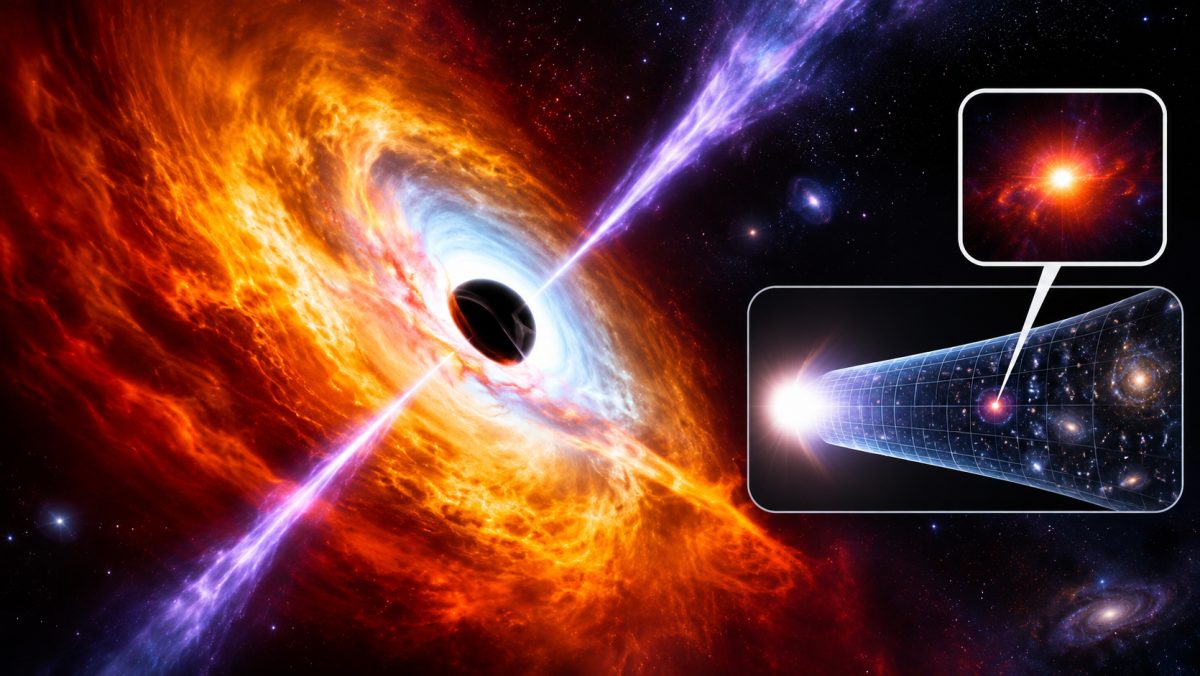

A tiny red dot in a telescope image turned out to be the oldest quasar ever seen, and scientists are still trying to figure out how it got so big so fast.
Scientists have confirmed the discovery of the oldest quasar 630 million years after the Big Bang, a record-breaking object named J1504+6252 that pushes back the clock on when giant black holes could form. The European Space Agency announced the finding on 24 November 2026, based on data from its Euclid space telescope and follow-up work from NASA's James Webb Space Telescope.
Andromeda Stars Merged in Rare Event Astronomers Watched Unfold for Years
How The Oldest Quasar 630 Million Years After Big Bang Was Found
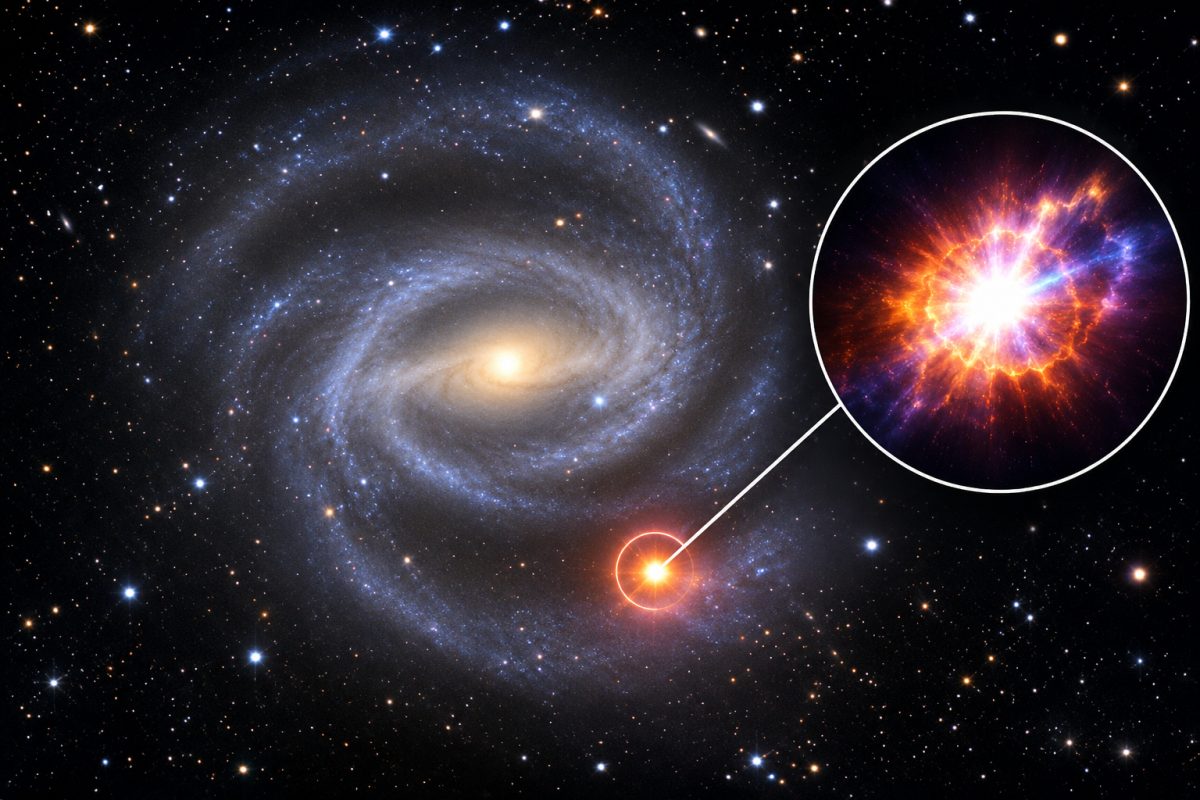
Euclid was built mainly to study dark matter and dark energy by mapping huge numbers of galaxies across the sky. But while scanning that wide field of view, it picked up something unusual: a faint red dot that turned out to be a quasar sitting farther away, and farther back in time, than any ever recorded. A quasar is the blazing core of a galaxy, lit up by gas and dust falling into a supermassive black hole at incredible speed and heat.
Once Euclid flagged the object, researchers turned to the James Webb Space Telescope for a closer look. Webb's instruments measured the quasar's redshift at 8.13, a number that tells astronomers how far light has stretched on its journey across the universe. That reading placed the quasar at roughly 630 million years after the Big Bang, meaning the universe was only about 5 percent of its current age when this light first left its source. Webb also measured the mass of the black hole powering it: about 360 million times the mass of our Sun.
This Star Swallowed Its Companion, and Astronomers Watched It Happen
Scientists Nickname The Discovery Dún Aonghasa
The research team gave the quasar a nickname, Dún Aonghasa, borrowed from a prehistoric stone fort on Ireland's Aran Islands. The name fits the idea of an ancient structure standing watch from deep in the past, long before most of the universe's galaxies had even formed. Its formal catalog name remains J1504+6252.
The findings appeared in the journal Astronomy & Astrophysics on 24 November 2026, in a paper titled "Euclid: Discovery of a quasar at z = 8.13 hosting a 360-million solar-mass black hole," led by researcher J. Wolf. ESA described the object plainly as the most distant quasar to date, calling it a rare galactic core spotted just 630 million years after the Big Bang. The Max Planck Society, which supported the research, said the discovery tightens the limits on which theories of early black hole formation can actually work.
Why A 360 Million Solar Mass Black Hole This Early Is A Problem
The size of the black hole is what has scientists puzzled. Under most standard models, black holes start small, as leftover cores from the first generation of giant stars, weighing maybe tens or hundreds of times the mass of the Sun. From there, they grow slowly by swallowing gas and merging with other black holes. The trouble is, there simply isn't much time for that slow process to produce something 360 million times heavier than the Sun within just 630 million years of the universe's birth.
Some researchers favor a different idea, known as the heavy-seed model, where black holes form directly from the collapse of massive gas clouds, starting out big instead of small. This discovery doesn't prove that theory correct, but it does narrow the field. Any model trying to explain early black holes now has to account for one that reached 360 million solar masses in less time than previously confirmed. It's a tight timeline, and Dún Aonghasa makes it tighter.
A Record That Keeps Getting Broken
This isn't the first time Euclid has broken its own record. Back in July 2026, the telescope had already found a different early quasar that held the distance title. J1504+6252 beats that previous record by about 40 million years further back in cosmic history. That might sound like a small gap compared to the age of the universe, but during the chaotic first billion years, 40 million years can mean the difference between a young, struggling black hole and one that has already grown into a monster.
News of the discovery spread quickly, with outlets including the Associated Press, CBS News, DW, Popular Science and others covering the story within a day of ESA's announcement. Most coverage focused on the same two striking details: the sheer distance of the object, and the surprising mass of the black hole sitting at its center so early in time.
What Comes Next For Early Universe Research
Scientists aren't done studying Dún Aonghasa. Researchers plan to keep analyzing the Euclid and Webb data, hoping to learn more about the quasar's host galaxy, its exact spectrum, and how its black hole might have grown so quickly. There's also a good chance this record won't last long. Euclid's survey is still expanding, and Webb remains available for targeted follow-ups, meaning an even older or more distant quasar could turn up at any time.
The bigger goal isn't just chasing a new record, though. Scientists want to find more objects like this one so they can tell whether early monster black holes were rare flukes or a common feature of the young universe. Either answer would reshape how astronomers explain the fastest growth spurt in cosmic history, the one that built galaxies, quasars, and black holes within the universe's first billion years.