
A SETI Institute astronomer is teaching computers to spot the cosmic stuff nobody can explain yet.
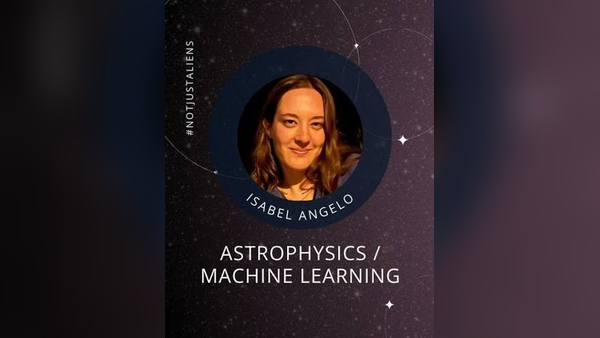
Isabel Angelo, an astronomer at the SETI Institute in Mountain View, California, was profiled by Science News on November 21, 2026, for her work using machine learning to search space telescope data for unexplained patterns that could point to new cosmic phenomena or signs of extraterrestrial intelligence.
Jeremy Hansen Artemis II Splashdown Story Reveals Flames Filled the Orion Capsule
Isabel Angelo Astronomer Builds Models to Catch the Unexpected
View this post on Instagram
Isabel Angelo doesn't spend her days staring up at the sky. She spends them staring at numbers. Mountains of them. Her work pulls from space telescope archives, both old instruments and new ones, looking for the rare observation that breaks the pattern.
Instead of checking every single data point by hand, Angelo and her colleagues at the SETI Institute built machine-learning models to do the heavy lifting. These models scan massive piles of telescope data and flag anything that looks off. Something that doesn't match the usual boxes astronomers use to sort objects in space. That includes comets, baby stars, and stars wrapped in thick clouds of gas and dust.
The goal isn't just to find more of what's already known. It's to catch the stuff that slips through the cracks because it doesn't look like anything scientists have cataloged before. As Angelo put it in the Science News piece, the models are built to find things that "look 'weird' in space that we don't know how to explain yet."
GPM J071507−114153: Dead Star Near Sun-Like Twin Sends Pulses Every 8 Minutes
Why the SETI Institute Machine Learning Approach Goes Beyond Radio Signals
People often think of SETI as just listening for alien radio broadcasts. Angelo's work stretches that idea much further. Her research touches exoplanets, possible extraterrestrial intelligence, and broader searches for astronomical oddities that have nothing to do with radio waves at all.
One example raised in the profile is the idea of an alien megastructure circling a nearby star. But Angelo's method isn't built around chasing one specific theory. It's built to catch anomalies first and ask questions later, without assuming ahead of time what a strange signal should look like.
That open-ended design matters. If you only search for one kind of signal, you'll miss everything else. By letting the models flag anything unusual, Angelo keeps the door open for discoveries nobody has predicted yet. It's a wider net, cast across data instead of the sky itself.
How Machine Learning Finds Anomalies in Telescope Data
Modern telescopes produce an almost unmanageable amount of information. No team of humans could look through it all line by line. That's where the models come in. They compare new observations against patterns they've already learned, then sort out the ones that don't fit.
Angelo expects most of these flagged objects to turn out to be perfectly normal. A comet here, a newborn star there, maybe a star buried in dust that just looked strange at first glance. She said plainly, "These are things that I would expect [the models] to find." That's not a letdown. It's actually the point. The system needs to prove it can correctly spot normal stuff before anyone trusts it to spot something genuinely new.
The real prize is further out. As Angelo explained, "the goal is to find something that's not even in any of these categories." That single sentence sums up the entire project. It's not about confirming aliens exist. It's about building a tool sharp enough to notice when something in the universe doesn't match anything we've seen before.
No Confirmed Discovery Yet, But the Method Could Change Astronomy
It's worth being clear about what hasn't happened. There's no confirmed alien signal. No verified megastructure. No announcement of a brand-new type of cosmic object. The Science News profile describes a research method, not a breakthrough discovery. Angelo's work is exploratory, and the people involved know that most leads will fizzle out into ordinary explanations.
That built-in skepticism is actually a strength. Every anomaly the models find still has to survive human review. Astronomers check whether it's a known object that got mislabeled, a glitch in the instrument, a processing error, or something that actually deserves a second look with other telescopes. Only a tiny fraction of flagged data will ever reach that final stage.
Still, the stakes are real. Large telescope archives are full of old data that few people have ever combed through closely. Angelo's approach gives that forgotten data a second chance to reveal something scientists overlooked the first time around.
What Comes Next for Isabel Angelo and the Search for Cosmic Oddities
The next step is follow-up work on whatever the models flag. That means comparing strange signals against other telescope data, rechecking old records, and repeating measurements to see if an anomaly holds up or disappears. None of that work comes with a fixed date or deadline based on what's currently known.
Angelo's long-term goal stays simple even if the science behind it is complicated. Find something that doesn't belong in any of astronomy's existing categories. Until that happens and gets independently checked, her work stands as a smart new way to search, not proof of anything beyond Earth. But it's exactly the kind of quiet, patient effort that tends to lead to the biggest surprises in science.