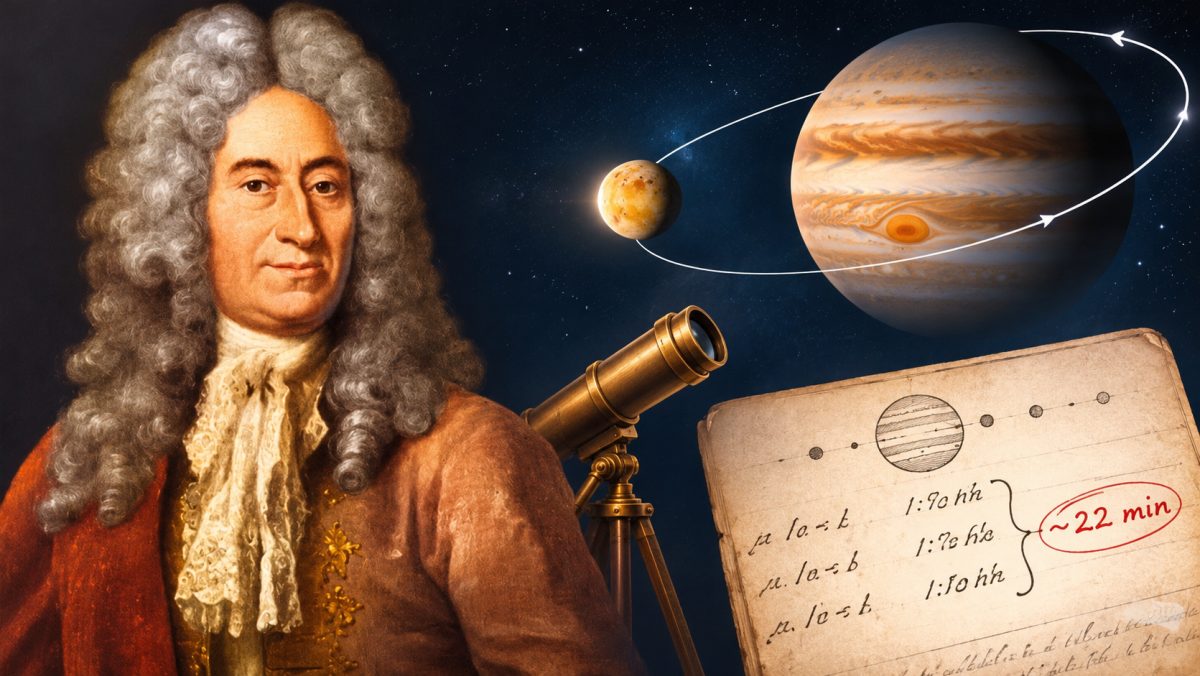

A Danish astronomer trying to build a better space clock ended up proving light itself needs time to travel.
On Nov. 21, 1676, Ole Rømer stood before the French Royal Academy of Sciences in Paris and explained something strange he had found while watching Jupiter's moon Io. The Danish astronomer showed that Io's eclipses kept arriving earlier or later than predicted, and he traced the cause to the finite speed of light, a discovery that reshaped how scientists understood the universe.
2026 Super El Niño Just Broke a Record No One Expected to See
Why Rømer Was Watching Jupiter's Moon in the First Place
Rømer wasn't hunting for the speed of light. He was doing a much more practical job. In the early 1670s, Giovanni Domenico Cassini, who ran the Paris Observatory, put the young astronomer to work building better prediction tables for Io's eclipses. Sailors at sea could use those eclipses like a cosmic clock, comparing the predicted eclipse time with their own local time to figure out their longitude.
Io made this job look easy at first. The moon disappears behind Jupiter's shadow on a short, steady schedule, so it seemed like the perfect timekeeper. Rømer joined the Paris astronomical scene around 1671 and dug into the observations, expecting to simply tighten up the numbers already in use.
This Star Swallowed Its Companion, and Astronomers Watched It Happen
The Pattern That Didn't Add Up
Instead of clean, steady timing, Rømer kept running into a nagging mismatch. When Earth was swinging closer to Jupiter in its orbit, Io's eclipses showed up earlier than the tables predicted. When Earth drifted farther away, the eclipses ran late. This wasn't random noise from a shaky telescope. It followed Earth's position in space, every single time.
Space.com's reporting on the event pegs the swing at about 11 minutes early when Jupiter was near and about 11 minutes late when the planets were far apart. Something was stretching or shrinking the apparent timing of an event happening millions of miles away at Jupiter, and Io itself hadn't changed its behavior. Rømer realized the missing piece wasn't Io's orbit. It was the extra distance the light had to cross to reach Earth.
The Announcement in Paris and What It Proved
Rømer tested his idea by predicting that an Io eclipse on Nov. 9, 1676, would run late compared to the old tables. The prediction held up. Twelve days later, on Nov. 21, 1676, he walked into the Royal Academy of Sciences and laid out what the Wikipedia summary of the event calls his "new method of calculation."
NASA's educational materials describe his core argument simply: light did not spread instantly but, like sound, traveled at a certain speed. The Academy's gathering gave Rømer a public stage for an idea that ran against centuries of assumption, since Aristotle and many thinkers after him had treated light as something that simply appeared everywhere at once, with no travel time at all.
A short account of the presentation ran in December in the Journal des sçavans, Europe's first scientific journal, spreading the finding beyond the room in Paris. Rømer figured light took roughly 22 minutes to cross the diameter of Earth's orbit around the sun. That number translates to a speed estimate of around 200,000 kilometers per second, or about 124,000 miles per second, using modern units.
How Close Rømer Got to the Real Number
Rømer's figure was in the right ballpark but nowhere near exact. The speed of light in a vacuum is now fixed at exactly 299,792.458 kilometers per second. His estimate came up short because 17th-century astronomers didn't have precise measurements of the solar system's true scale, and their telescopes and clocks carried plenty of error by today's standards.
None of that undercuts what he actually proved. The real breakthrough wasn't the specific number, it was showing that light has a speed at all, something that could be tested and checked through repeated observation rather than argued about in philosophy halls. That shift mattered more than getting the digits perfect, because it gave later scientists a real phenomenon to refine instead of a guess to debate.
A Discovery Born From a Different Goal Entirely
The Io project was never meant to settle a debate about the nature of light. Cassini wanted eclipse tables for navigation. Rømer wanted to give sailors a usable cosmic clock. What he found instead was a built-in flaw in that clock, one caused by light itself taking time to cross space.
That's the part of the story worth remembering. Rømer didn't set out looking for the speed of light and stumble onto it by luck in the way a treasure hunter finds gold. He noticed a stubborn, repeating pattern in his data, refused to write it off as error, and followed it to its real cause. The Paris Observatory supplied the telescopes and tables, the Royal Academy supplied the stage, and a young Danish astronomer supplied the stubborn curiosity to ask why a moon kept showing up at the wrong time.