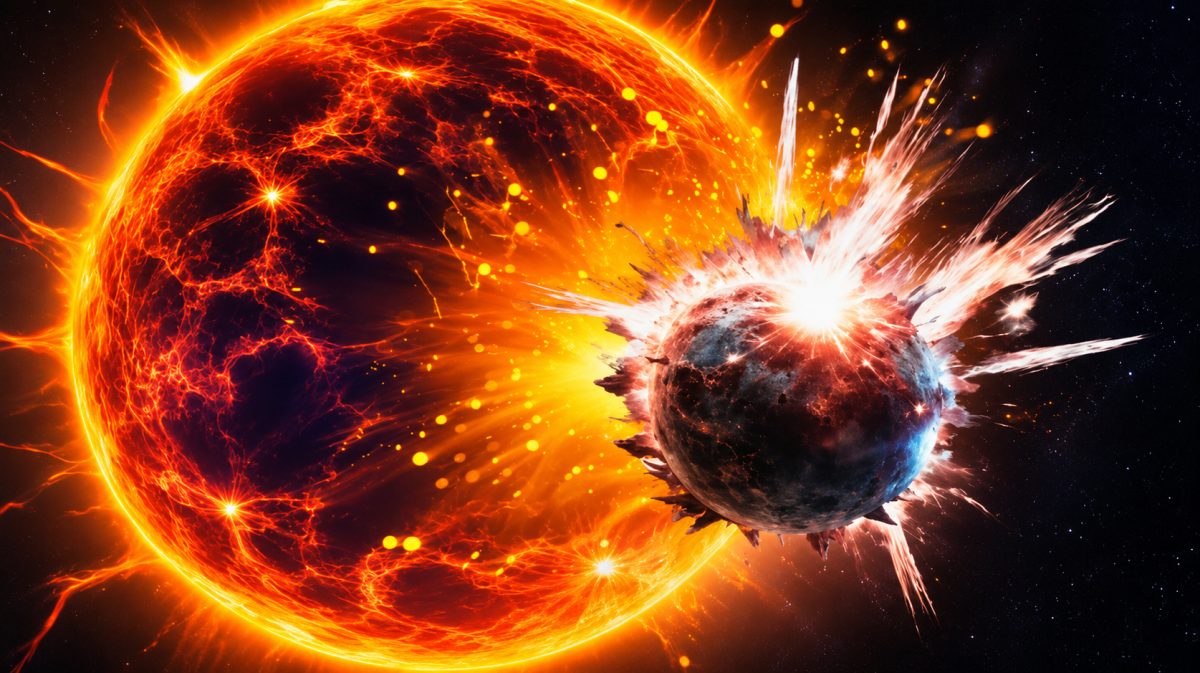

A giant star puffed up, grabbed its smaller neighbor, and pulled it in slowly over years, and this time scientists saw every step.
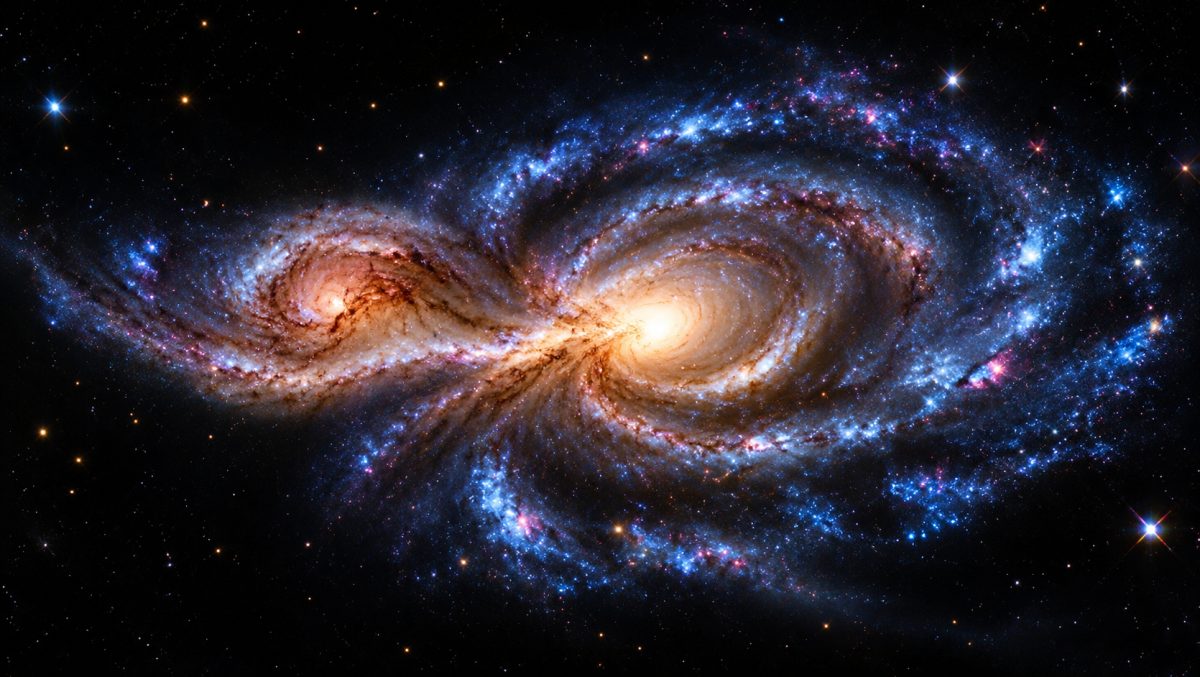
A star swallowed its companion in a galaxy near our own, and astronomers caught the whole thing on record for the first time ever. The event, named AT 2025abao and nicknamed Bao, happened on the edge of the Andromeda Galaxy, about 2.5 million light-years away. A swollen giant star roughly seven times heavier than our Sun pulled in a smaller star weighing about 0.7 times the Sun's mass, finishing the job in late 2025.
Solo Meerkats Navigation Study Reveals How Lost Animals Find Their Way Home
How the giant star swallowed its companion
View this post on Instagram
The story starts back in 2018. That's when the smaller star first touched the outer edge of the giant star's puffed-up atmosphere. The giant was in a late life stage called the asymptotic giant branch, where stars swell up huge as they run low on fuel. Once the smaller star dipped into that outer gas layer, it couldn't escape.
Gas inside the giant's atmosphere acted like a brake. It dragged on the smaller star, stealing its energy and momentum bit by bit. Instead of circling safely at a distance, the smaller star kept sinking deeper. Scientists call this common-envelope evolution, a process where two stars end up sharing one gas envelope instead of living as separate neighbors.
This slow sinking isn't quick. It took almost seven years for the smaller star to spiral all the way down into the heart of the giant. By late 2025, the companion reached the giant's inner layers and merged completely, setting off a bright explosion of light known as a luminous red nova.
Animals Humans Want to Talk to: Dogs Beat Cats in Live Science Poll
Telescopes that caught the star swallowing its companion in action
Researchers didn't just guess what happened. They watched it unfold using several telescopes working together. The WINTER telescope at Palomar Observatory and NASA's NEOWISE spacecraft tracked the system's infrared glow for years, picking up subtle changes as the merger crept along.
Then, in December 2025, NASA's James Webb Space Telescope stepped in with sharp infrared vision. Webb's data turned out to be the missing piece. According to NASA, those observations gave scientists the final evidence needed to fully reconstruct what happened before, during, and after the merger.
Viraj Karambelkar, an astrophysicist at Columbia University, led the research team behind the discovery. He said the findings mark "the first direct observations of this process happening—the first time a giant star engulfing its companion was caught in the act." That quote, shared in coverage of the study, captures just how rare this catch really is.
Why scientists call this merger a breakthrough
Common-envelope evolution isn't a new idea. Scientists have used it since the 1970s to explain how some of the universe's tightest star pairs form. The theory says two stars can end up jammed close together, or they can crash together entirely, depending on whether the shared gas envelope gets blown away or not.
Until now, nobody had watched this process happen beginning to end. Scientists had seen the aftermath of mergers before, like sudden red flashes in the sky, but never the slow build-up leading into one. Bao changes that. It links together four separate stages that used to be studied apart: a normal binary system, the moment of first contact, the long inward spiral, and the final burst of light.
This matters because common-envelope evolution is believed to explain how neutron stars, black holes, and other tightly packed cosmic pairs come to exist. Having a real example to study gives scientists something solid to test their computer models against, rather than relying only on theory.
What the eruption looked like and what it wasn't
When the two stars finally merged, the system threw off a huge amount of gas, somewhere between 0.1 and 0.2 times the mass of our Sun. That material blasted outward, creating the bright glow that first caught astronomers' attention.
It's worth being clear about what this event was not. It wasn't a supernova. The giant star didn't undergo the kind of core collapse that triggers those massive explosions. Instead, the brightness came from the merger itself, as the two stars combined and released stored-up orbital energy, pushing gas out into space in the process.
Nature's press materials described this as the first direct observation of a companion star merging with its dying host star inside a binary system. The research behind the discovery appeared in the journal Nature on November 18, 2026, with follow-up coverage from outlets including Ars Technica, Science News, and NASA's own science team soon after.
What comes next after this star swallowed its companion
The merger itself is finished, so there won't be a second eruption or a repeat performance from this particular pair. But the story doesn't end there. Scientists plan to keep watching the leftover material, tracking how that ejected gas cools and spreads out over time.
Researchers also want to use Bao as a template. If this pattern, the slow brightening followed by a sudden burst, shows up in other survey data, astronomers might be able to catch similar mergers earlier next time, maybe even before the final eruption happens. That would let scientists study the inspiral phase in even more detail across different kinds of star pairs throughout our galaxy and beyond.