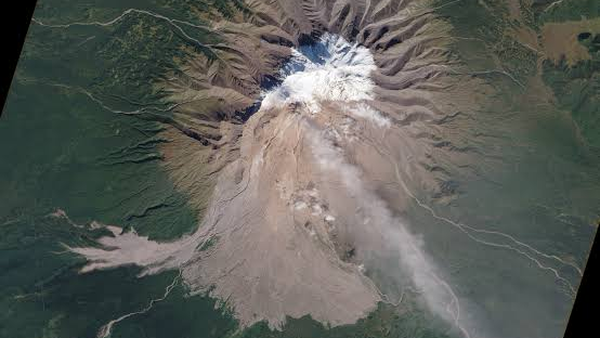

A snow-covered Russian volcano is quietly building a massive mound of lava right at its summit, and the photo proves it.
A new satellite image published Nov. 24, 2026, shows the Shiveluch lava dome growing rapidly inside the volcano's summit caldera on Russia's far-eastern Kamchatka Peninsula, surrounded by snow and streaked with dark marks that may be fresh lava, ash deposits or avalanche debris, according to Live Science.
Isabel Angelo Astronomer Uses AI to Hunt Strange Signals Hiding in Plain Sight
A Striking Image Reveals Fast Dome Growth
The satellite picture shows Shiveluch, sometimes spelled Shivelyuch or Sheveluch, standing about 10,771 feet, or 3,283 meters, tall. It is a stratovolcano, meaning it was built up over centuries by layer after layer of hardened lava, ash and rock. In the image, a dark, almost circular blob sits near the top of the caldera. That blob is the lava dome, and it has reportedly been expanding quickly over the past several months.
Dark streaks run down multiple sides of the mountain, including one long line that stretches from the summit caldera toward the lower slopes. Nobody has confirmed exactly what each streak is made of. It could be freshly hardened lava, loose volcanic debris, or scars left by avalanches sliding off the steep, snow-packed terrain. The mixture of bright white snow and jet-black volcanic material is what makes the photo so striking, but it also hides some of the finer details scientists would need to say for certain what is happening on the ground.
Nighthawk Bison Jump in Texas Reveals 3,000 Years of Cliff Hunts
Why Scientists Compare the Lava to Toothpaste
Researchers at NASA's Earth Observatory, whose observations were cited in the report, described the way this lava behaves in a very everyday way. They said the lava gets pushed out slowly and piles up into lobes, slopes and spine-like shapes, just like toothpaste does when you squeeze a tube. That is not a scientific type of rock. It is simply a helpful comparison to explain how thick and slow-moving the magma is.
This matters because Shiveluch's magma is extremely viscous, meaning it is thick and sticky rather than runny. Thin, runny lava spreads out across the land fast. Thick lava like this does not travel far. Instead, it backs up right near the opening it came from and keeps growing upward and outward, forming a dome instead of a flowing river of fire.
Nearly Three Decades of Rumbling Activity
Shiveluch is not new to this kind of behavior. The volcano has been erupting on and off for close to 30 years, making it one of the most consistently active volcanoes anywhere on the Kamchatka Peninsula, a region already packed with roughly 40 active volcanoes. A dome grew in roughly the same spot back in 1993, and that older dome looked considerably bigger than the one caught in the new image, giving scientists a useful size comparison across time.
In an earlier eruption episode, the Kamchatkan Volcanic Eruption Response Team, known as KVERT, documented a similar toothpaste-like swelling of the dome between March 28 and April 4. That earlier event shows this is a repeating pattern at Shiveluch rather than a one-time surprise. The volcano sits above a part of the Kamchatka volcanic arc where the Pacific Plate slides underneath the Eurasian landmass, feeding magma up toward the surface over long stretches of time.
The Hidden Danger Behind a Slow-Looking Dome
It is easy to look at a slow-oozing lava dome and assume it is not very dangerous. That assumption would be wrong. Lava domes like this one can crack, shed chunks of hot rock, or suddenly collapse without much warning. A collapse can send scalding blocks, ash and gas rushing down the mountainside in what is called a pyroclastic flow, which can move far faster than the lava itself ever did.
Snow adds another layer of risk. Hot material from the dome can melt snow and ice almost instantly, creating lahars, which are fast-moving mudflows packed with water, ash and rock. Live Science's report notes that it remains unclear whether the dome shown in the new image has already collapsed since the photo was taken. That uncertainty is exactly why volcanologists keep watching Shiveluch so closely.
What Comes Next for the Smoking Mountain
No evacuation, emergency declaration or official statement tied specifically to this new image has been reported. There is also no confirmed damage or injury connected to the dome shown in the photo. What happens next depends entirely on whether the dome keeps swelling or gives way.
Continued growth would mean even more unstable material piling up at the summit, raising the odds of a future collapse. A sudden failure, on the other hand, could trigger the kind of pyroclastic flow or lahar that makes Shiveluch one of the volcanoes scientists watch most carefully. Expect future satellite passes and updates from monitoring groups like KVERT to show whether this toothpaste-like dome keeps oozing outward, or whether gravity finally wins.