
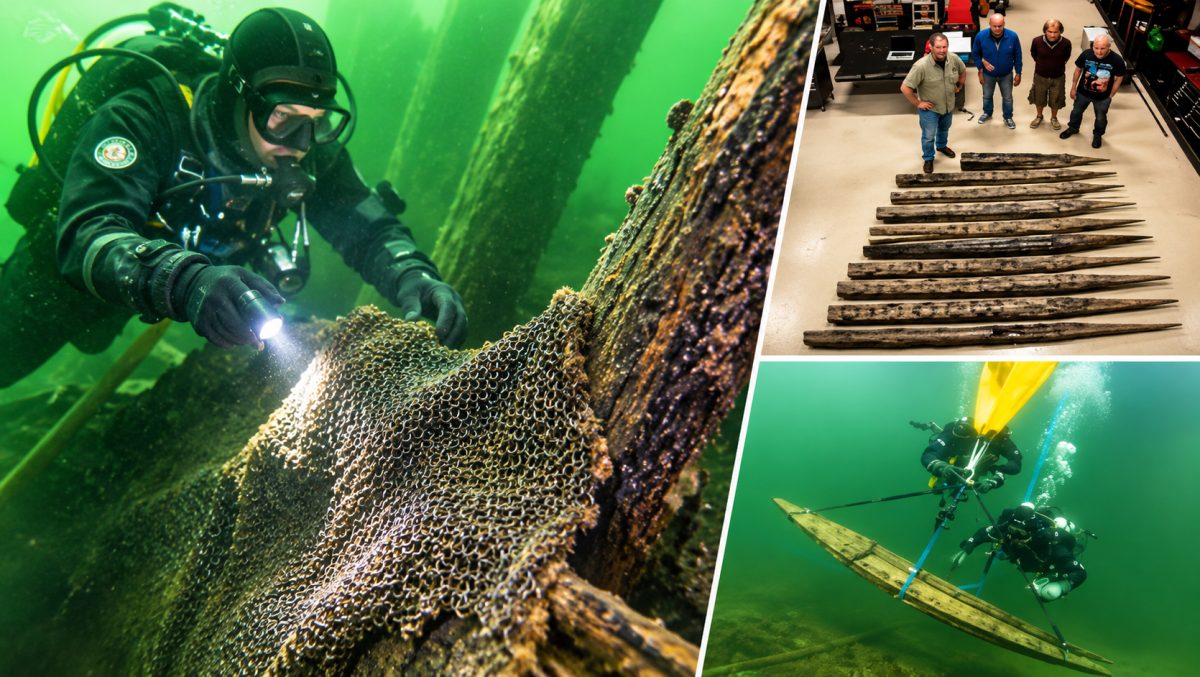

Divers exploring a 500-year-old royal shipwreck just found armor that should not have survived this well.
An international team of archaeologists has recovered fragments of exceptionally preserved chain mail from the Gribshunden shipwreck, the Danish royal warship that sank in the Baltic Sea off southern Sweden in June 1495. The find came from beneath the ship's forecastle, where researchers also spotted a distinctive munitions chest, pointing to a military storage area on what was once King Hans's floating castle.
Nighthawk Bison Jump in Texas Reveals 3,000 Years of Cliff Hunts
Divers Uncover Armor Near Hidden Weapons Chest
A 15th-century shipwreck is yielding clues to the medieval tragedy that destroyed Griffin, King Hans's "floating castle." https://t.co/GToB1DLpAH
— Live Science (@LiveScience) November 24, 2026
The chain mail turned up during a recent dive campaign led by researchers from the University of Southampton, Södertörn University and Stockholm University. Rolf Warming, an archaeologist at Stockholm University who leads the Griffin project, said the armor was found lying right out in the open. He described it as 'rather surprisingly, completely exposed,' according to Live Science. That detail matters because most metal objects from this era either rust away or stay buried under sediment for centuries.
This mail is not made of iron. It is built from a copper alloy, something close to latten or brass. That choice of metal, combined with the Baltic Sea's cold and low-salt water, helped the armor survive in remarkable shape. The University of Southampton called the pieces 'well-preserved fragments of exceptionally high-quality chain mail armour' in its announcement of the discovery. The location also stood out. The mail sat near a munitions chest, suggesting this part of the ship was used to store military gear rather than food, trade goods or personal belongings.
Riemann Hypothesis Solved? Mathematician and AI Claude Stun Math World
Gribshunden Chain Mail Discovery Points to a Working Warship
Gribshunden, sometimes called Griffin, was built around 1485 for King Hans, who ruled Denmark and Norway and wanted to hold the broader Scandinavian political union together. The ship was not a simple cargo vessel. It was the king's floating headquarters, carrying soldiers, noblemen, weapons and valuable goods wherever he needed to project power or hold talks.
In June 1495, King Hans sailed toward the town of Kalmar to meet with the Swedish council about the Kalmar Union, the alliance tying Denmark, Norway and Sweden together. He went ashore before disaster struck. The ship, anchored near the Swedish coast with soldiers and Danish nobles still aboard, caught fire or exploded and sank, killing many of the people on board. The king survived because he was not on the vessel when it went down.
From Sport Divers to Modern Science Labs
Sport divers first found the wreck back in the 1970s, but nobody knew for sure what ship it was. Archaeologists did not confirm it as Gribshunden until 2013, after piecing together its construction, location and the objects scattered around it. That identification turned a mysterious wreck into one of the most important shipwrecks in the Baltic.
Interest grew fast after that. In 2018, Swedish and Danish institutions formed a research group to study the site properly. The first big excavation came in 2019, when a team mapped the wreck using photogrammetry and dug a trench roughly 6 by 2 meters, a tiny slice covering less than 1 percent of the entire site. Even that small dig produced a trove of artifacts, including crossbow parts, an arquebus fragment, cannon shot, a dagger handle, silver coins, wooden casks, exotic spices and a wooden tankard marked with a crown. Scientists later sent a sample of the mail to the MAX IV laboratory, where it was examined at the NanoMAX beamline, a tool powerful enough to study the metal down to a microscopic level.
Why This Shipwreck Keeps Rewriting History
Gribshunden sank during a pivotal stretch of military history, right when old-style armor and crossbows were starting to share the battlefield with early firearms and cannons. Because the ship went down fast and stayed largely undisturbed, it works almost like a time capsule. Researchers get to see exactly what weapons, armor and supplies a royal warship carried, instead of guessing from scattered records or museum pieces collected much later.
There is no proof yet that this particular mail belonged to King Hans himself. It more likely equipped soldiers, guards or other men serving on the ship. A rare maker's mark found on one piece of mail could eventually help researchers trace where the armor was forged and how it moved through trade routes across medieval Europe.
What Comes Next for the Gribshunden Wreck
The excavation is still in its early days. With less than 1 percent of the wreck explored so far, archaeologists expect future dives to keep focusing on the forecastle and other areas linked to military storage. Conservation work will be critical too, since artifacts pulled from the seabed can start breaking down fast once they hit open air.
Researchers plan to keep studying the chain mail's alloy, its construction and that maker's mark, hoping to learn more about where it came from and who made it. Each new piece recovered from Gribshunden adds another layer to the story of a king, a doomed flagship and the final moments of a 15th-century disaster that still has secrets buried in the Baltic mud.