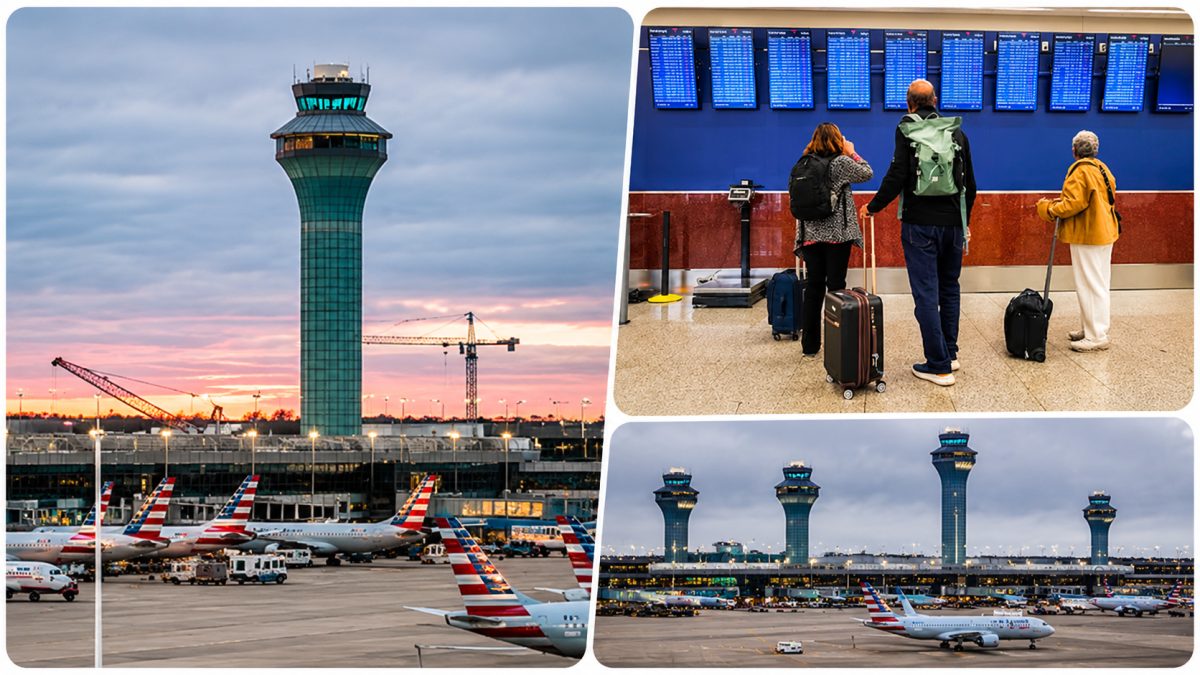

Travelers already packed into O'Hare on the busiest travel day of the year suddenly found their flights stuck on the ground, and nobody could say exactly why at first.
The FAA ordered a ground stop at Chicago O'Hare International Airport on Tuesday, November 24, 2026, after an equipment outage disrupted air-traffic operations at one of the nation's busiest airports. The stop began shortly after 3 p.m. Central time and was lifted around 4:30 p.m., though a ground-delay program kept affecting flights into the night, the FAA said.
Highest DII Holding Stocks September 2026: HDFC Bank, Reliance Top List
Timeline of the O'Hare equipment outage ground delay
View this post on Instagram
The trouble started fast. CBS Chicago reported the ground stop was issued around 3:30 p.m. Tuesday because of the equipment problem, with officials initially expecting it to last until about 4:15 p.m. WGN Radio reported the FAA called it simply an 'equipment outage,' without naming the broken part right away.
By about 4:30 p.m. Central time, the full ground stop was lifted. But the FAA didn't just flip a switch back to normal. Instead, it started a ground-delay program, which let some planes fly toward O'Hare while still spacing out arrivals so technicians could keep working. WGN reported the average delay during the ground stop stretched to 47 minutes, a real headache for families trying to get home for the holiday.
Financial Literacy and Sustainability: Why Smart Money Habits Help The Planet Too
What broke and why it mattered so much
CNN, citing a source familiar with the matter, reported the failed system was ASD-X, short for airport surface-detection equipment. That system helps controllers track planes and vehicles moving around the airport grounds, which is a big deal at a sprawling, crowded airport like O'Hare. Without it working fully, controllers have to be far more careful about which aircraft move where, and that slows everything down.
CNN reported that incoming flights were held for roughly 25 minutes during part of the disruption. That number doesn't exactly match the 47-minute average WGN reported, and that's likely because the two outlets were measuring different stretches of the event, or different categories of delay. Either way, the bottom line for passengers was the same: flights sat waiting, and plans got pushed back.
FAA statement confirms the outage was contained to O'Hare
The FAA released a statement making clear the problem didn't spread beyond one airport. "The FAA is no longer under a ground stop at Chicago O'Hare International Airport but is temporarily delaying some flights while technicians work to repair a piece of air traffic equipment," the agency said. It added that the issue "does not impact all flights nor affect any other airports or FAA systems."
That statement mattered because of timing. CNN noted the disruption landed on what was expected to be the single busiest travel day of the entire Thanksgiving season. Any slowdown on a day like that ripples outward fast, since gates, crews and connecting passengers are all stacked tightly together with little room for error.
A rough back-to-back stretch for Chicago's busiest airport
Tuesday's outage wasn't O'Hare's first hiccup of the week. One day earlier, on Monday, November 23, the airport dealt with a separate ground stop lasting about 90 minutes. According to ABC7 Chicago and Newsweek, the FAA blamed that one on staffing constraints at Chicago Terminal Radar Approach Control, not equipment failure. An FAA advisory cited in Newsweek's reporting listed 2,211 total assigned delay minutes from that Monday event, with a maximum single delay of 82 minutes and an average around 48 minutes.
Two disruptions in two days at the same airport, even with different causes, is enough to rattle travelers who were already bracing for a packed holiday rush. CNN also noted this stretch came roughly a week and a half after a separate, nationwide FAA technology outage that forced the agency to ground aircraft across the country. Nothing in the available reporting ties that earlier nationwide problem directly to Tuesday's O'Hare equipment failure, but the back-to-back timing added to a sense that the system was being tested hard right when it mattered most.
What travelers can expect while repairs continue
The FAA said its ground-delay program was scheduled to run until just before midnight local time Tuesday. That doesn't mean every single flight faced a delay that long. Instead, it means controllers kept the option open to space out arrivals and assign individual delays as needed while technicians finished their repair work on the ground equipment.
What's still unclear is exactly when the ASD-X system was fully back online, how many flights ended up delayed or canceled by the end of the night, and whether the ripple effects carried into Wednesday travel. No official repair-completion time or final cancellation count had been published in the available reporting. For now, the FAA's message to the public was straightforward: the problem was real, it was limited to O'Hare, and crews were working to fix it during one of the most demanding travel days of the year.