
Chinese companies could not buy the best Nvidia chips directly, so they just rented the computing power instead.
The Trump administration moved on Monday, November 16, 2026, to shut down that workaround. The Commerce Department issued a new rule that closes the Nvidia chip loophole letting Chinese firms remotely tap advanced American AI chips sitting inside data centers in other countries.
Trump Addresses Jensen Huang Chinese Spy Plot, Calls Nvidia CEO 'Brilliant'
Commerce Department targets the remote access workaround
The Bureau of Industry and Security, a branch of the Commerce Department, released what's called an interim final rule. This type of rule lets the government act fast on export controls while still leaving room for public comment later. The goal here is simple: stop Chinese companies from leasing Nvidia computing power from data centers sitting outside China, especially in Southeast Asia.
Under the new rule, companies now need a license before exporting, reexporting, or transferring advanced semiconductors to five specific places. Those are Indonesia, Malaysia, Singapore, Thailand, and Brazil. Commerce flagged these countries as carrying a higher risk that chips could end up diverted to China through indirect channels. The rule also forces overseas data centers to check who their customers really are if those centers supply large amounts of computing power to companies based in China, Russia, Iran, or other countries under U.S. arms restrictions.
Mike Johnson Chip Export Restrictions: Why Congress Is Suddenly Uniting on China
Jensen Huang scandal lit the fuse on this rule
This whole push didn't come out of nowhere. Reporting says Nvidia's former CEO, Jensen Huang, resigned just the week before, after admitting to an affair with a woman named Alice Huang. She's been described in reports as a former leader tied to Singapore-based Megaspeed International, and allegedly connected to Chinese intelligence. U.S. authorities are reportedly investigating Megaspeed over claims that Nvidia chips were quietly funneled into China.
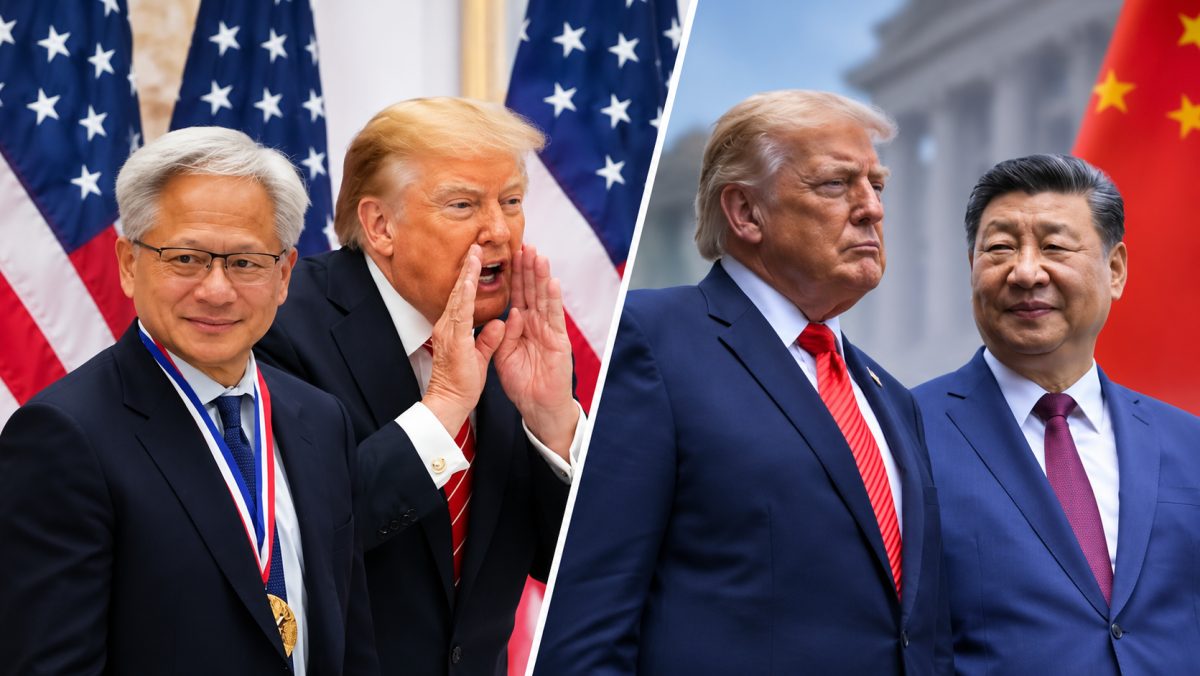
Washington Post reporting from November 13 described a deeper fight playing out behind closed doors. Huang had built unusually close access to President Trump and pushed hard for more freedom to sell or provide AI chip access inside China. That access apparently frustrated national security officials and China hawks inside the administration, who saw it as handing Beijing a technology edge it shouldn't have. The scandal around Huang became the spark, even though the new rule itself covers far more ground than just one company or one executive.
Why cloud rentals became the easiest way around the rules
For years, the direct path was blocked. Chinese firms generally could not legally buy Nvidia's top-tier AI chips outright. But cloud computing opened a side door. A company in China didn't need to import a single chip. It could simply send its workload to a data center in Singapore or Malaysia, rent time on Nvidia-equipped servers there, and get nearly the same result as owning the hardware itself.
That gap sat largely unaddressed until now because older export rules focused on physical shipments, not remote digital access. The new rule changes that by treating compute access itself as something that needs tracking. Data centers providing what the rule calls "significant volumes of compute" to companies headquartered in restricted countries now must identify their end users and prove they're not just serving as a backdoor into China's AI ambitions.
Industry faces new compliance headaches as Trump travels through Asia
Southeast Asian data centers and cloud providers are now staring down a mountain of new paperwork. They'll need to trace customer ownership, figure out where corporate headquarters actually sit, and monitor computing volumes closely enough to know when a license is required. Singapore, Malaysia, Thailand, and Indonesia are named directly in the rule, so facilities there are bracing for extra scrutiny.
The timing lines up with President Trump's trip to Asia, which began around November 15. Officials reportedly didn't expect China to retaliate immediately over the new restrictions. Still, the rule gives Commerce room to grow. It allows the secretary of commerce, working with the secretary of state or the national security adviser, to add more countries to the restricted list down the road.
Nvidia's reputation now hangs on what investigators find
Nvidia itself hasn't been shown to have knowingly broken any export rules, and the allegations tied to Megaspeed remain unproven claims rather than settled facts. But the company's chips sit at the center of this entire dispute, and that puts Nvidia's distribution practices and customer screening under a brighter spotlight than ever.
What happens next depends heavily on two things: how the Megaspeed investigation plays out, and how strictly Commerce enforces the new licensing requirements once they're published in the Federal Register. If regulators keep pushing in this direction, cloud companies everywhere may soon face chip-style export rules based not on where hardware sits, but on who's actually using it and how much power they're pulling.