
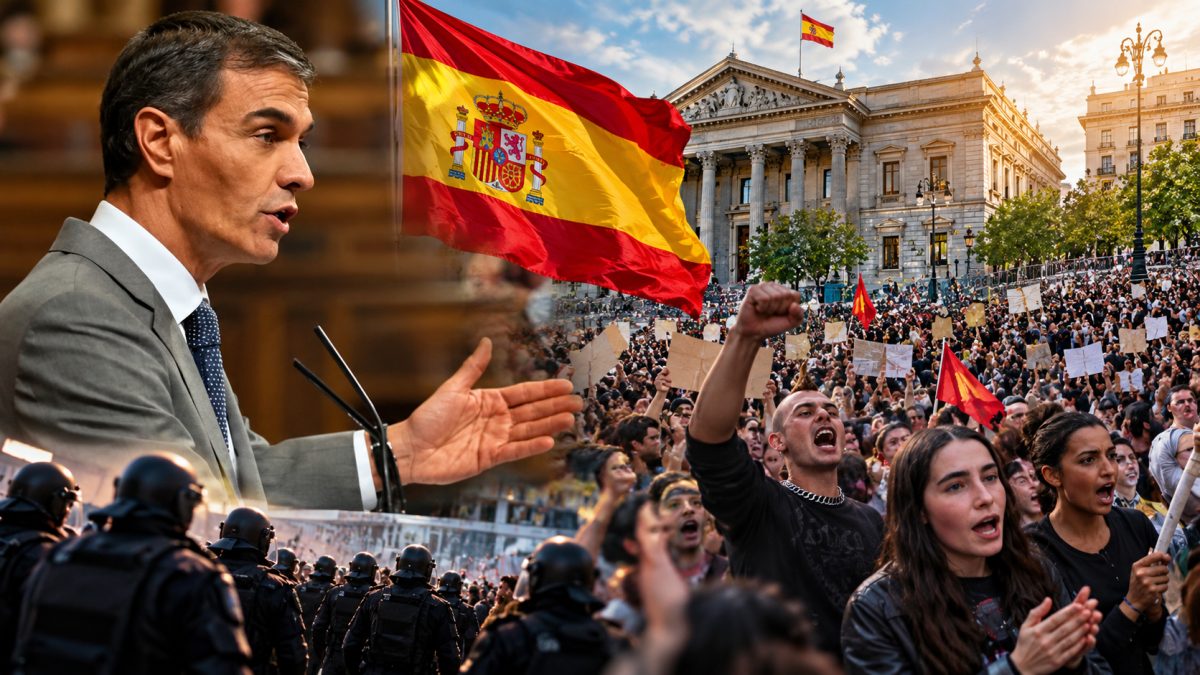

Narrow parliamentary defeats on tenant protections ignite nationwide demonstrations, as Spain's prime minister weighs whether to call elections months ahead of schedule.
Spain's housing crisis escalated into a direct threat to Prime Minister Pedro Sánchez's government on Friday, October 2, 2026, when Congress rejected two emergency decrees designed to protect renters and curb evictions. The following day, Saturday, October 3, tens of thousands of demonstrators marched through Madrid and roughly 50 other Spanish cities demanding affordable housing and stronger tenant safeguards, intensifying speculation that Sánchez could dissolve parliament and call a snap general election, possibly as early as November 29.
France's School Protests Erupt Into Arson and Clashes as PM Lecornu Calls Emergency Meeting
How the Vote Collapsed in Congress
The defeat was narrow but decisive. The first decree failed 172 votes to 178, while the second fared worse, receiving only 166 votes in favor against 184 opposed, according to Euronews and the Associated Press. Sánchez's governing Socialist-led coalition could not secure the numbers it needed after the conservative People's Party, the far-right Vox, and the regionalist Union of the Navarrese People voted against the measures, while the Catalan party Junts withheld its support entirely.
The outcome marked another legislative blow for a minority government that has repeatedly struggled to convert fragmented parliamentary alliances into working majorities. Reuters reported that protesters had already gathered outside Parliament as the vote unfolded, reflecting how closely the decrees were tied to public anger over a specific case rather than abstract policy debate. The Associated Press noted that the setback sparked immediate speculation in Spanish media that Sánchez could move up elections originally scheduled for 2027.
CMS Contract Scandal Widens as Activist Named in Memo Quits Black Political Caucus Post
Streets Fill as Sindicato de Inquilinas Leads the Charge
Demonstrators marched toward Madrid's Puerta del Sol square chanting for a general strike, according to Euronews, with similar rallies unfolding in Valencia and dozens of other cities, per DW. Crowd estimates diverged sharply: Spanish authorities put the Madrid turnout at approximately 70,000, while organizers insisted as many as 500,000 people took part, according to Euronews. Reuters and Al Jazeera both confirmed the existence of large-scale nationwide protests even as the competing figures underscored the political stakes of how the movement's size is perceived.
The primary organizing force behind the demonstrations was the renters' association Sindicato de Inquilinas, which according to ABC News and the AP called for additional protests and pushed for a general strike. The group's demands centered on unaffordable rents, tenant insecurity, and what it described as the government's failure to deliver effective protection against evictions.
The protests were deeply shaped by the televised eviction of Maricarmen, an 87-year-old Madrid woman whose removal, according to AP reporting, triggered widespread public outrage, spontaneous demonstrations, and a camp-in at Madrid's most prominent square in the days before the parliamentary vote. Her case transformed the housing decrees from routine legislation into a highly visible test of the government's commitment to vulnerable tenants, making their rejection in Congress politically explosive.
Feijóo Demands Elections as Sánchez Holds Back
PP leader Alberto Núñez Feijóo seized on the defeat to press for an immediate election. He urged Sánchez to "call elections as soon as possible," arguing the prime minister had the support of "neither the streets nor parliament," according to Al Jazeera. In a separate statement reported by AFP, Feijóo said early elections were necessary "because the country can't take any more."
Despite the mounting pressure, Sánchez's office maintained that no decision had been made. DW reported that Sánchez "has so far ruled out calling early elections," while Euronews cited his office insisting no decision had been taken, even as government and Socialist Party figures had floated the possibility. Reuters and DW both reported that Spanish media expected the government to assess the scale and intensity of Saturday's demonstrations before deciding on timing, with November 29 circulating as one speculative date, though it remains unconfirmed.
The Political Calculus Behind a Possible Snap Poll
The decision facing Sánchez carries substantial risk in either direction. Calling an early election would let him campaign directly on housing, framing the opposition as obstructing relief for renters while seeking a clearer mandate than his current fragmented coalition provides. But it could equally expose the Socialists to defeat if the PP and Vox capitalize on government fatigue and unresolved controversies, as Il Sole 24 Ore noted in describing Sánchez as now weighing whether to "challenge the right by calling a snap election."
Waiting until the scheduled 2027 election would give the government more time to rebuild alliances with Junts and other regional parties and to draft replacement housing measures. Yet continued paralysis risks reinforcing the perception, voiced by Feijóo and amplified by the housing movement, that Sánchez cannot govern effectively. The New York Times reported that the failed vote prompted calls for snap elections even from within Sánchez's own Socialist ranks, signaling that the pressure is not confined to the opposition benches.
What Comes Next for Spain's Housing Standoff
No replacement bill or scheduled vote has been confirmed in current reporting. The government's immediate options include introducing revised legislation, negotiating separately with Junts or other regional partners, or pursuing non-legislative measures to address evictions and rent pressures. Meanwhile, Sindicato de Inquilinas has signaled the protest movement will continue, with calls for a general strike suggesting the housing crisis may evolve into a sustained social campaign independent of conventional party politics.
The central uncertainty remains whether Sánchez will gamble on an early mandate or attempt to govern through the housing standoff until 2027. His choice will hinge on three converging pressures: the opposition's demand for elections, the renters' movement's push for immediate relief, and the practical arithmetic of rebuilding a working majority in a deeply fragmented Congress.