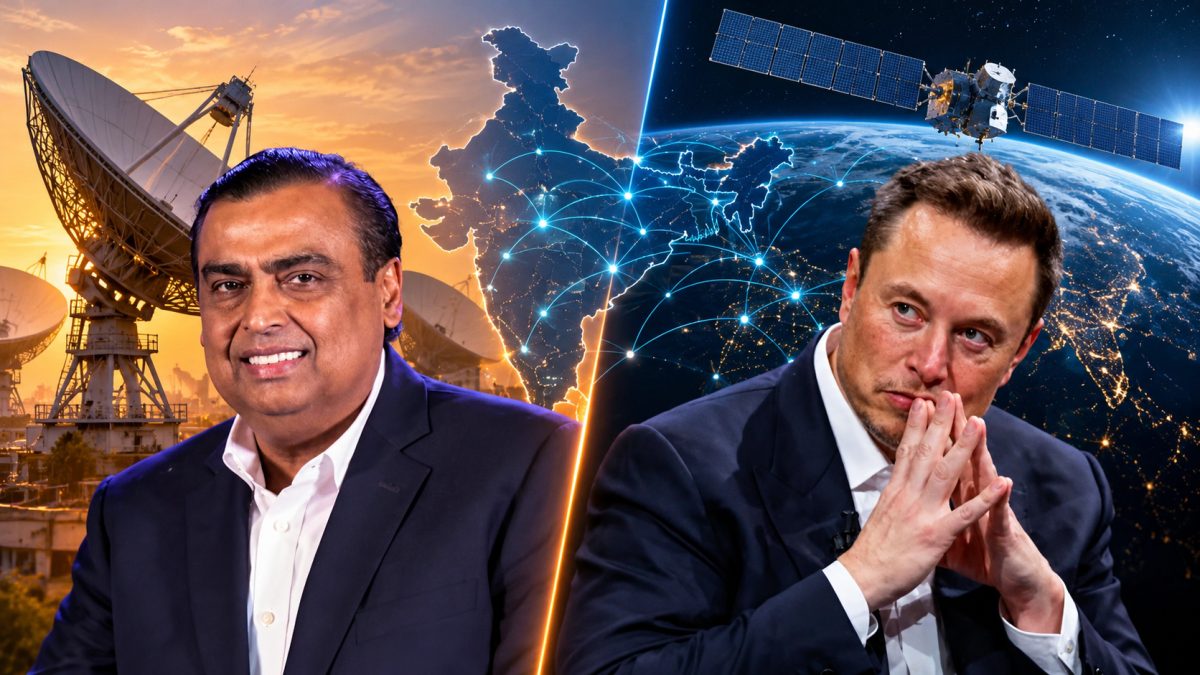

Reliance says bring on the competition, but nobody gets to skip India's satellite rulebook, not even Starlink.
Reliance Industries publicly responded on October 16, 2026, to Elon Musk's accusations that vested interests were delaying Starlink's entry into India, saying it welcomes the competition but every operator, including its own Jio business, must follow the country's laws, security checks, and spectrum rules.
Jio IPO Valuation Could Push Reliance Past Tata Group In India Rankings
Reliance Elon Musk Starlink Competition Rules Statement Breaks Silence
View this post on Instagram
The statement came days after Musk publicly criticized delays holding up Starlink's commercial launch in India. He suggested that hidden forces were working against SpaceX's satellite internet business, pulling India's richest companies into a very public spat with one of the world's most famous entrepreneurs.
Reliance pushed back firmly but calmly. The company said, "We welcome competition in satellite communications, including Starlink. Every player, Jio included, must serve the people of India and abide by the laws and policies of the land." It was a direct answer, but it avoided personal attacks on Musk himself, choosing instead to frame the issue around fairness and equal treatment under Indian regulations.
Reliance also pointed out that its own satellite arm, Jio Satellite Communications, is stuck waiting for the same clearances as Starlink. That detail mattered a lot. It let Reliance argue that it isn't getting special treatment from regulators, and that Jio faces the identical bottleneck that Musk was complaining about.
Elon Musk Accuses Indian Oligarchs of Blocking Starlink, Here's What's Really Delaying Launch
Why Starlink Launch Delayed In India Despite Having A Licence
Starlink has held a license to operate in India for a while now, but a license alone doesn't let the company switch on its service. Two big steps remain: security clearance from Indian agencies and formal allocation of satellite spectrum. Without both, no commercial rollout can happen, no matter how ready the technology is.
This isn't just a Starlink problem. Communications Minister Jyotiraditya Scindia said on October 9, 2026, that India does not allow monopolies and follows a technology-neutral approach to satellite policy. He confirmed that three licensed players, Starlink, Jio Satellite Communications, and Bharti-backed Eutelsat OneWeb, are all sitting at roughly the same stage, waiting on security sign-offs and spectrum decisions.
The spectrum piece has its own complicated history. On September 9, 2026, India's Digital Communications Commission approved recommendations from the Telecom Regulatory Authority of India on how satellite spectrum should be priced. The proposed charge was 4% of adjusted gross revenue, with a minimum annual fee of ₹3,500 per MHz, applying equally to geostationary and non-geostationary satellite operators. That approval still needs to go to the Cabinet before it becomes final policy.
Jio Starlink Satellite Internet Competition India Traces Back To 2021
Starlink's push into India isn't new. SpaceX has been trying to enter the Indian market since 2021, long before this public clash with Reliance. In March 2025, SpaceX signed distribution agreements with both Reliance Jio and Bharti Airtel to sell Starlink equipment and services across India, but those deals were always conditional on getting government approval first.
That agreement created an unusual dynamic. Jio is technically set up to help distribute Starlink's hardware while also building its own competing satellite internet service. Reliance's statement acknowledged this overlap, framing it not as a conflict but as proof that Indian companies aren't afraid of foreign competition entering the market.
Reliance also repeated language it has used before in other contexts, saying it has "never feared competition" and that the company grew up in a business environment that welcomed both domestic and international investment. That messaging was clearly aimed at countering any suggestion that Reliance was using political influence to slow down a foreign rival.
India Satellite Spectrum Rules Starlink Jio OneWeb Face Together
The government's position throughout this dispute has stayed consistent. Officials maintain that the same regulatory process applies to every applicant, whether the company is based in India or overseas. That means Starlink doesn't get fast-tracked, but it also doesn't get singled out for extra delays compared to Jio or OneWeb.
For regular people, this fight is about more than corporate rivalry. Satellite internet could bring reliable connectivity to remote villages and areas where cell towers don't reach. But none of that happens until the spectrum pricing is finalized and security clearances are issued to all three operators.
Scindia indicated the government is close to finalizing the pricing framework for satellite communication services, though no exact date has been confirmed. The Department of Telecommunications is expected to take the spectrum pricing recommendations to the Cabinet for final sign-off, a step that would clear the last major hurdle before any commercial launch can begin.
What Comes Next For Starlink, Jio, And OneWeb In India
Nothing moves forward commercially until the Cabinet approves the spectrum allocation and pricing plan, and until security agencies complete their clearance checks on all three operators. Until then, Starlink, Jio Satellite Communications, and Eutelsat OneWeb remain stuck at essentially the same checkpoint, regardless of how loudly anyone complains about it publicly.
Reliance's message was simple at its core: competition is fine, rules are not optional. Whether that satisfies Musk or cools down the public feud remains to be seen, but for now, India's satellite internet race stays paused until the paperwork catches up with the ambition.