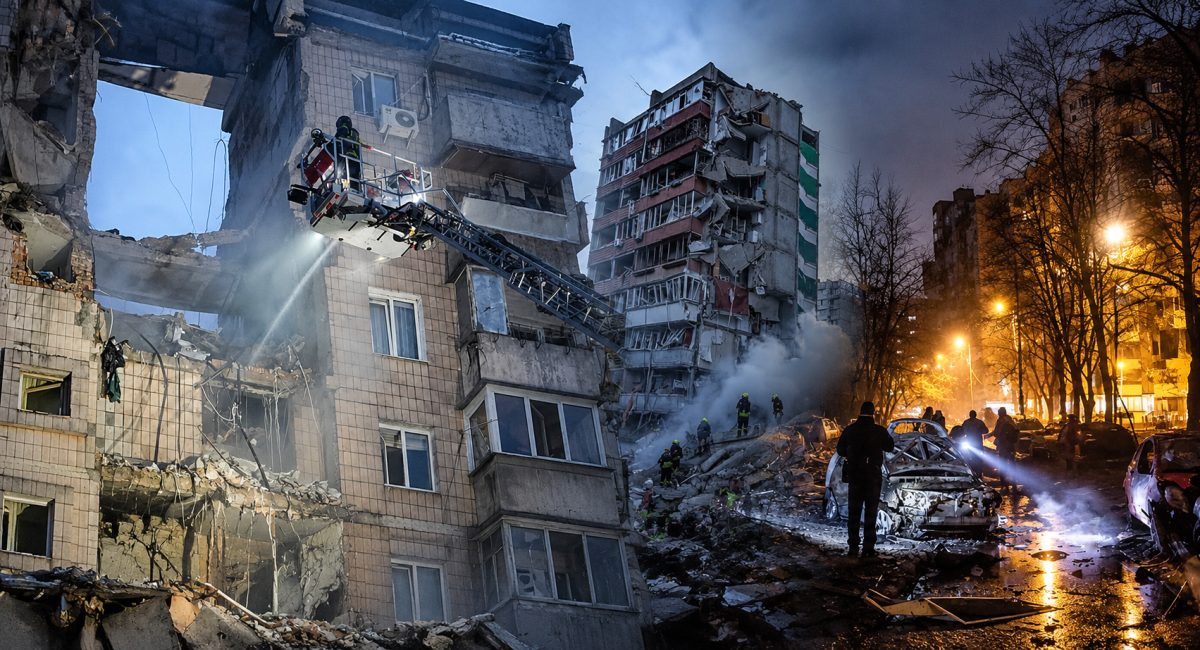

A Kyiv couple went back to sleep after missiles hit, then woke up again when more strikes landed close to home.
Life in Kyiv during Russian attacks now follows a grim pattern of alarms, explosions and quick decisions, according to a New York Times report published October 16, 2026, that followed residents through a night and day of strikes on Ukraine's capital. The newspaper described how families like Nikita Horskyi and Alona Horska cope when missiles fall close to home with almost no warning.
Iran Attacks Sink Two Ships Near Strait of Hormuz in Just 24 Hours
A Night of Explosions Shows What Life in Kyiv During Russian Attacks Looks Like
The air-raid alarm went off at 3:11 a.m. Residents had barely three minutes before the first missiles hit. Nikita Horskyi and Alona Horska were jolted awake by roughly ten loud explosions, the Times reported. Their 16-story apartment building has no proper shelter, so Horska did what many Kyiv residents now do. She built makeshift beds in the hallway, following what locals call the two-wall principle, putting as many walls as possible between themselves and the outside of the building.
The family tried to go back to sleep. That is part of the story too. People in Kyiv have grown so used to attacks that many try to rest through them. But this night, more missiles struck nearby. Two of the impacts killed security guards, the Times reported. The couple's choices that night, when to shelter, when to sleep, when to run, capture exactly how daily life in Kyiv during Russian attacks actually works now.
Houthi Attack on Riyadh Airport Kills 12, Injures 309 in Deadliest Strike in Years
Power and Water Cut Across the Capital
The overnight strike on the Horskyis' neighborhood happened against a much bigger assault. President Volodymyr Zelenskyy said Russia fired 39 ballistic missiles and more than 120 drones on October 14 at energy and infrastructure targets in Kyiv, Kyiv Oblast and Kharkiv. He called the scale of the attack, timed as it was, an act of "ostentatious disrespect toward the United States."
A second wave of strikes late on October 15 hit energy facilities again, cutting power across parts of Kyiv and dropping water pressure on the right bank of the Dnipro River, a city of roughly three million people. Ukraine's state power operator, Ukrenergo, confirmed the damage. "Widespread power outages have occurred in certain areas of Kyiv and the surrounding region," the company said, adding that repair crews would only move in once air-raid alerts had ended.
The night before, on October 13 and 14, Russia launched a combined missile and drone attack that knocked out power for more than 600,000 consumers in Kyiv and eight other regions, including Kharkiv, Chernihiv, Sumy and Zaporizhzhia. Electric buses and trams stopped running. Emergency power cuts were ordered across the city as crews scrambled to stabilize the grid.
Officials Warn Russia Is Targeting Basic Survival
United Nations officials briefed the Security Council on October 9, warning that Russian strikes had killed more than 100 civilians across Ukraine in a single week. They said the pattern of attacks on power, heating and water systems threatened to leave millions of people without basic services just as winter was closing in.
The UN briefing painted a blunt picture of life in Kyiv during Russian attacks. Air-raid alerts were not occasional anymore. They were daily, and they often stretched on for hours, officials said, "causing immense stress and stoking fear." One UN official went further, saying the apparent goal of the campaign was "to make normal life impossible," pointing to strikes on bridges that cut residents off from hospitals, food and safety.
Zelenskyy also raised concerns about gaps in Ukraine's defenses. He said Ukraine received no advance intelligence from international partners about five Russian ballistic missiles that struck civilian infrastructure in Kyiv. The claim surfaced amid rising tension between Zelenskyy and the Trump administration over continued military support.
Residents Adapt Without Giving Up Normal Routines
What stands out in the Times account is not panic. It is adaptation. Kyiv residents still go to work. They still care for relatives, run errands and commute, but every one of those routines now runs through a constant background calculation. Is this alarm serious? Should we go to the basement? Is it safe to keep sleeping?
The hallway beds built by Alona Horska are a small but telling detail. Many buildings in Kyiv, even large ones, were never built with proper shelters. So residents improvise, stacking furniture and mattresses against interior walls, trying to put distance between themselves and the windows and exterior walls most likely to take a hit.
Winter Adds Pressure to an Already Strained City
The timing of these strikes matters. Officials and residents alike are bracing for a harder winter, with damaged power plants and substations meaning less heat and electricity when temperatures drop. Ukrenergo has said repair crews will keep working through damage assessments once alerts lift, but repeated strikes on the same infrastructure make lasting fixes harder to achieve.
No single event in this reporting marks an end point. The strikes are continuing, the UN warnings remain unresolved, and Kyiv's three million residents are left managing daily life around a threat that shows no sign of stopping. The city has not stopped functioning. It has simply learned, strike after strike, how to keep functioning anyway.