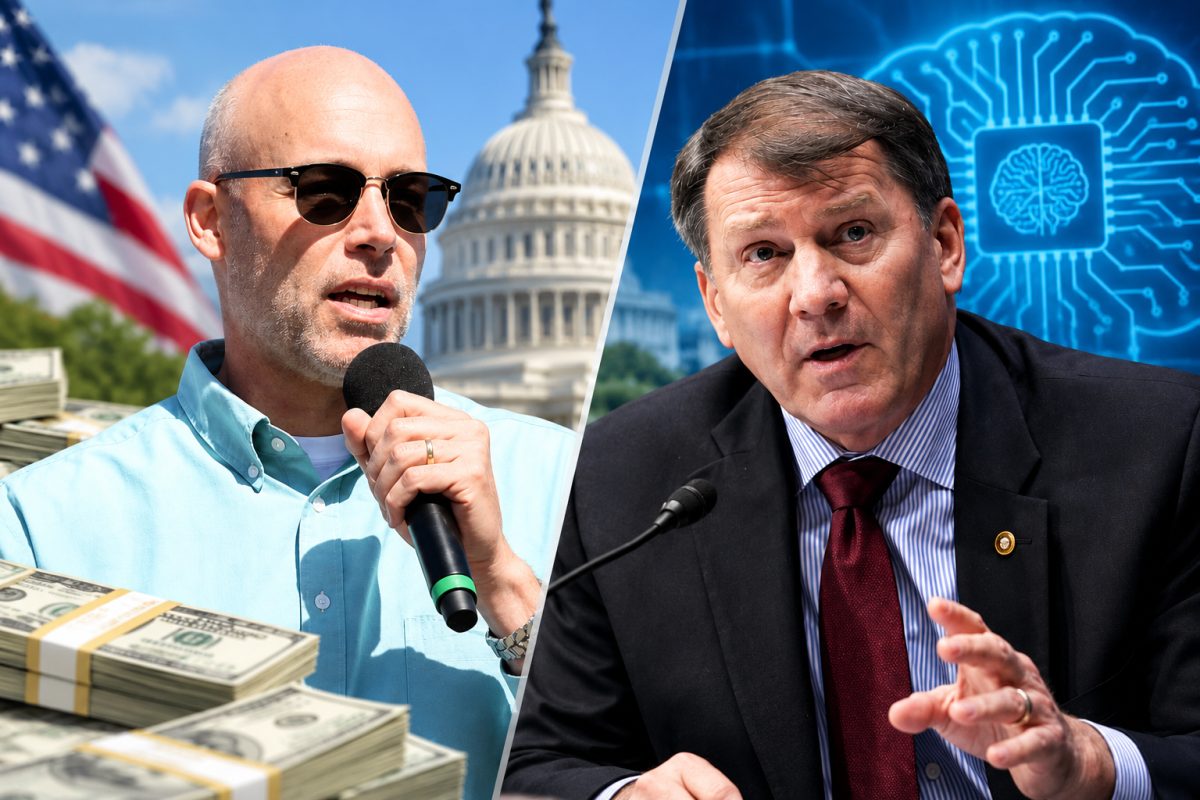

Money, AI data centers and a one-on-one Senate race are colliding in South Dakota just weeks before voters head to the polls.
South Dakota Senate campaign finance records are now at the center of a sharp fight between Republican Sen. Mike Rounds and independent challenger Brian Bengs, who says Rounds has taken more than $215,000 from AI data-center interests ahead of the Nov. 3, 2026, election.
Battlefield 6 AI-Generated Skins Spark Fury Over Five Pistols and Typo
South Dakota Senate campaign finance battle heats up over AI money
View this post on Instagram
Bengs made his accusation public at a September press conference, arguing that Rounds' fundraising ties to artificial intelligence and tech-aligned groups put the senator in the pocket of outside interests rather than South Dakota voters. He said Rounds had collected more than $215,000 linked to AI data-center interests and benefited from super PACs tied to broader tech money.
"He has taken over $215,000 American dollars from AI data center interests, and is backed with hundreds of thousands more from super PACs that support big tech interests," Bengs said. He followed with a pointed line aimed straight at voters: "Now, he can claim he represents us, but the money tells a different story."
Nothing in the available record suggests Rounds broke any law. Federal rules allow individuals, corporations and political committees to spend on campaigns under specific limits, and the Supreme Court's 2010 Citizens United ruling already cleared the way for independent corporate and union spending. Bengs' complaint is political, not legal, but it taps into growing unease about AI infrastructure projects that could reshape land use, water supplies and electricity costs across South Dakota.
AI Ransomware Attacks Now Hit 84% of Victims, New Report Reveals Shocking Trend
Mike Rounds Brian Bengs campaign finance 2026 numbers tell a mixed story
Federal filings through Sept. 30 paint a complicated picture. Rounds reported $1,747,953.19 cash on hand, compared to just $145,703.12 for Bengs. But Bengs actually out-raised Rounds during the July-to-September quarter, pulling in $891,621.55 versus Rounds' $433,254.82. Rounds spent far more in that same window, $1,462,898.31 compared to $801,431.14 for Bengs.
Individual donors clearly favor Bengs right now. He collected $858,621.55 from individuals in the quarter, while Rounds brought in $226,254.82 from that same source. Political committees tell the opposite story, handing Rounds $209,000 compared to just $33,000 for Bengs. Looking at the full campaign so far, Rounds has raised roughly $5.06 million and spent about $6.29 million, while Bengs has raised close to $1.68 million and spent around $1.53 million.
Outside groups are pouring money in too. Republican-aligned organizations spent nearly $1.2 million backing Rounds in a recent stretch, while independent-aligned groups spent about $516,000 supporting Bengs. One group, the South Dakota Conservative PAC, reported $590,861 in spending specifically aimed at opposing Bengs.
How much money has Brian Bengs raised in South Dakota Senate race explains his strategy
Bengs has built his entire campaign around small donations and distrust of big money in politics. His campaign said the average contribution during the second quarter was just $34, a number he repeats often to contrast himself with Rounds, whom he's nicknamed "Big Money Mike."
"The single biggest problem for our government in its entirety is big money controlling the system," Bengs said. He added, "I have yet to meet a person who thinks that our elected officials don't answer to big money donors over us regular voters who are not writing ten thousand dollar checks."
Rounds' campaign has pushed back hard, focusing less on the AI accusation itself and more on where Bengs' money comes from. Senate adviser Rob Skjonsberg said Bengs "fails to disclose that less than 16% of his donations came from South Dakotans," and went further, calling Bengs "a tool for the Democrat socialists trying to take over the country." Skjonsberg added, "Make no mistake, Bengs is beholden to the big government radical socialists. His campaign is funded by them."
Mike Rounds AI data center donations fuel a bigger national conversation
The race shifted dramatically back in August when Democratic nominee Julian Beaudion ended his campaign shortly after winning the June primary, leaving Bengs as the only major challenger to Rounds. Bengs, a military veteran who ran as the Democratic Senate candidate in 2022 and lost to Republican John Thune, is now running as an independent, betting that South Dakota voters are open to someone outside the usual two-party setup.
Rounds, first elected to the Senate in 2014 and now seeking a third term, won reelection in 2020 by more than 30 percentage points, a margin that once made this race look like a formality. That's no longer the case. National political watchers have started paying closer attention, noting that Bengs' independent run offers a real test of whether populist, anti-big-money messaging can shake up a deep-red state that Republicans usually don't worry about.
South Dakota Senate election campaign spending 2026 heads toward a final stretch
With the Nov. 3 election approaching fast, the financial gap between the two campaigns remains the defining storyline. Rounds holds a massive cash reserve and deep connections to national Republican fundraising networks, giving him room to spend aggressively down the stretch. Bengs has shown real strength in small-dollar donations and quarterly fundraising, but he's working with a fraction of the cash Rounds has banked.
Whether Bengs can turn his AI-funding attacks and grassroots donor base into actual votes remains the open question. Outside spending from both sides keeps climbing, and if that trend holds, South Dakota's Senate race could end up far more expensive, and far more competitive, than anyone expected when the campaign began.