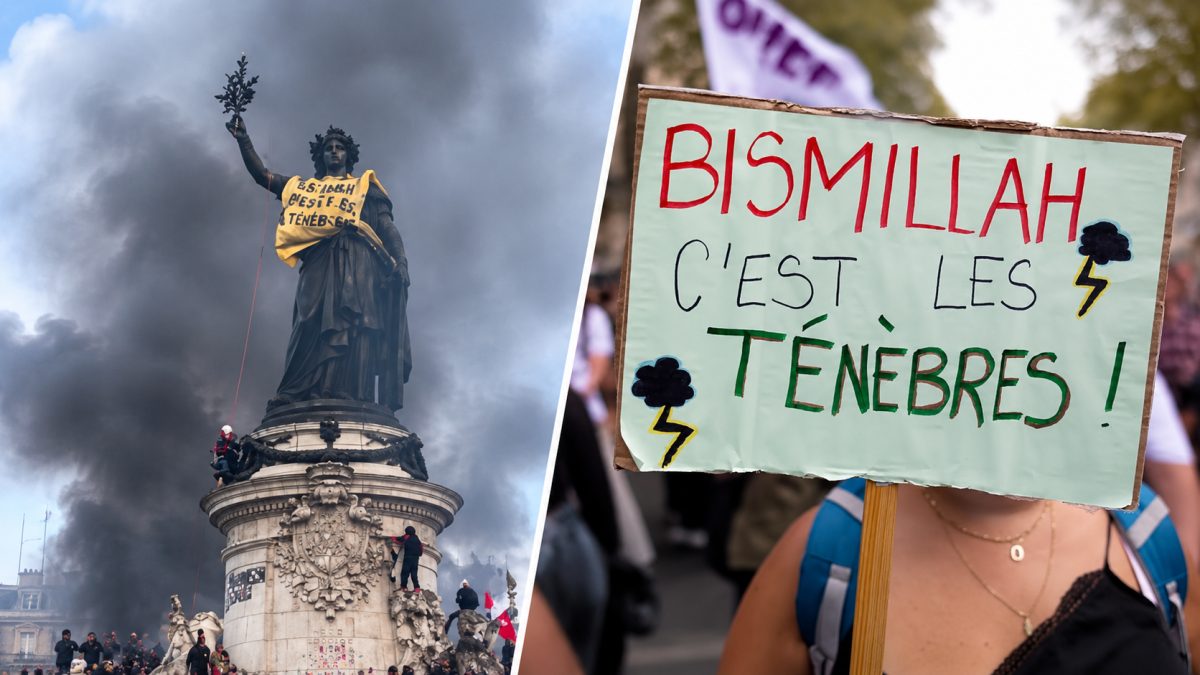

A strange five-word phrase born on Snapchat somehow became the loudest chant of France's student protests this fall.
Bismillah c'est les ténèbres, a phrase that roughly means "In the name of God, it's the darkness," has become the unofficial slogan of student protests sweeping France since September 2026, after students suspected police tried to infiltrate their Snapchat groups using awkward slang.
France's School Protests Erupt Into Arson and Clashes as PM Lecornu Calls Emergency Meeting
How The Bismillah C'est Les Ténèbres Meaning Took Shape
View this post on Instagram
The phrase first appeared in a screenshot of a Snapchat message sent by someone using the name Mamadou. The message opened with "Bismillah, c'est les ténèbres" before asking for details about a planned school blockade, according to reporting from Euronews and Middle East Eye. Students organizing the protests found the wording off. It mixed Arabic religious language with French slang in a way that felt unnatural, almost like someone trying too hard to sound like a teenager.
"Bismillah" is Arabic for "in the name of God." Muslims say it before starting a task, though in casual French slang it can simply mean something close to "let's go." "C'est les ténèbres" literally means "it's the darkness," but young people use it to describe something catastrophic or just plain bad. Put together, the phrase doesn't really make logical sense, and that's exactly why students noticed it. New Lines Magazine reported that the account appeared aimed at a young organizer helping coordinate blockades at high schools across the country.
Howard University and Wells Fargo to Host Financial Symposium for Student Athletes
Suspected Police Infiltration Sparks A Movement-Wide Meme
Students quickly suspected that Mamadou might not be a real teenager at all, but rather a police officer trying to pose as one to get inside private groups used to organize demonstrations. Reporting cited by New Lines Magazine, referencing French outlet La Provence, said geolocation data linked to the message pointed toward a police station in Aix-en-Provence. That detail alone doesn't prove who sent the message or why, and neither the French police nor the Interior Ministry has publicly confirmed any connection, according to Euronews.
Rather than ignore the strange message, protesters embraced it. The phrase spread fast, showing up on handwritten signs, banners, and chants at demonstrations nationwide. Middle East Eye described it as a symbol mocking both suspected surveillance and the racial stereotypes baked into the message itself, since the Snapchat exchange reportedly included Algerian flag emojis and other markers meant to signal North African identity. Le Monde reported the slogan reflected what it called "reverse stigmatization," where students flipped a tool apparently built to target them into a joke aimed back at authorities.
Protests Began Over School Funding, Then Widened
The demonstrations that gave rise to the slogan started in September 2026 over complaints about poor school resources and inadequate education funding. Thousands of teenagers blockaded high schools and took to the streets, based on reporting from New Lines Magazine. Over time, the movement grew to include anger over alleged police violence against young protesters, which gave the Snapchat episode even more weight.
Le Monde reported on two specific incidents cited by protesters. A 14-year-old referred to as Eden allegedly suffered a broken jaw after being struck by a tear-gas grenade launcher on September 28. Then on October 5, a 15-year-old named Evan allegedly lost a hand during a protest near his high school in Lens, reportedly after a police grenade went off. These remain reported allegations rather than confirmed findings from an official investigation. A student identified by Le Monde under the pseudonym Marwa said she wrote the slogan on her protest sign because, in her words, "The police don't understand anything about high schoolers – they're stupid and racist."
From Classroom Joke To International Headline
The slogan's reach grew well beyond French classrooms. Climate activist Greta Thunberg reportedly used the phrase on October 13 while visiting striking students at a high school outside Paris, according to New Lines Magazine, giving the meme a jolt of international attention. By mid-October, outlets including the New York Times, Euronews, Middle East Eye, and Novara Media were all explaining the phrase to readers who had never heard of it before.
The New York Times described it as shorthand for a generational divide, noting the phrase barely makes sense on its own terms yet carries real weight for the students using it. Novara Media made a similar point, writing that the phrase "doesn't really mean anything, but it has become a ubiquitous meme." That contradiction is the whole story. A message that was supposed to blend in instead became a punchline, then a rallying cry, then a worldwide news item.
What Remains Unconfirmed As Protests Continue
Despite all the attention, several basic facts remain unverified. Nobody has officially confirmed that Mamadou was a police officer. No government agency has released a statement addressing the Snapchat screenshots directly. The exact number of schools blockaded nationwide and the total number of protesting students haven't been independently confirmed either, based on the available reporting.
What is clear is that the slogan isn't going away anytime soon. It keeps appearing on signs and in chants as the broader protest movement continues, driven by anger over school funding and alleged police violence against minors. Whether French authorities ever identify the Snapchat account holder, confirm the Aix-en-Provence location, or launch a formal investigation into the injuries reported by Le Monde will determine whether this story moves from meme territory into something with real accountability attached.