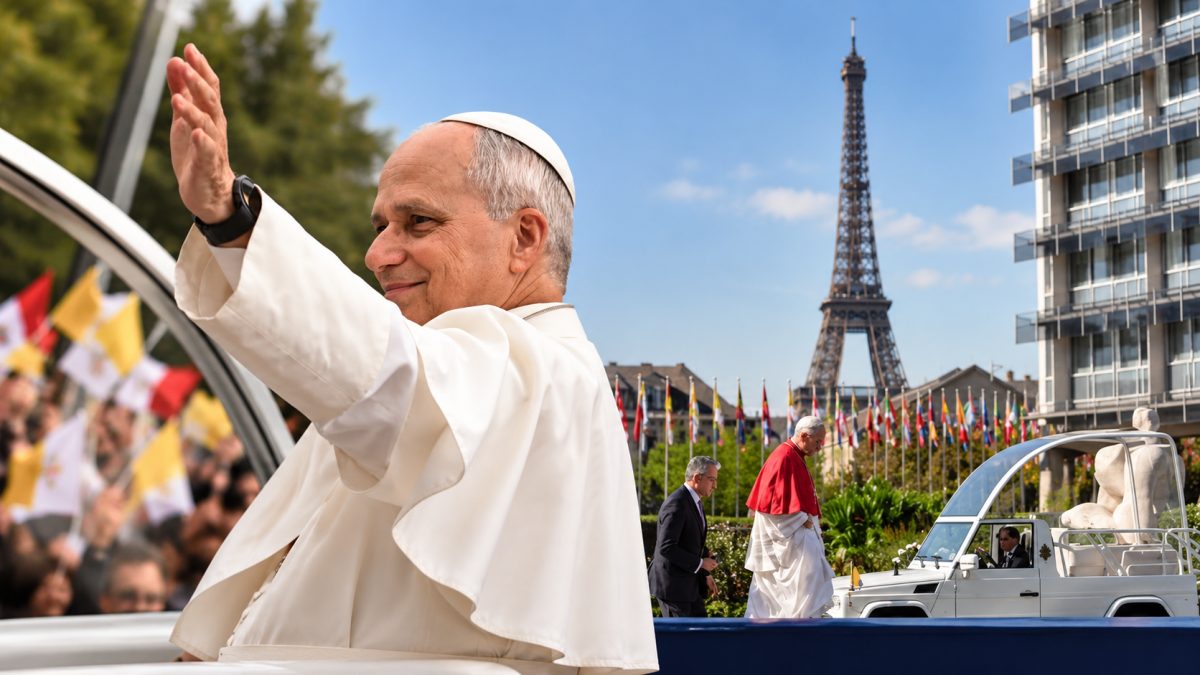

An estimated 800,000 people packed the Champs-Élysées for the largest event of the pope's four-day France trip, a day after he warned Emmanuel Macron of a looming 'paradise of machines.'
Pope Leo XIV celebrated an open-air Mass in front of an estimated 800,000 people in central Paris on Saturday, Sept. 26, according to the Vatican, transforming the Champs-Élysées and Place de la Concorde into the largest gathering of his four-day visit to France. The 71-year-old pontiff rode through the city in the popemobile before presiding over the service beneath a temporary white canopy erected as an altar, with the congregation stretching more than two kilometers toward the Arc de Triomphe, according to France 24.
Priyanka Chopra, Jennifer Lawrence Share Viral Moment At Paris LVMH Prize
A Crowd That Outgrew Its Own Registration
View this post on Instagram
The scale of the turnout stunned even Vatican logistics planners. About 600,000 people had registered in advance to attend, but roughly 800,000 showed up — a gap of some 200,000 people, according to the Associated Press. The Vatican said the figure was supplied by local authorities rather than an independent audit, meaning the number represents an official estimate rather than a precise headcount.
The Mass drew an extensive clerical presence to match the crowd: approximately 2,400 priests and deacons and around 100 bishops concelebrated the service, according to ITV News. Authorities had to manage pedestrian flow across the Champs-Élysées, Place de la Concorde and the corridor toward the Arc de Triomphe, allowing worshippers who could not reach the altar to follow the liturgy from along the avenue.
Reuters reported that at the Mass, Leo urged Catholics to root their happiness in faith rather than material possessions, a message the AP framed as evidence of the Catholic Church's enduring pull in a nation that is constitutionally secular and has seen decades of declining religious practice. The AP described the event as a sign of the church's "enduring appeal in the once staunchly Catholic but officially secular country."
Why Pete Hegseth Refused to Hold Jesse Watters' Drink at Trump's Xi State Dinner Photo-Op
Friday's Arrival and the Macron Meeting
The Mass capped a visit that began Friday, Sept. 25, when Leo's charter flight landed at Paris-Orly Airport and church bells rang nationally to mark the occasion, according to NPR. Vatican estimates put Friday's turnout to see the pope at approximately 300,000, and officials had anticipated that more than one million people could take part in events across the first two days combined.
President Emmanuel Macron received Leo at the Élysée Palace that afternoon, where the pope delivered remarks linking artificial intelligence, nuclear weapons and threats to human life as interconnected moral challenges. "If we are to avoid losing our humanity amid a 'paradise of machines' invading and conditioning our daily lives, there is an urgent need for education in ethical discernment and the capacity to acknowledge the moral good," Leo said, according to Reuters and multiple outlets including NPR and Al Jazeera.
Reuters further reported that Leo urged the world to reconsider the trajectory of AI research, warning that machines could eventually take control of the Earth, and separately cautioned that the United Nations risked becoming a "charade." Those remarks extended the visit beyond religious devotion, positioning the pope as a global commentator on technology, international governance and human dignity rather than a figure confined to ecclesiastical concerns.
Beyond the Altar — Youth, Lourdes and the Broader Itinerary
The France trip carried a devotional dimension as well as a public one. Following Saturday's Mass, Leo traveled to Lourdes, the pilgrimage site in southwestern France associated with 19th-century apparitions of the Virgin Mary, where he prayed at the grotto, according to France 24. The stop placed the visit's final stretch in the tradition of Catholic pilgrimage rather than public diplomacy.
Earlier in the trip, the pope also addressed roughly 80,000 young believers, aged 17 to 35, at a stadium gathering in the Paris suburb of Saint-Denis. Reporting does not establish whether that youth event was counted within the 800,000 estimate for the Champs-Élysées Mass, and the two figures should be treated as separate event totals rather than a combined attendance number.
What the Numbers Do — and Do Not — Prove
The scale of Saturday's crowd offers clear evidence that papal appearances can still mobilize enormous numbers of people in France, even as weekly religious observance has weakened over decades and the state maintains strict secular governance. Available reporting did not identify any organized protest movement, market reaction, or shift in church-state policy connected to the visit, indicating its immediate measurable impact was primarily civic and logistical — the coordination of security and crowd management for one of the largest religious gatherings the country has hosted in years.
What the attendance figures cannot establish is whether the moment translates into lasting change. A single Mass or pilgrimage can draw tourists, culturally Catholic participants and curious onlookers alongside committed worshippers, and nothing in the reporting indicates new church membership, increased regular Mass attendance, or measurable shifts in public attitudes toward religion. The lasting significance of the visit, observers suggest, will depend on how the Vatican and French Catholic institutions build on the momentum generated by a single extraordinary Saturday in Paris.