
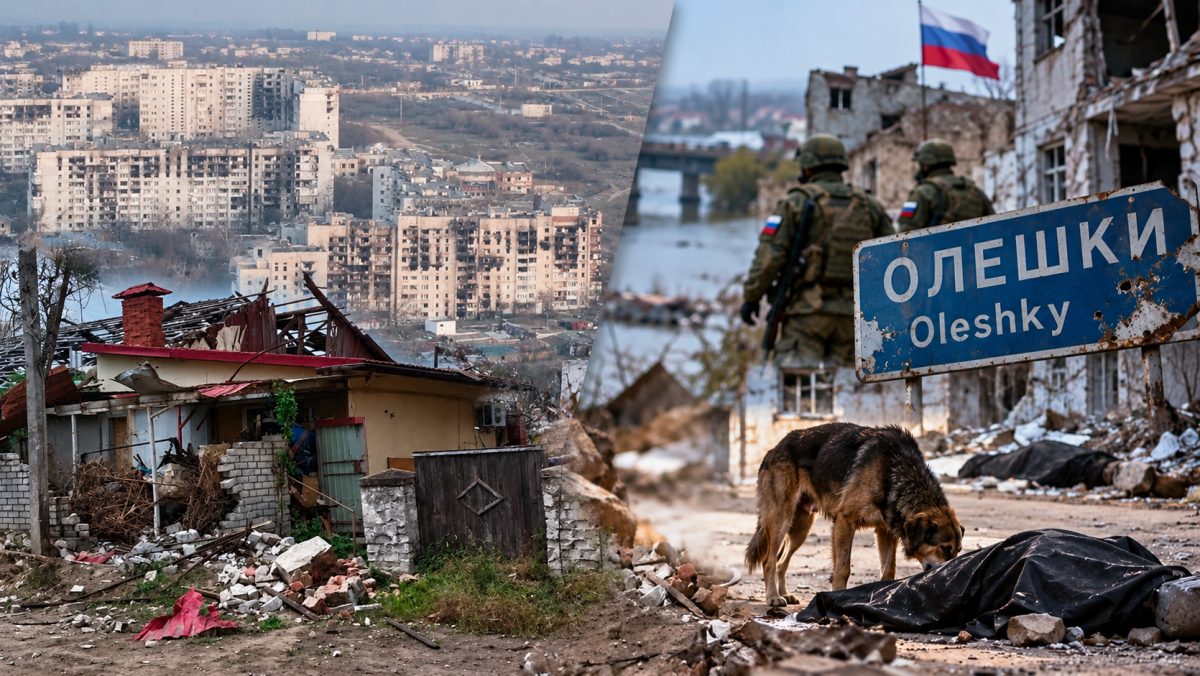

Four months after the last confirmed supply mission, residents of the occupied Kherson region city describe starvation conditions, blocked evacuation corridors and bodies left unburied amid drone surveillance.
Residents remaining in Russian-occupied Oleshky, a city in Ukraine's southern Kherson region, are surviving on one meal a day made from courgette soup and foraged purslane, according to messages shared with the Guardian and published on 27 September 2026. The city's last confirmed successful food-delivery and evacuation mission occurred on 26 May, according to Oleshky Military Administration head Tetiana Hasanenko, and Ukrainian officials say deliveries had not resumed by mid-September, leaving thousands of civilians without meat, flour, cooking oil or bread.
Russian Drone Strikes Ukrainian Train Near Poland After Johnson Convoy Passed
How Food Access Collapsed Since May
View this post on Instagram
The blockade traces back to a single date. Hasanenko said the 26 May mission was the last time supplies and evacuations reached Oleshky successfully, a claim independently corroborated by a United Nations human-rights monitoring update that found no food had reached the city between 26 May and 24 June. Subsequent attempts to restore access ended in violence: on 2 June, Russian drones attacked vehicles carrying food, killing two drivers and injuring others, according to the Kyiv Independent. A further attempt on 1 September was halted after Russian forces attacked five vehicles with drones.
By 18 September, Ukrainian reporting indicated the city had gone almost four months without a confirmed delivery of food or medicine. German broadcaster DW, reporting on 23 September, described the situation as a famine risk, citing Hasanenko's own words: "you can't just call this starvation — it's a famine." She separately told the Kyiv Independent there was "absolutely no meat, flour, oil, butter, ready-made bread, and other basic products in the city."
Ovechkin Appears In Pro-Putin United Russia Campaign Ad Ahead Of Elections
Residents Reduced to Foraging and Bartering
The Guardian's account, based on messages shared by residents, described meals consisting of potato-free soup made from courgettes grown in what were once flower boxes outside apartment blocks, sometimes supplemented with purslane, an edible weed. The BBC separately reported that residents had exhausted the vegetables they grew over the summer and turned to cooking garden weeds, with local Telegram groups becoming informal channels for identifying which weeds are safe to eat and how to prepare them.
Those same Telegram channels have also become marketplaces of last resort, used to organize small-scale food sales, swaps and donations among neighbors. A resident told the Kyiv Independent there was "absolutely nothing to buy" and little realistic opportunity for barter, while some households have preserved bread in jars to stretch dwindling reserves. A resident contacted by DW, when asked about lunchtime meals, replied simply: "To be honest, I haven't eaten anything yet." Another account captured the psychological toll: "People want to be given some kind of hope, but there is no hope."
Mines, Drones and the Danger of Retrieving the Dead
The humanitarian collapse extends beyond food scarcity. The Guardian reported that bodies are being left for dogs because approaching them exposes residents to deadly drone attacks, a detail underscoring how even basic tasks — burial, medical care, food collection — now carry lethal risk. The UN has confirmed that landmines and drone surveillance are simultaneously preventing food deliveries, medical transfers and organized civilian evacuation, effectively sealing the city off from conventional humanitarian access.
Ukrainian military or state-linked channels have reported air-dropping supplies into Oleshky, according to the Guardian's coverage, but such drops offer only limited, sporadic relief rather than a substitute for a secure and recurring corridor. The International Committee of the Red Cross has reportedly signaled readiness to assist with a negotiated evacuation, though agreement on security guarantees between Russia and Ukraine remains unresolved.
Scale of the Crisis and Verified Figures
Ukrainian Parliament Commissioner for Human Rights Dmytro Lubinets estimated on 16 September that more than 6,000 people might remain in Oleshky and nearby settlements, including approximately 200 children, though this figure spans the wider area rather than the city alone. His office had verified 358 individuals requiring urgent assistance to leave safely, a figure officials describe as a defined starting point for any evacuation operation, even as the broader population estimate suggests a far larger logistical challenge.
Earlier in the year, a letter-writing campaign publicized by ABC News generated enough attention to push occupation forces to demine some local roads and temporarily permit supplies into Oleshky, allowing residents to rely partly on garden produce through the summer. That opening proved temporary rather than sustained, and by mid-September officials confirmed neither deliveries nor departures were continuing.
What Comes Next for Trapped Civilians
Without a restored supply route or protected evacuation corridor, aid officials expect conditions to deteriorate further as household gardens and stored food are exhausted heading into colder months. The immediate steps identified by Ukrainian officials and humanitarian bodies include securing Russian and Ukrainian agreement on a safe corridor, obtaining guarantees against drone and artillery strikes, clearing or bypassing mined roads, and prioritizing the 358 verified urgent cases while planning for the wider population.
Russia's position on the attacks and its willingness to facilitate a negotiated corridor were not established in available reporting, and any characterization of a deliberate starvation policy would require evidence beyond the documented pattern of blocked routes, drone strikes and occupation conditions. Until independent access is restored, verification of conditions inside Oleshky will remain limited to residents' messages, Ukrainian official statements and UN monitoring updates.