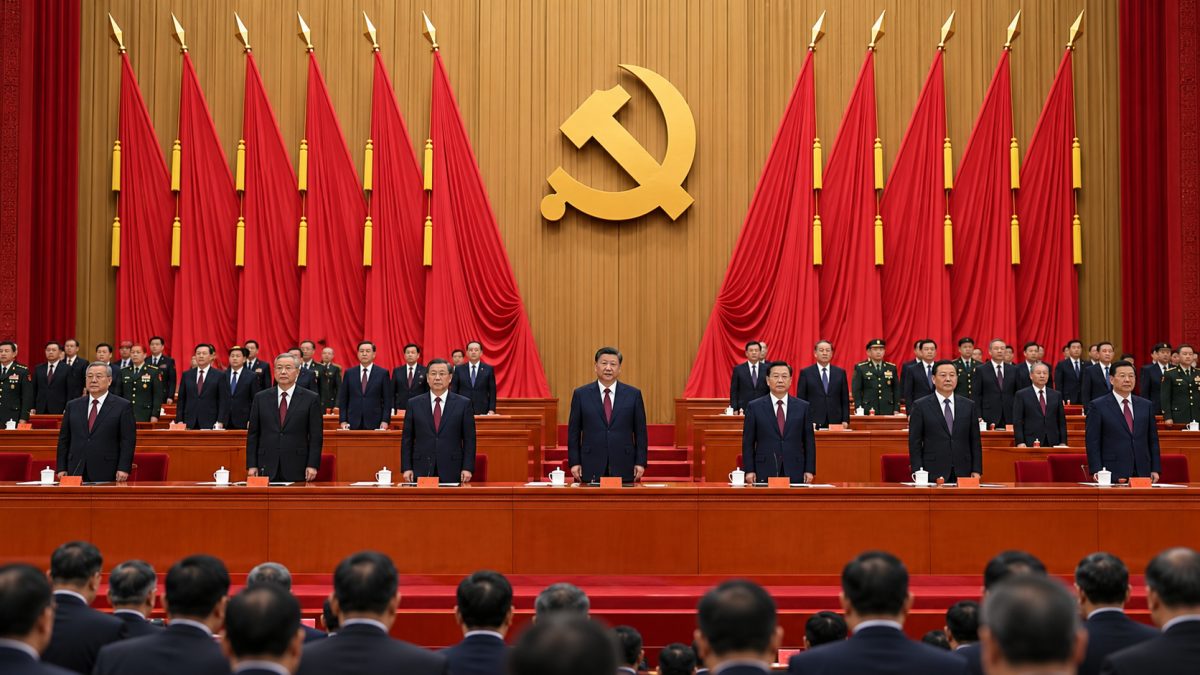

Chinese leaders locked themselves in a Beijing hall for four days to talk about loyalty, power, and who gets to keep it.
China's Communist Party opened its Fifth Plenum in Beijing on Monday, October 26, 2026, bringing together roughly 300 top officials through October 29 as Xi Jinping's corruption crackdown moves deeper into the party's highest ranks, including two Politburo members facing possible expulsion.
China Unveils New Bond Market Stabilization Plan to Stop a Dangerous Selloff Spiral
Xi Jinping corruption crackdown takes center stage in Beijing
The meeting runs behind closed doors at a time when Xi, China's president and Communist Party general secretary, is pushing officials to fall in line. He opened the session by delivering a work report from the Politburo and walking members through a draft document on what the party calls full and rigorous self-governance. State media framed the document as a response to concerns about discipline, corruption, and officials growing too comfortable in their posts.
Reuters reported the plenum could formally ratify the expulsions of two Politburo members, Zhang Youxia and Ma Xingrui, over allegations that include corruption and disloyalty. If confirmed, it would mark one of the most striking moves yet in a campaign that has already reached into the military's top ranks and touched officials once seen as close to Xi himself. The BBC noted that state media cast the gathering as paving the way for a broader tightening of discipline across party ranks.
China Finance Minister Lan Fo'an To Open APEC Hong Kong 2026 Meeting
Timeline shows months of quiet preparation before the conclave
The groundwork for this week's meeting stretches back months. On July 30, the Politburo announced the October gathering would study what it called major issues tied to the sustained advancement of party self-governance. Then on September 21, Xi chaired another Politburo session that locked in the October 26-29 dates and set the stage for what was coming.
Just days before the plenum opened, the moves accelerated. On October 23 and 24, Reuters reported the session could address personnel questions tied to disgraced officials, and the party announced new leadership in six provinces, including two fresh provincial party chiefs and six officials lined up to become governors. That timing was no accident. Analysts say shuffling regional leadership right before a major discipline meeting signals Beijing wants loyal, vetted people in place at the local level before bigger decisions get made in the capital.
Official statements point to loyalty as much as bribery
A party journal article attributed to Xi laid out three priorities guiding this phase of the campaign: making sure the party leadership's decisions get carried out without question, locking the enormous power held by officials into what he called an institutional cage, and keeping up what he described as high pressure anti-graft enforcement with greater penetrating power.
That language matters. It suggests the crackdown isn't just about officials pocketing bribes. Reporting from the BBC pointed to the idea of moral corruption, a term analysts say could stretch to cover disloyalty or behavior seen as undermining Xi's authority. In other words, breaking political ranks can be treated the same way as financial wrongdoing. Reuters described the overall goal plainly as tightening discipline and pressing officials to actually implement orders coming from Beijing, rather than quietly ignoring them.
A campaign running since 2012 now shapes the path to 2027
Xi launched his anti-corruption drive after taking the party's top job in 2012 and formalized an internal discipline campaign in 2014. Over more than a decade, it has investigated millions of people across China's bureaucracy and removed hundreds of senior officials, including top military officers. The Fifth Plenum is the fifth such gathering of the Central Committee formed in 2022, and it lands at a pointed moment, just ahead of the 21st Party Congress expected in 2027.
Analysts widely expect Xi to retain his position at that congress, extending his time at the top for another five-year term. The plenum itself doesn't hand out that decision, but it shapes the environment leading into it, setting disciplinary standards, testing loyalty, and clearing out officials seen as unreliable. Reuters described the session as potentially the last major party gathering before that 2027 reshuffle, which raises the stakes for everything decided this week.
What comes next after the closed-door session ends
The plenum is scheduled to wrap up on October 29, after which official communiqués should spell out what was actually adopted in the self-governance document and whether the reported expulsions of Zhang Youxia and Ma Xingrui go through. Because the meeting itself stays closed to outside observers, most of what the public learns will come through party statements and whatever disciplinary announcements follow in the weeks ahead.
Beyond this week, the bigger story is the road to 2027. Xi's anti-corruption campaign shows no sign of slowing down, and the provincial leadership changes announced just before the plenum suggest the reshaping of China's political bench has already started. For now, the clearest signal is this: in Xi's China, rank alone no longer guarantees protection from investigation, and loyalty is being treated as seriously as any ledger of bribes.