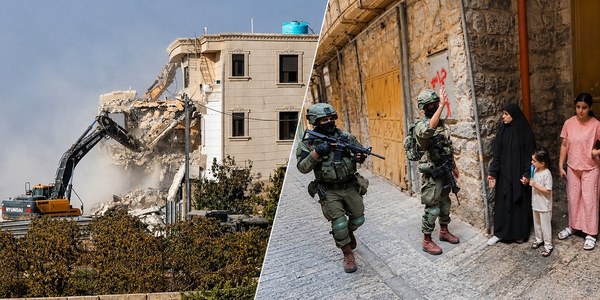

Bulldozers rolled through two Hebron neighborhoods within hours of a deadly checkpoint shooting, and families say they barely had time to grab their keys.
The Hebron home demolitions began on Friday, 23 October 2026, after two Palestinian gunmen killed two Israeli soldiers at a checkpoint in the occupied West Bank city. By Saturday, local officials said around 1,200 Palestinians had already been forced out of their homes, with another 1,300 people facing possible displacement in the days ahead.
US Diplomats Leaving Saudi Arabia as Houthi Attacks Spark Fear of Wider War
How the Hebron home demolitions unfolded
View this post on Instagram
The attack happened at a temporary Israeli military checkpoint on Friday morning. Two gunmen opened fire, killing two soldiers and lightly wounding three others, according to the Israeli military. Troops said they killed both attackers at the scene. Within hours, Israeli forces moved into the Farsh al-Hawa area and started tearing down buildings, according to CNN.
By Saturday, the demolitions had spread to the nearby Ein Deir Baha neighborhood. Hebron Mayor Youssef al-Jaabari said the operation covered roughly 0.35 square kilometres of dense urban land. Video shared online showed what looked like an entire street reduced to rubble, with homes marked ahead of time with spray paint so bulldozer crews knew which buildings to hit.
Residents described a chaotic scramble to leave. Some said they were told to get out without being allowed to take their cars. Israeli forces set up cordons around the affected areas and only let people exit through three designated points, where they faced questioning and security screening, the military said.
Bismillah C'est Les Ténèbres Meaning: Why This French Slogan Went Viral
Numbers shift as officials track different groups of victims
News outlets reported slightly different figures, and that's because they were counting different things. Reuters put the number of displaced Palestinians at about 1,200 as of Saturday, based on a local official's account. The BBC's radio coverage cited roughly 250 displaced families, while a separate BBC report mentioned at least 200 families forced out. CNN said about 500 families, or close to 2,500 people, lived in the broader operational zone, though the number actually displaced at that point was smaller.
Hebron's municipal leader, Yousef Zouhair al-Jabari, said an additional 1,300 people could still lose their homes if the operation continues as planned. That would push the total toward 2,500 people, a figure that matches what Mayor al-Jaabari separately described as the scale of the broader plan. Hebron itself is home to about 200,000 residents, so the affected area represents a small but densely packed slice of the city.
Netanyahu says homes will be destroyed one by one
Israeli Prime Minister Benjamin Netanyahu ordered the operation personally after the attack. His office quoted him saying troops would go house by house. "We will evacuate the residents, we will go from house to house, we will also seize the weapons there, and all the terrorist infrastructure will be dealt with and destroyed," he said. In another comment, he said Israel would "act to destroy this place."
The Israeli military and the Israel Security Agency released a joint statement describing the demolitions as part of a counterterrorism push. They said forces were carrying out "precise, targeted and thorough searches" to find weapons and dismantle what they called terrorist infrastructure. The statement also referenced earlier steps, including mapping the attackers' residences, setting up roadblocks around Hebron and the nearby town of Halhul, and imposing a cordon on both areas before the demolitions started.
Palestinian officials call the response disproportionate
Palestinian leaders in Hebron pushed back hard against the scale of the operation. Al-Jabari called it "disproportionate and unjustified," according to Reuters. Residents echoed that anger. Majdi Nasser, one of the displaced, told Reuters, "We are isolated; we don't do anything. This is all arbitrary."
Many of those forced out say they have no link whatsoever to the two gunmen behind Friday's attack. The demolitions hit more than just homes — officials said businesses, small factories, roads and other infrastructure were also destroyed or damaged, raising worries about how residents will earn a living once the operation ends. Israeli authorities, for their part, said some of the structures torn down were illegal buildings that posed a security risk, though the reporting available does not show individual legal orders tied to each demolished property.
What comes next for displaced families
Israeli officials have signaled the operation could run for several more days, with continued searches, roadblocks and possibly more demolitions. That means the displacement number, already at 1,200, could keep climbing toward the 2,500 figure local officials have warned about.
What remains unclear is just as important as what's confirmed. There's no announced timeline for when families might return, no public compensation plan, and no court process mentioned for residents who say their homes were destroyed without any connection to the attack. For now, hundreds of families in Hebron are sleeping elsewhere, waiting to see how much of their neighborhood will still be standing when the bulldozers finally stop.