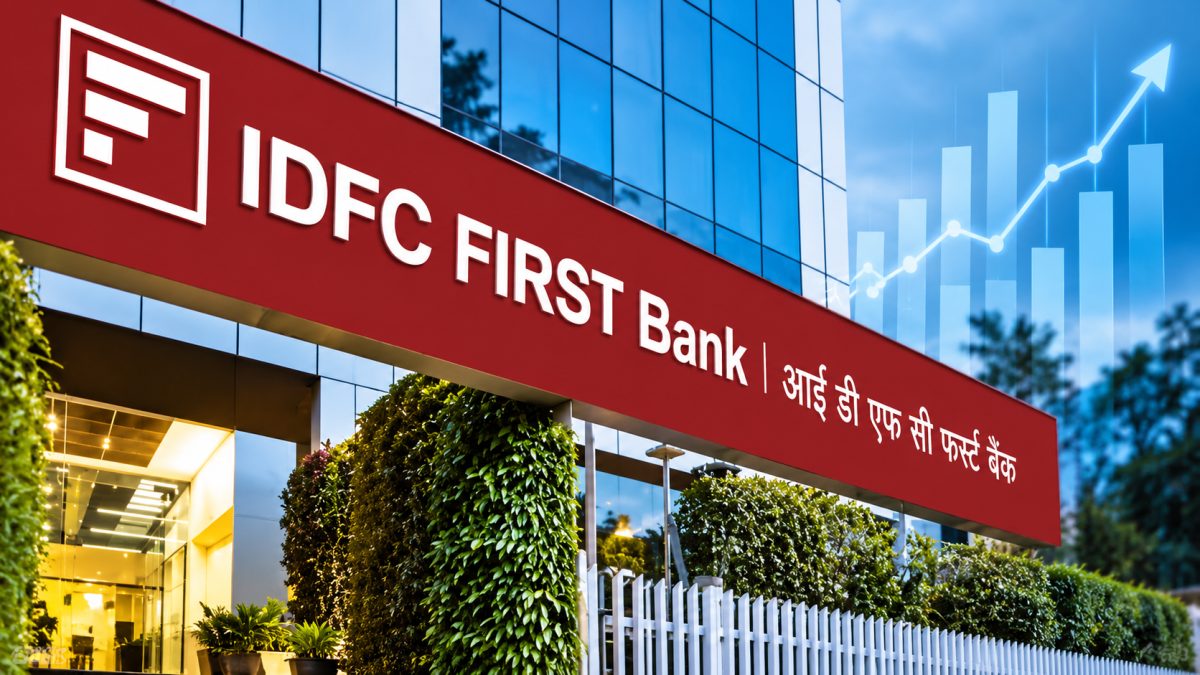

IDFC FIRST Bank just posted back-to-back billion-rupee profit quarters, and the numbers behind it tell a bigger story.
IDFC FIRST Bank reported a 196.5% year-on-year jump in profit after tax to ₹1,045 crore for the quarter ended September 30, 2026, the bank announced on October 24, 2026. This marks the second consecutive quarter the Mumbai-based lender has crossed the ₹1,000 crore profit mark, following a similar performance in the previous quarter.
Central Bank of India Q2 FY27 Results: Profit Jumps 21% as Loans Surge 30%
IDFC FIRST Bank Q2 FY27 Results Show Sharp Profit Jump
The bank's standalone profit after tax climbed from ₹352 crore in the same quarter last year to ₹1,045 crore this time around. That is close to a three-fold increase, and it did not happen by accident. Net interest income, the gap between what the bank earns from loans and what it pays out on deposits, rose 21% year-on-year to ₹6,184 crore, up from ₹5,113 crore a year earlier.
Total income for the quarter touched ₹14,218 crore, compared to ₹11,828 crore in the same period last year. The bank credited the improvement to a mix of factors including stronger core operating profit, better other income, tighter cost control, and lower provisions set aside for bad loans. None of these moved in isolation. Together, they pushed the bottom line higher at a pace that surprised many market watchers tracking IDFC FIRST Bank Q2 FY27 results.
HealthPartners and Essentia Health Plan Merger Creating Minnesota's Newest Health Care Giant
Loan Assets and Deposits Both Climb During the September Quarter
Total loan assets, which include loans and advances, credit substitutes, and loans backed by FCNR(B) deposits, grew 30.1% year-on-year to ₹3,46,913 crore as of September 30, 2026. Breaking that down, loans and advances stood at ₹3,38,929 crore, while credit substitutes added another ₹7,984 crore to the pile.
Strip out the FCNR(B)-backed loans, which are tied to foreign-currency deposits from non-resident depositors, and the underlying loan growth comes in at a more modest 22.2% year-on-year. That gap matters because FCNR(B)-linked lending can inflate headline numbers without reflecting the bank's core domestic lending strength. Deposits, meanwhile, grew 25.9% year-on-year, showing the bank kept pace on the funding side while it expanded credit.
Management Points to Operating Leverage and a New Credit Rating
V. Vaidyanathan, the bank's managing director and chief executive officer, highlighted the back-to-back profit milestone directly. "Our PAT crossed ₹1,000 crore for the second quarter in a row, in both Q1 and Q2 FY27," he said. He also pointed to a fresh international recognition for the bank, noting, "We are also now internationally rated, with an investment-grade rating from S&P Global Ratings."
Vaidyanathan also spoke about cost discipline, saying, "Our Opex growth has been lower than income growth by about 500 basis points for the second consecutive quarter, demonstrating strong operating leverage." The bank's official statement added that its cost-to-income ratio kept falling and that return on assets was "within touching distance of 1%." According to the bank's investor presentation, core profit after tax grew 233.5% year-on-year and 15.5% quarter-on-quarter, a sign that the growth was not purely a one-time boost.
Asset Quality Trends and What the Numbers Mean Going Forward
Asset quality showed improvement too, though the exact figures need careful reading. Some reports put gross non-performing assets at 1.32% for the September quarter, while the bank's exchange filing referenced a lower figure of 1.01% under a separate reporting metric. The difference likely comes down to how each figure is calculated or presented, and readers should treat both numbers as provisional until the full audited financial statements are out.
Financial publications covering the results largely framed them as a strong quarter, pointing to the near-tripling of profit, double-digit NII growth, healthy deposit mobilization, and better credit quality. No independent analyst downgrade, regulatory comment, or public pushback against the results turned up in the available coverage, so the reaction so far appears to lean positive, though formal market reaction through share price movement was not confirmed in the available material.
Attention Now Turns to the December Quarter
The immediate question for IDFC FIRST Bank is whether it can keep this momentum going. Sustaining deposit growth, protecting margins, and keeping a lid on operating expenses while the loan book keeps expanding will all matter. Management has signaled that operating leverage and a declining cost-to-income ratio remain top priorities heading into the next few quarters.
The next checkpoint will be the bank's Q3 FY27 results, expected sometime after the quarter ending December 31, 2026. An exact date has not been set publicly yet, and it will likely be confirmed closer to the date through a stock exchange filing. For now, two straight quarters above ₹1,000 crore in profit give the bank a strong base to build on.