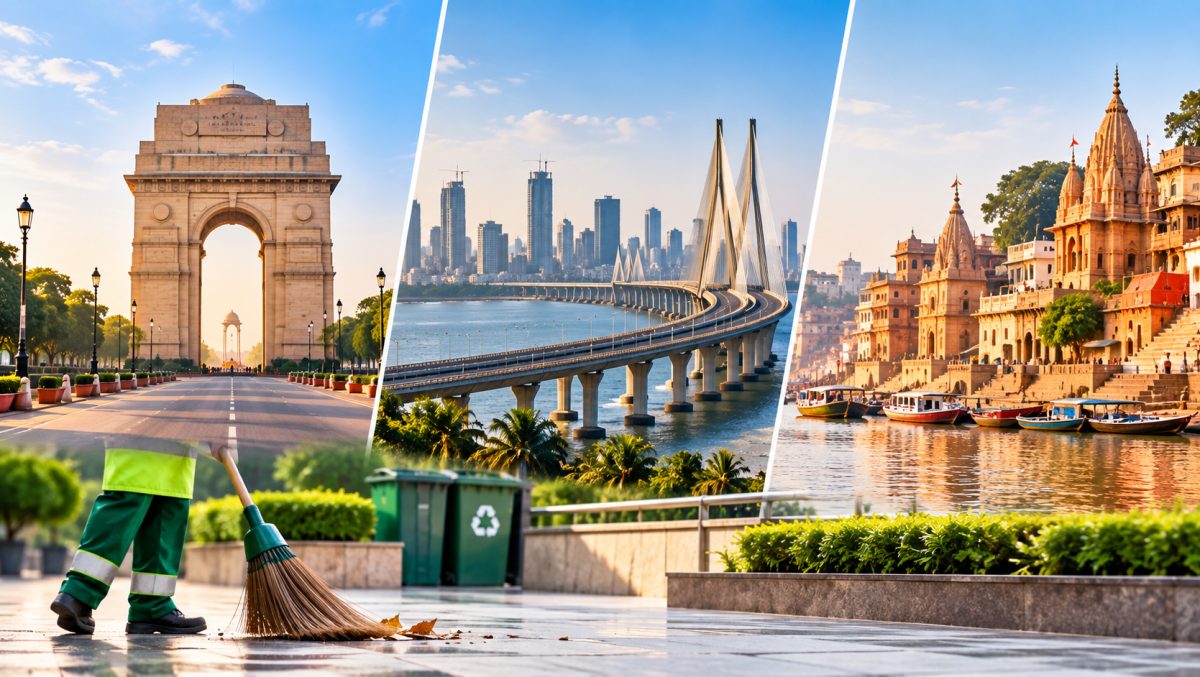

Housing Minister Manohar Lal unveils a 50-city Model City Framework tying cleanliness performance to digital KPI tracking, following Prime Minister Modi's directions at the 51st PRAGATI meeting.
The Union government on September 29, 2026, launched PRAGATI-50, an initiative to develop 50 cities across 24 states and Union Territories as role models for urban cleanliness, with Housing and Urban Affairs Minister Manohar Lal formally rolling out the programme in New Delhi. The initiative, framed under the Swachh Bharat Mission–Urban 2.0 (SBM-U 2.0), was launched in pursuance of directions issued by Prime Minister Narendra Modi during the 51st PRAGATI meeting, the government's flagship platform for reviewing large-scale governance and implementation issues, according to a Press Information Bureau release.
India's Exports to US and China Surge Sharply in August 2026
What PRAGATI-50 Actually Sets Out to Do
Unlike routine municipal sanitation drives, PRAGATI-50 is designed to push selected cities toward measurable, sustained and publicly visible improvements, the Ministry of Housing and Urban Affairs (MoHUA) said. The ministry described the approach as combining targeted interventions, key performance indicators, technology-enabled monitoring, structured handholding and regular outcome-based reviews rather than one-off cleanup exercises.
At the launch, Manohar Lal said the selected cities would go beyond ordinary sanitation work to demonstrate "sustained, high-performance parameters of visible cleanliness." According to a report by All India Radio's newsonair.gov.in, the minister emphasized that the initiative aims to build a Model City Framework covering cities of economic, cultural, heritage, pilgrimage, tourism and administrative significance, so that successful practices can later be replicated nationwide.
India Joins US-Led 25-Nation Coalition Shaping Next-Generation 6G Networks
The 50-City List and Its Geographic Spread
The cities named across various verified reports include a mix of metros, pilgrimage towns and administrative capitals. The Times of India's published list includes Tirupati, Gaya, Patna, Bilaspur, Ahmedabad, Gurugram, Faridabad, Dharamsala, Srinagar, Ranchi, Mysuru, Nashik, Puri, Ludhiana, Udaipur, Coimbatore, Warangal, Ayodhya, Mathura, Varanasi, Haridwar and Kolkata. Separate reporting by PTI, carried by ThePrint and Times of India's live blog, adds Delhi, Mumbai, Surat, Jammu, Bengaluru, Bhopal, Ujjain, Indore and Shimla to the roster.
Odisha's Bhubaneswar and Puri also feature on the list, a selection that regional outlet Prameya News described as recognition of the state's efforts in strengthening urban sanitation and scientific waste management. No single official document reviewed reproduces the complete 50-city list in identical form across sources, meaning the final published roster should be cross-checked against MoHUA's formal notification. The spread across 24 states and Union Territories nonetheless signals an attempt to capture diverse urban contexts — from religious tourism hubs like Ayodhya, Mathura, Varanasi and Haridwar to industrial and economic centres like Ludhiana, Coimbatore and Surat.
Scope Extends Beyond Street Sweeping
The programme's stated focus covers solid-waste management, used-water management, sanitation, visible cleanliness and citizen participation, according to the newsonair.gov.in report and MoHUA statements. The ministry intends the Model City Framework to address the full urban sanitation chain — from waste collection and processing to wastewater treatment, public sanitation facilities and behavioural change among residents — rather than isolated infrastructure announcements.
A central feature is digital monitoring. Reports indicate a PRAGATI-like review mechanism has been established on the Swachhatam Portal, with ministry officers assigned to each selected city for regular supervision and handholding. Babushahi.com reported that Manohar Lal is expected to chair review meetings every two months, though the precise review calendar and reporting format should be confirmed against the ministry's publicly available material. This mechanism is intended to track KPI progress and allow periodic intervention wherever implementation lags.
Linked Launches: Startups, Test Beds and Recycling Infrastructure
The September 29 event was not limited to the city list. According to PIB and posts from the official MoHUA account, the launch included the Swachh Bharat Test Bed developed by CSIR-CMERI, the onboarding of the third cohort of Swachhata startups in collaboration with IIT Kanpur, the inauguration of a Reduce, Reuse and Recycle Centre at Sankalp Bhawan in New Delhi, and the launch of a Swachhata Behaviour Change Digital Kosh. Together, these measures show the Centre pairing municipal-level monitoring with technology testing, startup incubation, recycling infrastructure and public behaviour campaigns under one umbrella event.
For pilgrimage and tourism-heavy cities such as Puri, Ayodhya, Mathura, Varanasi, Haridwar and Tirupati, the stakes are particularly visible. These destinations face seasonal population surges that strain waste management, public toilets and road cleanliness — making sanitation performance highly conspicuous to both residents and visiting pilgrims or tourists.
Unanswered Questions on Funding and Enforcement
The launch announcement stops short of detailing the financial allocation per city, baseline cleanliness levels, precise KPIs, implementation deadlines or consequences for missed targets. No verified funding figure appears across the reports reviewed, leaving unclear whether cities will receive dedicated central grants or must rely on existing SBM-U 2.0 allocations alongside state and municipal resources.
That ambiguity will determine whether PRAGATI-50 represents fresh investment or primarily a new monitoring and coordination layer atop an existing mission. The next phase is expected to bring city-specific action plans, nodal officer assignments, baseline assessments and periodic digital reviews. Given the government's outcome-based framing, the initiative's ultimate credibility will hinge on whether the 50 cities publish measurable baselines, disclose progress consistently and sustain improvements once the initial burst of central attention fades.