
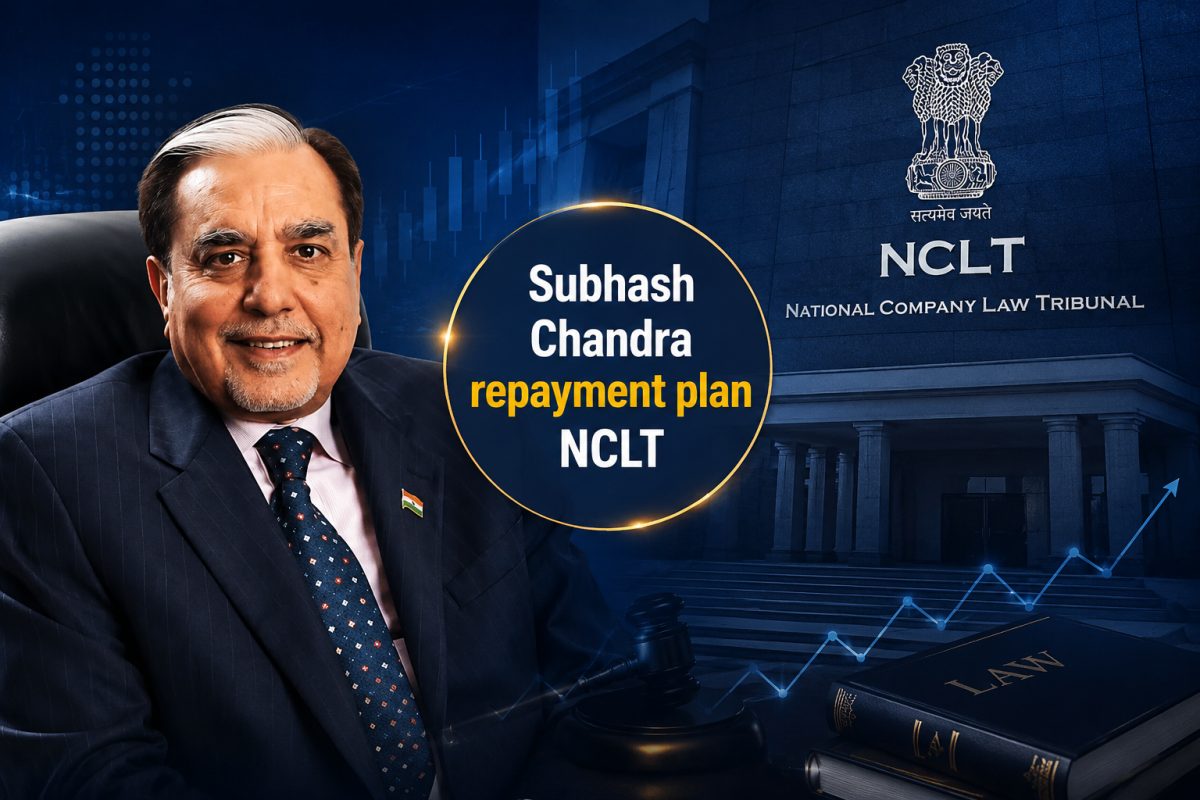

Newly constituted panel finds no enforceable majority in earlier split-bench process, pausing implementation of the Zee founder's personal insolvency settlement.
The National Company Law Tribunal's newly constituted five-member bench in New Delhi on Tuesday stayed an earlier order that had approved Zee Group founder Subhash Chandra's ₹6.25 crore repayment plan in his personal insolvency proceedings, and separately barred him from selling, transferring or otherwise dealing with his assets while the case remains pending. The bench, headed by NCLT President Justice (retd) Anupinder Singh Grewal, examined the chain of prior orders in the matter and concluded there was no clear majority view capable of being given effect to under Section 419(5) of the Companies Act. The repayment plan at the centre of the dispute had offered creditors ₹6.25 crore plus roughly ₹25 lakh toward insolvency process costs, against admitted claims of about ₹22,006.57 crore, a figure media reports have rounded to ₹6.5 crore in total.
View this post on Instagram
The case is not about debt owed by Zee Group companies. It concerns Chandra's personal liability as a guarantor for loans extended to group entities, placing it within the category of personal guarantor insolvency proceedings under the Insolvency and Bankruptcy Code.
How the Split Verdict Led to a Third-Member Tiebreaker
The dispute traces back to an original two-member NCLT bench that delivered a split verdict on Chandra's repayment proposal. With the two members divided, the tribunal brought in a third member, Nilesh Sharma, to break the deadlock, a mechanism used when a bench cannot reach consensus.
On August 25, Sharma's opinion favoured approval of the repayment plan under Section 114 of the IBC. According to reporting on that order, Sharma's decision leaned on the fact that 80.814% of creditors by voting share had approved Chandra's offer, which under the insolvency framework meant dissenting creditors would be bound by that outcome. The matter was then referred back to the regular bench for consequential directions on implementation, setting the stage for the order approving the ₹6.25 crore plan.
Why the Newly Formed Five-Member Bench Intervened
The five-member bench was constituted after the earlier process produced conflicting views, and several reports describe it as a historic or first-of-its-kind panel at the NCLT. Rather than simply allowing the third-member opinion to stand and be implemented, the newly formed bench undertook its own review of all three prior orders — the original split verdict and the subsequent tiebreaker ruling.
That review led the bench to determine that the sequence of orders did not produce an outcome enforceable under Section 419(5) of the Companies Act, the provision governing how tribunal benches must resolve differences of opinion among members. Based on that finding, the bench stayed the order approving the repayment plan and issued notice in the matter, meaning the plan cannot currently be put into effect. The bench also imposed an interim restriction preventing Chandra from alienating, encumbering or otherwise dealing with his properties, directly or indirectly, for as long as the proceedings remain pending.
Scale of the Claims Against a Fraction Proposed for Repayment
The size of the mismatch between claims and the proposed settlement has drawn significant attention. Admitted claims against Chandra in the case total roughly ₹22,006.57 crore, while the approved plan before the stay offered creditors just ₹6.25 crore, plus the additional sum earmarked for process costs. Multiple reports characterise this as amounting to a near-total haircut for creditors, with some describing the shortfall as close to 99% or higher relative to the claims on record.
Reports also note that claims specifically backed by Chandra's personal guarantees, as distinct from the broader admitted claims figure, amounted to about ₹3,992 crore, underscoring the scale of the recovery gap even when narrowed to guarantee-linked liabilities.
Creditor Pushback and the Possibility of Further Appeals
Not all creditors accepted the earlier approval quietly. HDFC Bank, one of the creditors in the case, had said it was exploring an appeal to the National Company Law Appellate Tribunal against the order that accepted Chandra's ₹6.5 crore offer, according to earlier reporting. That signals at least some financial creditors viewed the settlement as inadequate relative to what was owed and were prepared to pursue the matter through appellate channels regardless of how the NCLT proceedings concluded.
With the five-member bench's stay now in place, the immediate legal question of whether the repayment plan can be implemented remains unresolved. The tribunal has issued notice in the matter, indicating further hearings will follow, and the practical effect for now is that Chandra's assets stay protected from disposal while creditors retain the option to keep contesting the proposed repayment framework through the pending proceedings.