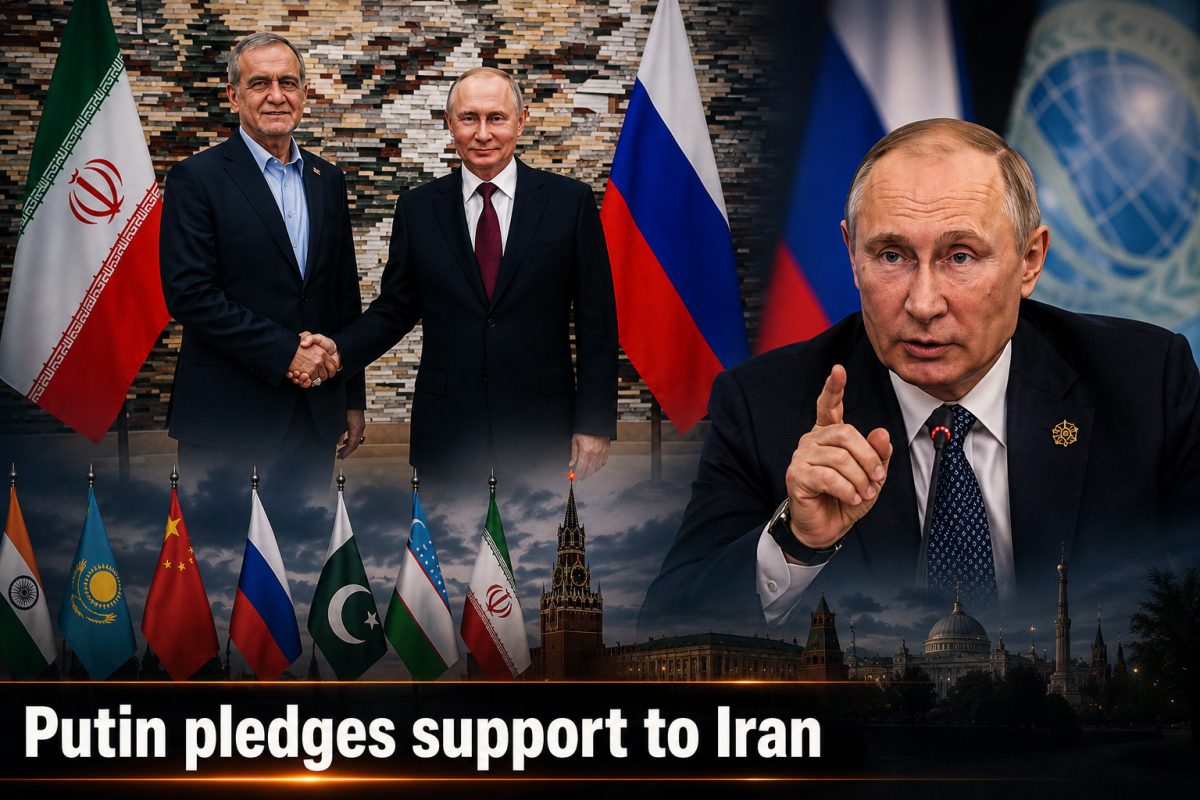

Russian and Iranian presidents deepen alliance at Shanghai Cooperation Organisation summit amid US strikes on Iranian targets and ongoing sanctions pressure.
Russian President Vladimir Putin pledged continued support to Iran during a bilateral meeting with Iranian President Masoud Pezeshkian on Tuesday, September 1, 2026, on the sidelines of the Shanghai Cooperation Organisation summit in Bishkek, Kyrgyzstan. The meeting came as the United States launched fresh strikes against Islamic Revolutionary Guard Corps targets in Iran, adding urgency to Putin's public declarations of solidarity. Putin used the regional gathering to frame Russia-Iran ties as a strategic partnership and to encourage fellow SCO leaders to push back against what he described as American unilateralism and sanctions.
According to Russian state news agency TASS, Putin told Pezeshkian that Moscow was providing Tehran with "necessary assistance" and "essential goods" during what he called a "difficult period." He praised the Iranian people for their "courage and resilience" in defending their national interests, saying Russia stood in solidarity with Iran as it confronts sustained American pressure.
Putin's Pledge of Assistance Amid Renewed US Strikes
The bilateral meeting unfolded against the backdrop of fresh US military action against IRGC targets inside Iran, a development that lent immediate weight to Putin's remarks. Putin confirmed that Russia was actively working to help Tehran in what he characterized as its confrontation with the United States, according to reporting from the New York Post and other outlets covering the summit.
Putin's language went beyond expressions of sympathy. He explicitly tied Russian support to the shared experience of facing Western sanctions, describing the assistance to Iran as part of a broader effort to resist what he termed "unjust sanctions" imposed on both nations. The Iranian presidency's official readout of the meeting noted that the two leaders reviewed the "latest state of bilateral relations" and discussed ways to "strengthen and expand cooperation in various fields."
Pezeshkian's Gratitude and Anti-Unipolarity Message
Pezeshkian responded with pointed gratitude and sharp criticism of Washington. He thanked Putin for Moscow's support for Tehran "during the Iran war" and over US sanctions, describing Iran-Russia relations as "strategic" in comments carried by Iranian state media and TV BRICS. He argued that Iran and Russia could work together to resist what he called US "unilateralism."
In one widely cited remark from the summit, Pezeshkian said Iran and Russia were present "to fight against unipolarity," adding that both nations wanted to "break free from the limitations of this unipolar system." He expressed confidence that the two countries would ultimately prevail against American pressure. His comments drew a direct parallel between US sanctions on Iran and those imposed on Russia following its invasion of Ukraine, positioning both nations as similarly aggrieved parties confronting the same adversary.
Bishkek Summit as Platform for Broader Alliance Building
The Bishkek meeting marked at least the sixth bilateral encounter between Pezeshkian and Putin, according to Iran's ambassador to Moscow, Kazem Jalali, who had confirmed the planned meeting in the days before the summit. That pattern of frequent high-level contact underscores what regional analysts describe as an increasingly institutionalized relationship between Moscow and Tehran.
The Shanghai Cooperation Organisation summit itself, held under Kyrgyzstan's chairmanship, brought together Russia, Iran, China and several Central and South Asian states. Reporting indicates that Chinese President Xi Jinping also met separately with both Pezeshkian and Putin around the same period, with Beijing positioning itself as a mediator while courting allies among sanctioned and non-Western states. This has fed into broader coverage describing a Xi-Putin-Iran alignment taking shape at the summit.
Sanctions, Solidarity and the Path Ahead
Multiple outlets characterized the Bishkek gathering as showcasing the "increasingly close military and political alliance" between Moscow and Tehran, with both nations casting themselves as heavily sanctioned states fighting parallel confrontations with Washington. The emphasis on resisting a US-dominated global order was a consistent thread running through statements from both leaders throughout the day.
While the publicly available accounts of the meeting focus heavily on rhetoric and expressions of solidarity, they do not detail specific new defense agreements or arms transfers between the two countries. Pre-summit reporting had suggested nuclear energy cooperation could feature on the agenda, though the confirmed public statements from Bishkek centered primarily on political alignment, sanctions relief rhetoric, and mutual support amid separate conflicts with the United States. The Washington Post's characterization of the summit reflects this dynamic, describing it as a moment when Putin rallied fellow leaders to challenge American influence on the world stage.